

Multi-Location Business Card Management: How Enterprises Standardize Ordering Across Offices and Regions
Introduction
As organizations expand into multiple cities, regions, countries, and business units, maintaining consistency across operational processes becomes increasingly challenging. Business card management is one area where growth often exposes inefficiencies that were previously hidden.
A business card program that works effectively for a single office can quickly become difficult to manage across dozens of locations. Different approval structures, local vendors, regional branding variations, procurement requirements, and employee onboarding processes can create fragmentation throughout the organization.
Without a centralized framework, business card ordering often becomes inconsistent, difficult to monitor, and increasingly expensive to administer.
This is why many enterprises are investing in multi-location business card management platforms that provide centralized ordering, workflow automation, governance controls, reporting visibility, and API-connected infrastructure.
Business card printing is the transaction.
Business card management is the workflow.
Governance is the control layer.
API integration is the differentiator.
The Challenge of Managing Business Cards Across Multiple Locations
Many organizations initially manage business cards locally. Individual offices coordinate requests with regional vendors, and approvals are handled independently.
While this approach may appear flexible, it often introduces significant operational challenges.
Common Challenges
- Brand standards may vary across locations.
- Approval processes become inconsistent.
- Procurement visibility decreases.
- Reporting becomes fragmented.
- Vendor relationships multiply.
- Employee experiences differ between offices.
Over time, these issues create governance risks and operational inefficiencies.
What Is Multi-Location Business Card Management?

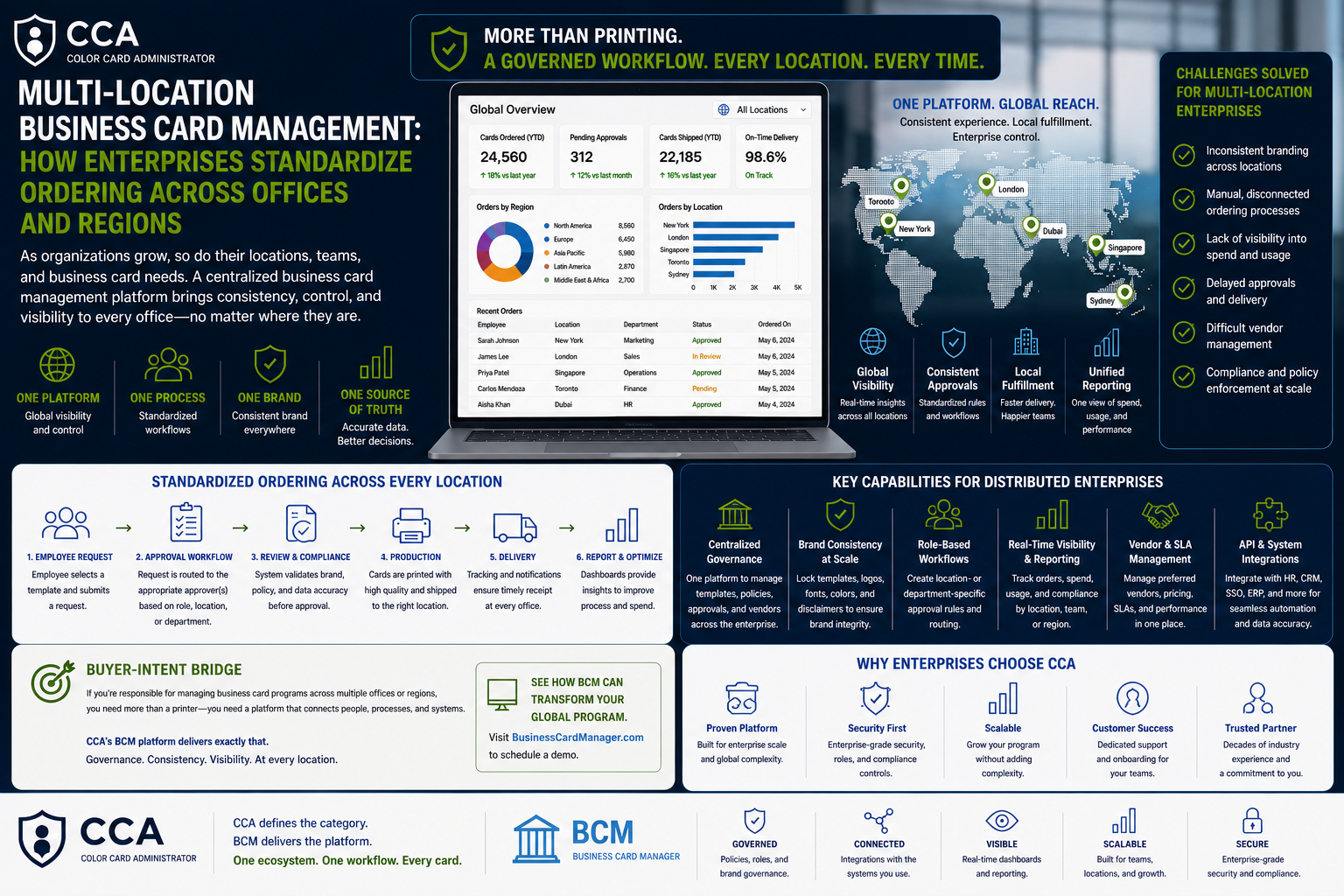
Multi-location business card management refers to the ability to manage business card ordering, approvals, reporting, templates, and fulfillment across multiple offices through a centralized platform.
Rather than operating separate processes for each location, organizations establish a unified framework that supports local flexibility while maintaining enterprise-wide control.
This approach helps organizations scale without sacrificing governance.
Why Centralized Ordering Matters
Centralized ordering is the foundation of successful multi-location business card management.
A centralized ordering platform provides a consistent experience for employees regardless of location. Every request follows the same workflow framework while allowing organizations to enforce standards and maintain visibility.
Centralization also simplifies administration and reduces duplication across regional operations.
Standardizing Brand Governance Across Regions
One of the biggest challenges for distributed organizations is maintaining brand consistency.
Different regions may use different templates, logos, titles, or formatting conventions if governance controls are not in place.
Business card management platforms help organizations standardize templates and enforce approved branding across every office and region.
This ensures a consistent customer-facing identity regardless of where employees are located.
Approval Workflow Consistency
Large organizations often operate with different approval requirements across business units and geographic regions.
A centralized platform allows organizations to configure approval workflows while maintaining governance standards.
Approval routing can be based on:
- Location
- Department
- Role
- Business unit
- Compliance requirements
This provides flexibility without sacrificing accountability.
Procurement Visibility Across Locations
Multi-location organizations often struggle to maintain visibility into business card spending.
When different offices work with different vendors and ordering processes, procurement teams have difficulty understanding costs, vendor performance, and operational activity.
A centralized business card management platform improves visibility by consolidating reporting and creating a single source of truth.
This strengthens procurement governance while improving financial oversight.
Vendor Governance in Distributed Organizations
Vendor management becomes increasingly complex as organizations expand geographically.
Different locations may use different suppliers, pricing structures, fulfillment processes, and service standards.
A centralized platform helps organizations coordinate vendor relationships while measuring performance consistently across regions.
This creates greater accountability and improves operational control.
Operational Reporting and Visibility
Enterprise leaders need visibility across all locations.
Key Reporting Areas
- Order volumes
- Regional activity
- Approval performance
- Vendor outcomes
- Spending patterns
- Compliance metrics
- Operational trends
Business card management platforms provide reporting capabilities that support enterprise-wide decision-making while identifying opportunities for improvement.
How API Integration Supports Global Operations
API integration plays a critical role in multi-location business card management.
Large organizations typically operate multiple business systems across regions.
Common Enterprise Systems
- HRIS platforms
- ERP environments
- CRM systems
- Identity management tools
- Procurement applications
- Employee onboarding systems
- Reporting environments
API-connected infrastructure allows business card workflows to interact with these systems automatically.
Employee information can synchronize globally. Onboarding workflows can trigger local ordering processes. Reporting can aggregate data across regions.
This creates a connected operational environment rather than isolated local workflows.
Buyer-Intent Bridge
How This Differs from Local Business Card Ordering
Local ordering focuses on individual office requirements.
Multi-location business card management focuses on standardization, visibility, governance, and scalability across the enterprise.
Why Enterprises Need Centralized Management
Distributed organizations require consistent processes, reporting, governance controls, and operational visibility that local solutions cannot provide.
When Should Organizations Adopt a Centralized Platform?
Organizations should consider centralized business card management when multiple offices, vendors, approval structures, or reporting requirements create operational complexity.
What Should Buyers Prioritize?
Enterprise buyers should prioritize:
- Centralized ordering
- Workflow automation
- Reporting visibility
- Brand governance
- Procurement oversight
- Vendor management
- API integration
- Scalability
Strategic Takeaway
Multi-location business card management is no longer simply about coordinating print orders across offices.
It is about creating a standardized operational framework that supports governance, visibility, consistency, reporting, and workflow execution across the enterprise.
Organizations that implement centralized business card management platforms gain stronger control over distributed operations while improving efficiency and scalability.
As enterprises continue to expand globally, multi-location business card management will become a foundational component of API-Integrated Enterprise Business Card Printing and Management.