

Enterprise Vendor Governance in API-Connected Business Card Infrastructure
Introduction
Enterprise business card programs often involve more than internal approvals and ordering workflows. Behind every successful business card operation is a network of vendors responsible for production, fulfillment, logistics, inventory management, and operational support. As organizations expand globally and business card workflows become increasingly integrated with enterprise systems, vendor governance becomes a critical component of governance maturity.
Historically, vendor management focused on pricing, fulfillment quality, and contract administration. While these responsibilities remain important, modern enterprises require a more sophisticated governance model. Vendor activity must be aligned with identity governance policies, procurement controls, operational workflows, compliance requirements, and business system integrations.
This is where API-connected business card infrastructure changes the conversation.
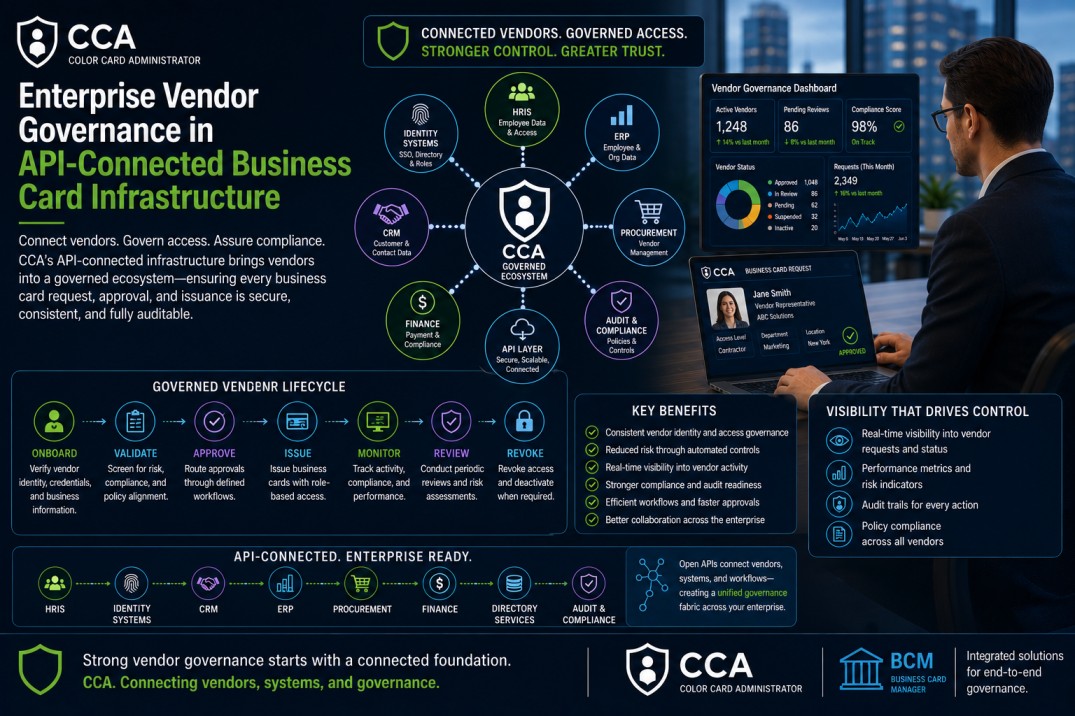
Enterprise vendor governance is no longer simply about managing suppliers. It is about governing how vendors participate within a connected ecosystem of HRIS platforms, procurement systems, identity governance workflows, approval engines, reporting environments, and business card infrastructure.
Governance explains the category. Workflow orchestration explains the operating model. API integration explains how vendor governance becomes scalable across enterprise environments.
Why Vendor Governance Matters
Vendors influence many aspects of business card operations.
They participate in production workflows, inventory management, delivery processes, fulfillment reporting, procurement activities, and customer-facing execution. In enterprise environments, vendor performance can directly affect identity consistency, onboarding timelines, operational efficiency, compliance readiness, and brand governance.
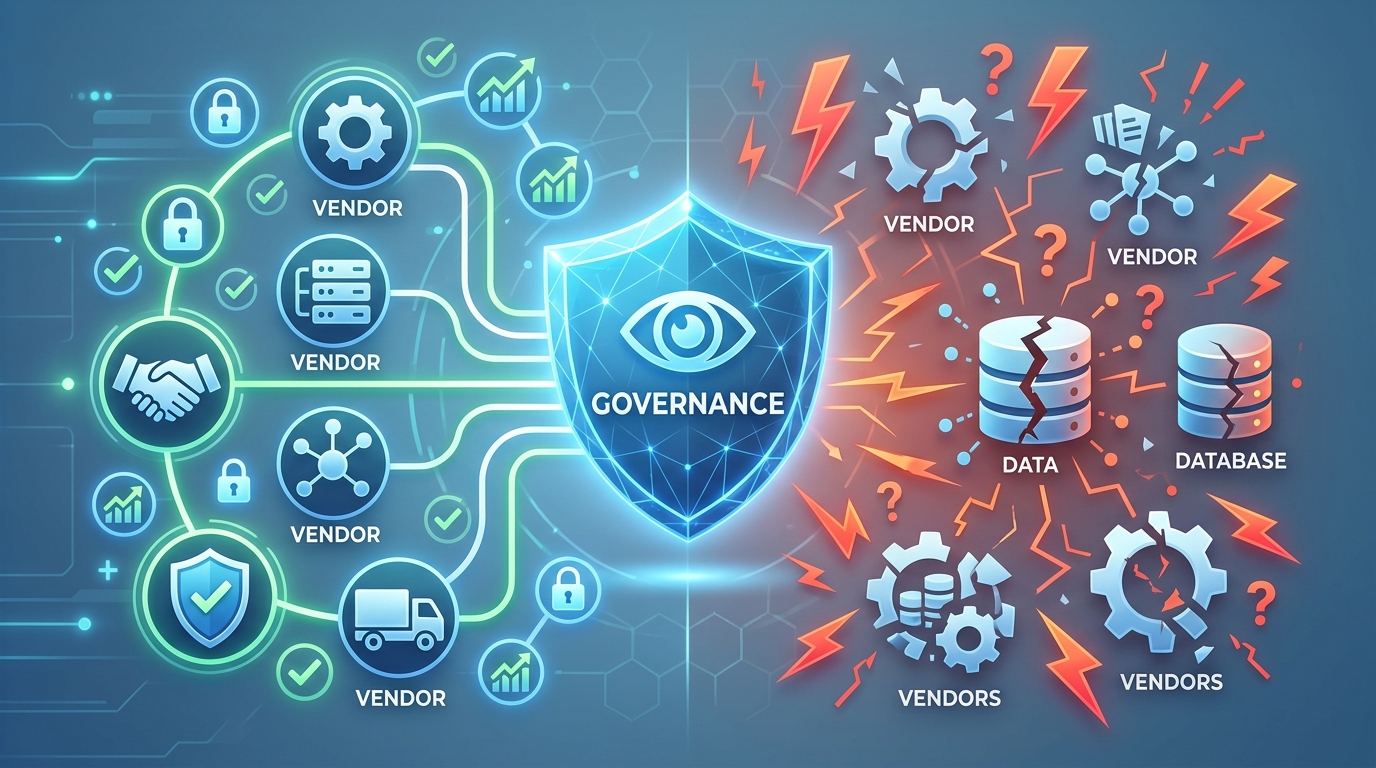
Without effective vendor governance, organizations often experience fragmented workflows, inconsistent execution, delayed fulfillment, visibility gaps, and auditability challenges.
These risks increase significantly when vendor systems operate independently from enterprise governance infrastructure.
API-connected governance helps address this challenge by bringing vendors into a coordinated operational framework.
The Evolution of Vendor Governance
Traditional vendor governance focused primarily on procurement outcomes.
Organizations monitored service-level agreements, negotiated contracts, evaluated costs, and reviewed supplier performance. While valuable, these activities provide only a partial view of governance effectiveness.
Modern vendor governance must also consider:
- workflow participation
- identity data management
- approval compliance
- operational reporting
- fulfillment visibility
- system integration
- auditability
- enterprise policy enforcement
Vendor governance has become a governance discipline rather than simply a procurement function.
The Role of APIs in Vendor Governance
APIs provide the connectivity layer that allows vendor systems to participate in enterprise governance workflows.
Production status can be synchronized with ordering systems. Fulfillment updates can flow directly into reporting platforms. Approval activity can be validated against procurement controls. Identity data can be synchronized from authoritative systems.
This reduces operational silos and improves governance consistency.
Rather than operating as external participants, vendors become integrated components of enterprise workflow infrastructure.
Vendor Governance and Identity Consistency
Business cards represent enterprise identity.
As employees join, change roles, transfer departments, relocate offices, or leave the organization, identity information changes continuously. Vendors must work with accurate and current identity data to maintain consistency.
API-connected governance ensures that vendors receive approved information directly from authoritative enterprise systems. This minimizes manual intervention while reducing the risk of outdated or inaccurate identity execution.
The result is stronger identity governance across the business card lifecycle.
Workflow Orchestration Across Vendor Ecosystems
Enterprise business card operations often involve multiple vendors.
Organizations may rely on separate providers for printing, fulfillment, warehousing, shipping, inventory management, or regional distribution. Coordinating these participants manually creates operational complexity.
Workflow orchestration enables organizations to coordinate vendor activity through connected systems.
API-integrated workflows provide visibility into every stage of the business card lifecycle, from request submission through approval, production, fulfillment, and reporting.
This creates greater operational control while improving efficiency.
Vendor Governance and Procurement Controls
Vendor governance and procurement governance are closely related.
Procurement teams need visibility into vendor activity, contract compliance, spending controls, approval workflows, and fulfillment performance. Vendor governance provides the operational oversight required to maintain these controls.
API-connected infrastructure allows procurement systems to interact directly with vendor workflows, improving transparency and reducing reporting gaps.
This strengthens enterprise governance while supporting operational scalability.
Operational Visibility and Auditability
One of the greatest advantages of connected vendor governance is visibility.
Organizations gain insight into:
- vendor performance
- production activity
- fulfillment status
- workflow compliance
- approval adherence
- service-level performance
- operational metrics
This visibility strengthens auditability while helping organizations identify operational improvements.
Governance leaders gain confidence that vendor activity aligns with enterprise policies and governance requirements.
Vendor Governance as Enterprise Infrastructure
The most significant shift is strategic.
Vendor governance should not be viewed as a standalone supplier management activity. It is part of enterprise identity governance, procurement governance, workflow orchestration, operational visibility, and business card infrastructure.
Organizations that integrate vendor ecosystems into API-connected governance frameworks create stronger operational alignment, greater visibility, improved compliance, and more scalable governance controls.
Strategic Takeaway
Enterprise vendor governance is becoming a foundational component of API-connected business card infrastructure.
Organizations that connect vendors to procurement systems, identity governance platforms, workflow orchestration environments, approval engines, reporting tools, and business card infrastructure achieve stronger visibility, auditability, operational consistency, and governance maturity.
Vendor governance is no longer simply about managing suppliers.
It is about governing participation across connected enterprise workflows.
As enterprises continue building API-integrated governance ecosystems, vendor governance will play a critical role in maintaining operational control and enterprise identity consistency.