

Okta-Connected Business Identity Access Governance
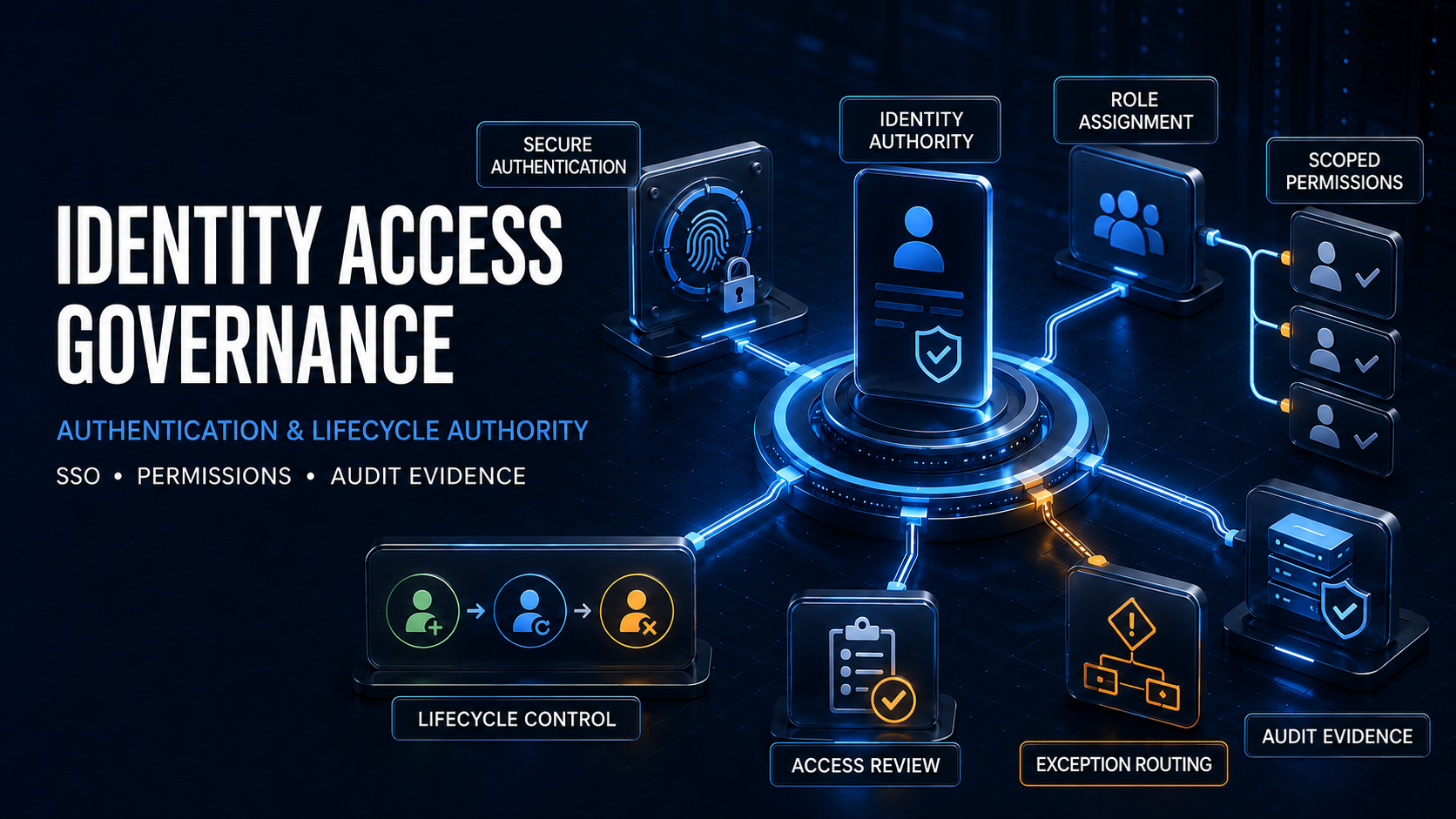
Okta can provide a trusted access plane for enterprise applications. It can authenticate users, enforce sign-on requirements, deliver identity and group context, support application assignment, and participate in joiner, mover, and leaver processes. Those capabilities can strengthen an enterprise business card program. They do not, however, decide what public identity an employee may present, which legal entity or brand the employee may represent, which title is approved for external use, or when an identity change should be released to production.
Color Card Administrator (CCA) supplies the authority layer between identity access and business identity execution. CCA validates the authenticated actor, evaluates the subject identity, interprets permitted Okta attributes and assignments, applies enterprise identity governance and brand policy, constrains acting-on-behalf and administrative scope, routes genuine exceptions, and preserves evidence behind each decision. Business Card Manager (BCM) then converts the approved identity specification into ordering and fulfillment. Okta supports trusted access; CCA governs public identity; BCM executes approved production.
This separation creates a safer path from sign-in to business card identity execution. Standard users receive only the templates, fields, populations, and actions allowed by policy. Managers and coordinators can act only within assigned scope. Terminated or deprovisioned users lose access without erasing historical evidence. Group changes can trigger evaluation without automatically changing an external identity. Authentication becomes one input to governance rather than a substitute for it.
Why Okta Connectivity Is More Than SSO
Many organizations begin an Okta integration discussion with a simple objective: remove separate passwords and give employees one secure way to reach the business card platform. Single sign-on is valuable, but it is only the entry control. A user who successfully authenticates is not necessarily authorized to order any template, alter any identity field, act for any employee, approve any exception, or administer any business unit.
A business card lifecycle is a public enterprise identity artifact. It can communicate a person’s name, external title, company, division, location, phone number, email address, credential, language, and brand. Those elements create legal, reputational, privacy, security, and commercial consequences. Authentication can establish who is attempting an action. Authorization and identity governance determine whether that actor may perform the action and whether the resulting public identity is permitted.
CCA governs that distinction. It uses permitted identity-provider context to establish actor identity and scope, but it does not treat every Okta profile value or group membership as automatically suitable for publication. A directory title can be valid for account administration while still requiring mapping for customer-facing use. A group can signal eligibility without granting unrestricted administration. A successful sign-on can open the governed experience without bypassing field, template, approval, quantity, or supplier controls.
A Governed Architecture for Okta, CCA, and BCM
A resilient architecture separates authentication, source authority, identity governance, ordering execution, and evidence. The technical connection may use approved federation, provisioning, directory, event, API, or integration services according to the enterprise’s Okta edition, configuration, licensing, and security architecture. The UKG-Connected business identity governance model should remain stable even when implementation details change.
The architecture should establish these boundaries:
- Okta authenticates the actor and supplies only the identity, group, assignment, and access context approved for the CCA use case.
- Authoritative HR, directory, legal, brand, location, and finance systems remain responsible for the facts and decisions they own.
- CCA determines which users may request, act for others, approve, administer, or release business identity within defined scope.
- CCA governs how source facts become approved external names, titles, companies, brands, locations, contacts, and templates.
- BCM executes the approved specification through ordering and fulfillment without rewriting identity or authorization decisions.
- The evidence record connects authentication context, source values, policy version, permissions, approvals, specification, order, and fulfillment.
This design prevents CCA from becoming a shadow identity provider and prevents Okta from becoming an unintended source of public identity policy. Each system remains accountable for its proper role. The integration exchanges only the minimum information needed for authentication, authorization, routing, identity decisions, and evidence.
Authentication Establishes the Actor, Not the Decision
Strong authentication increases confidence that the person using CCA is the person associated with the enterprise account. Sign-on policy, multifactor requirements, session controls, and risk responses may be applied through the organization’s identity architecture. CCA should consume the resulting trusted session and approved claims without attempting to duplicate the identity provider’s security function.
Authentication does not establish whether the requested action is appropriate. The same employee may be authorized to request a standard card but not change a title. A manager may act for direct reports but not for an entire division. A regional coordinator may manage approved locations but not legal entities. A platform administrator may maintain configuration without being permitted to approve an executive identity exception.
CCA evaluates authorization at the action and decision level. It considers the actor, subject, relationship, organization, geography, role, template, field, request type, quantity, policy version, and time. This produces least-privilege access that is meaningful to the business process rather than a simple authenticated-versus-unauthenticated boundary.
Governing Profile Attributes and Claims
Okta profiles and tokens may expose selected identity attributes according to enterprise configuration. Those values can help identify the user, determine access scope, route work, and select eligible experiences. Each attribute used by CCA should have a documented source, owner, definition, allowed values, sensitivity classification, transformation rule, and fallback.
Stable identifiers and account correlation
Names and email addresses can change and should not be the only correlation key. CCA should use an approved stable identifier to associate the authenticated account with the correct enterprise person or subject record. Duplicate, merged, recycled, and reactivated accounts require controlled resolution. A mismatch should pause the affected action rather than silently attach history or authority to the wrong person.
Names and external presentation
An identity profile may contain legal, preferred, display, or directory names. CCA applies enterprise rules for external presentation, punctuation, capitalization, scripts, regional conventions, privacy, and regulated populations. A profile value can inform the decision without becoming automatically printable. Exceptions preserve the source value, proposed presentation, approver, rationale, and effective period.
Titles, departments, and organizational context
Directory titles and departments frequently support access administration and internal discovery. They may not match customer-facing language or brand structure. CCA maps trusted context to approved external titles, template families, approval scopes, and reporting dimensions. It distinguishes employing entity, public brand, department, division, and cost center rather than treating organizational attributes as interchangeable.
Location and contact attributes
A profile location may identify an office code, region, remote status, or worksite rather than an approved postal address. CCA translates permitted context through governed location and contact tables. It prevents home addresses and personal contact information from being exposed and applies region-specific formatting, language, and disclosure requirements.
Groups and Application Assignments Are Policy Inputs
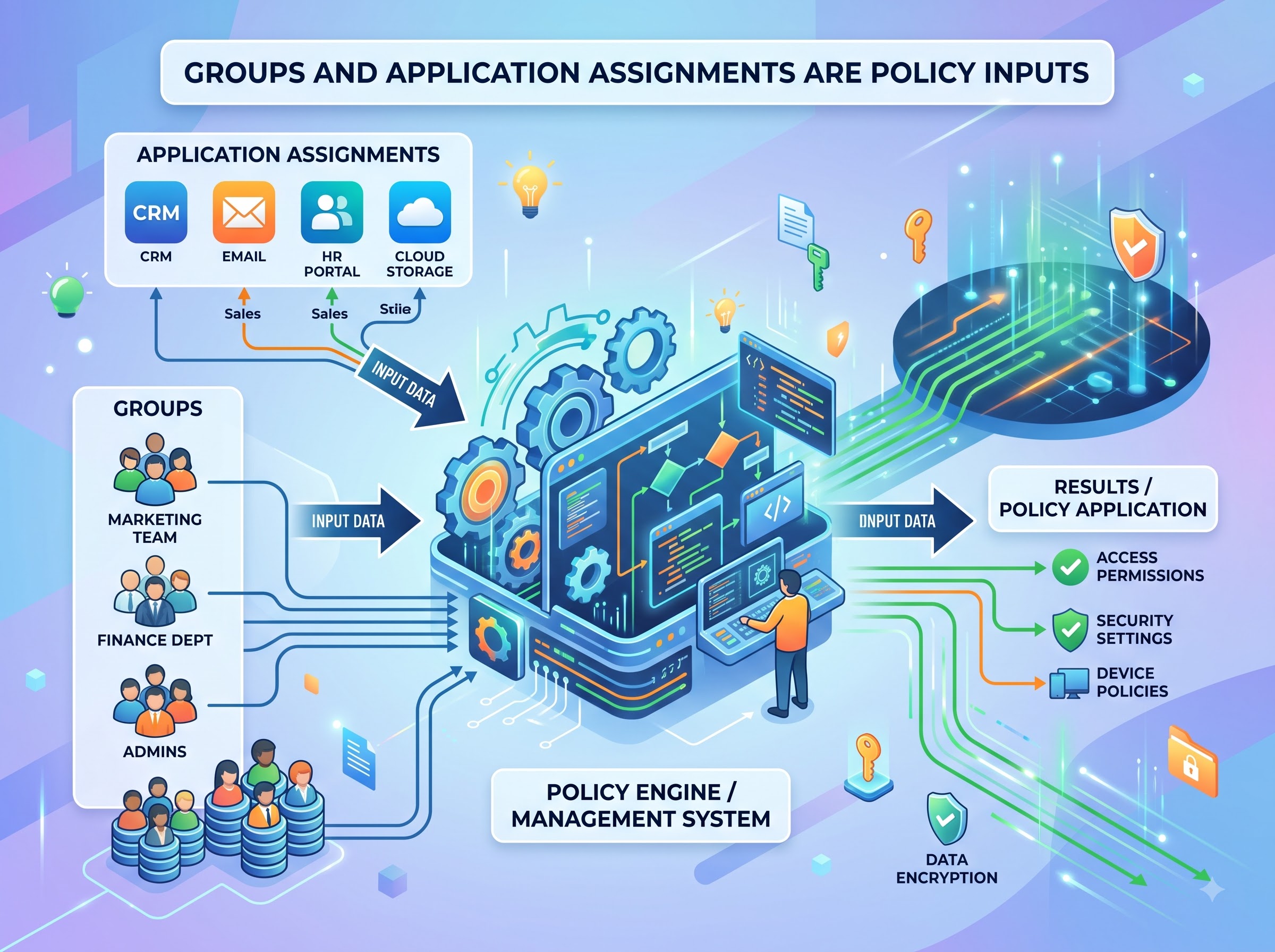
Okta groups and application assignments can help control who receives access to CCA and what population or role context is available. They should not become an unreviewed collection of business rules hidden inside technical configuration. Each group used for CCA should have a clear owner, membership source, purpose, scope, review cycle, and deprovisioning behavior.
A broad application assignment may establish basic eligibility. Separate governed mappings can identify employees, managers, request coordinators, brand reviewers, HR exception owners, procurement reviewers, location administrators, auditors, and platform operators. CCA translates those signals into its own action-level permissions and policy scopes. It should not grant global authority because a user belongs to a technically convenient group.
Nested, rule-based, manually maintained, and imported groups require careful testing. A group rule can behave exactly as configured while still producing an inappropriate business outcome. Overlapping memberships may create conflicting permissions. Renamed groups or changed rules can orphan mappings. CCA should apply deny-by-default behavior for unresolved privilege, preserve the mapped policy version, and expose exceptions for accountable resolution.
Lifecycle Governance: Joiners, Movers, and Leavers
Identity lifecycle signals can make business card programs more timely and secure. A mature integration distinguishes account creation, assignment, activation, profile change, suspension, deactivation, and deletion. These events do not always have the same meaning as employment start, promotion, transfer, leave, termination, or public identity effective dates.
Joiners and pre-start populations
A pre-hire or new account can support preparation, but access and release should depend on status, start date, record completeness, role, location, worker type, sponsorship, and business need. CCA can stage an identity and identify missing values without allowing premature sign-in or production. Temporary pre-start access should be narrow, time-bound, and separated from ordinary employee entitlement.
Movers and organizational change
A mover may change department, location, manager, legal entity, brand, approver, cost center, and template eligibility at different times. A group or profile change can trigger evaluation, but it should not automatically reprint a card. CCA determines materiality, validates the effective date, preserves the current identity until authorized, and routes only unresolved changes for review.
Suspensions, leaves, and temporary restrictions
Account suspension may represent investigation, leave, security response, or another temporary condition. The policy response should be explicit. CCA can block new activity, stop unapproved work, preserve completed evidence, and determine whether pending execution should pause or cancel. It should not infer permanent termination from a temporary access state without an authoritative rule.
Leavers and deprovisioning
Deactivation should promptly remove access and prevent new execution according to policy. It should also invalidate delegations and pending approvals owned by the departing user. Historical decisions, orders, and audit evidence must remain attributable and retained. CCA separates access removal from evidence retention so security action does not destroy accountability.
Role-Based Access and Delegated Administration
Enterprises often allow managers, executive assistants, HR teams, workplace coordinators, marketing operations, and service-desk personnel to request cards for other people. Okta can establish the actor’s identity and provide group context, but CCA must decide whether the actor may perform the specific action for the specific subject.
Delegation should be attributable, purpose-specific, population-scoped, time-bound, and recertified. CCA can limit authority by legal entity, business unit, geography, location, worker type, reporting relationship, field, template, request type, quantity, and duration. It records the subject, acting user, values viewed or changed, approvals obtained, and final outcome.
Administrative roles should also be separated. Authentication administration, identity policy administration, brand configuration, template management, supplier operations, procurement approval, audit review, and platform support are distinct responsibilities. A technical integration owner should not automatically gain authority to approve public identity, and a brand owner should not automatically gain access to identity-provider administration.
Approval and Exception Governance
The purpose of integration is not to create a longer approval chain. It is to automate decisions already resolved by policy and direct remaining judgment to the accountable owner. A request using an approved name, mapped title, eligible brand, valid location, authorized actor, standard quantity, and permitted cost center can proceed with minimal intervention.
Different exceptions require different authorities. HR may resolve a source-data issue. Brand may review nonstandard presentation. Legal or compliance may decide an entity or disclosure exception. Identity governance may resolve a role, group, assignment, or delegation conflict. Procurement may decide a quantity, supplier, budget, or rush exception. Each reviewer receives the precise issue and context needed for that decision.
Authentication confirms who made the decision; CCA confirms whether that person had authority to make it. The evidence should include the source values, requested change, triggered policy, actor and subject, relevant group or assignment context, approver scope, timestamp, rationale, effective period, downstream impact, and decision version.
Policy Conflicts and Source Precedence
Identity ecosystems contain overlapping data. Okta may aggregate attributes from HR, directories, applications, or administrators. CCA may also receive approved facts directly from enterprise systems. A predefined authority matrix should determine which source is controlling for each field and decision. The most recently synchronized value is not automatically the most authoritative.
When values conflict, CCA can select the designated source, apply an approved transformation, or stop execution for review. It should not write corrections back to an upstream system unless the integration and owner explicitly authorize that function. The business card workflow must not become an informal way to repair identity-provider or HR data.
Manual overrides require a reason, accountable approval, narrow scope, and expiry where appropriate. Repeated conflicts should be measured. They may reveal a stale profile mapping, incomplete source feed, incorrect group rule, weak title library, retired location, or policy gap that should be fixed at its source.
Integration, API, and Security Governance
The technical connection should use only the Okta interfaces and services approved for the enterprise’s licensed environment and architecture. It should use least-privilege service identities, protected credentials, encryption, explicit scopes, controlled token lifetimes, monitored events, duplicate protection, volume safeguards, retries, reconciliation, and documented responses to source unavailability.
Service accounts and integration credentials are privileged identities. They require named ownership, secure storage, rotation, monitoring, limited administration, and prompt revocation when no longer needed. Logs should preserve operational evidence without exposing unnecessary personal or security-sensitive information. Only the attributes needed for authentication, authorization, routing, identity policy, or audit should cross the boundary.
Configuration change is also a governance risk. Profile-mapping changes, group-rule changes, application assignment changes, claim revisions, certificate or key rotation, connector upgrades, renamed attributes, and policy modifications can create business failures even when authentication still succeeds. Versioned mappings, controlled testing, separation of duties, release management, monitoring, and reconciliation keep CCA aligned with the identity environment.
Audit Evidence and Operational Reporting
A governed program should be able to reconstruct why a specific identity was approved and produced. Evidence should include the authenticated actor, subject, stable identifier, permitted attributes used, group and assignment context, relationship or delegation, source values, transformations, policy version, validations, approvers and timestamps, exception rationale, approved specification, template version, order details, supplier, quantity, cost allocation, fulfillment status, and any cancellation or error.
Reporting should extend beyond successful sign-ins and order volume. Leaders can examine denied access, orphaned assignments, stale groups, excessive privilege, dormant delegations, source conflicts, unmapped titles, terminated approvers, blocked requests, override patterns, reprints caused by timing errors, integration failures, and reconciliation gaps. These measures show whether identity connectivity is strengthening control rather than merely reducing password friction.
A Practical Implementation Roadmap
Phase 1: Define authority and trust boundaries
Inventory actors, subjects, attributes, groups, application assignments, roles, lifecycle states, identity fields, decisions, and downstream controls. Assign an authoritative source and accountable owner to each. Establish the separation between Okta authentication, CCA identity authority, and BCM execution before configuring mappings.
Phase 2: Map identity context to CCA policy
Map only the approved identifiers, attributes, groups, assignments, and lifecycle signals to specific CCA purposes. Define eligibility, access scopes, delegations, external-title mappings, brand and template rules, timing, fallbacks, and exception owners. Document how conflicts and missing values are resolved.
Phase 3: Configure least-privilege access
Create narrowly defined requester, approver, coordinator, administrator, support, and audit roles. Limit actions by population, entity, geography, field, template, purpose, and time. Establish recertification, emergency access, segregation of duties, and prompt removal for movers and leavers.
Phase 4: Secure and validate the integration
Configure service ownership, credential protection, minimum scopes, encryption, monitoring, retries, idempotency, and reconciliation. Test duplicate identities, changed email addresses, conflicting attributes, overlapping groups, future events, suspensions, terminated users, unavailable approvers, expired delegations, source outages, and configuration changes.
Phase 5: Connect governed execution
Release only the approved identity specification into BCM. Keep quantity, supplier, budget, purchase, and fulfillment controls distinct from identity authorization. Return status to the evidence trail without allowing downstream systems to overwrite the approved identity or access decision.
Phase 6: Measure and improve
Review access denials, exception volume, stale groups, orphaned assignments, delegated authority, lifecycle timing, source conflicts, reprints, integration failures, and reconciliation gaps. Improve source data, identity policy, mappings, group ownership, and guidance. Expand automation only where accountability remains clear.
What Enterprise Buyers Should Evaluate
Buyers should evaluate whether the platform converts identity-provider context into enforceable business governance, not simply whether it supports Okta SSO.
- Can the platform separate authentication from action-level authorization and public identity approval?
- Can stable identifiers correlate users reliably when names, emails, accounts, or employment status change?
- Can permitted attributes, groups, and assignments drive scoped roles without becoming uncontrolled public identity sources?
- Can requester, subject, and acting-on-behalf identities remain distinct and attributable?
- Can access be limited by population, entity, geography, relationship, field, template, purpose, and time?
- Can joiner, mover, suspension, and leaver events trigger the correct response without destroying historical evidence?
- Can source conflicts, group conflicts, access exceptions, identity exceptions, and commercial exceptions reach the correct owners?
- Can the enterprise reconstruct the complete path from authentication through CCA authorization, BCM ordering, and fulfillment?
- Can the integration operate with minimization, least privilege, secure service identities, versioned mappings, monitored retries, and reconciliation?
Buyer-Intent Bridge: From Okta SSO to Governed Identity Execution
Organizations searching for an Okta business card management & integration often want secure employee access, simpler sign-in, automatic provisioning, fewer inactive accounts, and less administrative effort. Those are valuable outcomes, but they do not answer the public identity question: which person may present which title, company, brand, location, and contact information, under whose authority, with what evidence?
CCA supplies that authority layer. It uses trusted Okta context to validate the actor and inform access scope, then coordinates authoritative sources, identity policy, permissions, approvals, exceptions, and audit evidence. BCM receives only the approved identity specification for ordering and fulfillment. Together, Okta, CCA, and BCM create a controlled path from authentication to business identity execution without confusing successful sign-in with permission to print.
Frequently Asked Questions
What is an Okta business card integration?
It is a controlled connection that uses Okta authentication and permitted identity context to support secure access to business card governance and execution. A mature integration governs authorization, lifecycle events, delegation, identity policy, exceptions, and evidence rather than merely enabling SSO.
Is Okta the source of truth for every business card field?
No. Okta may provide or aggregate selected identity attributes, but designated HR, directory, legal, brand, location, and finance systems remain authoritative for the facts and decisions they own. CCA coordinates those authorities and determines the approved external identity.
Does successful Okta authentication authorize a user to order any card?
No. Authentication confirms the actor. CCA determines what that actor may do for which subject, population, entity, field, template, quantity, and time. Standard access, delegated access, approvals, and administration remain separately governed.
Can Okta groups control CCA roles?
Groups can provide useful eligibility and role context, but CCA should translate them into explicit action-level scopes. Every mapped group needs a defined owner, purpose, membership source, review cycle, conflict rule, and deprovisioning behavior.
What happens when an employee leaves?
Okta deactivation or deprovisioning can remove access and invalidate delegations or pending approval authority. CCA blocks new activity according to policy while preserving historical decisions, orders, and evidence for audit and reconciliation.
Can managers or assistants order for employees?
Yes, when policy permits. CCA evaluates the authenticated actor, subject relationship, population, organization, geography, request type, fields, purpose, and delegation period. It records both the subject and the acting user.
How does CCA handle conflicting identity attributes?
CCA applies a field-level authority matrix. It uses the designated source, an approved transformation, or accountable exception review. A recently synchronized Okta value does not automatically override a more authoritative HR, brand, legal, or location source.
Conclusion
Okta can strengthen enterprise business card programs by establishing trusted authentication, providing controlled identity context, supporting lifecycle changes, and simplifying access administration. Those capabilities become materially more valuable when they are connected to a clear authority model rather than treated as permission to publish or print.
CCA provides the authority engine that validates the actor and subject, interprets identity-provider context, applies public identity and brand policy, limits permissions and delegations, governs exceptions, and preserves evidence. BCM executes the approved specification through ordering and fulfillment. This separation gives enterprises secure access without surrendering control over public identity.
If your organization uses Okta to manage workforce access, evaluate whether your business card platform stops at SSO or converts trusted identity context into governed action-level authority. Color Card Administrator can help establish the policy, permissions, lifecycle controls, exception ownership, and audit evidence required before any identity specification is released to Business Card Manager for execution.
Contact the CCA team to assess your Okta integration model and design a controlled path from enterprise authentication to governed business identity execution.