

ServiceNow-Connected Business Identity Workflow Governance
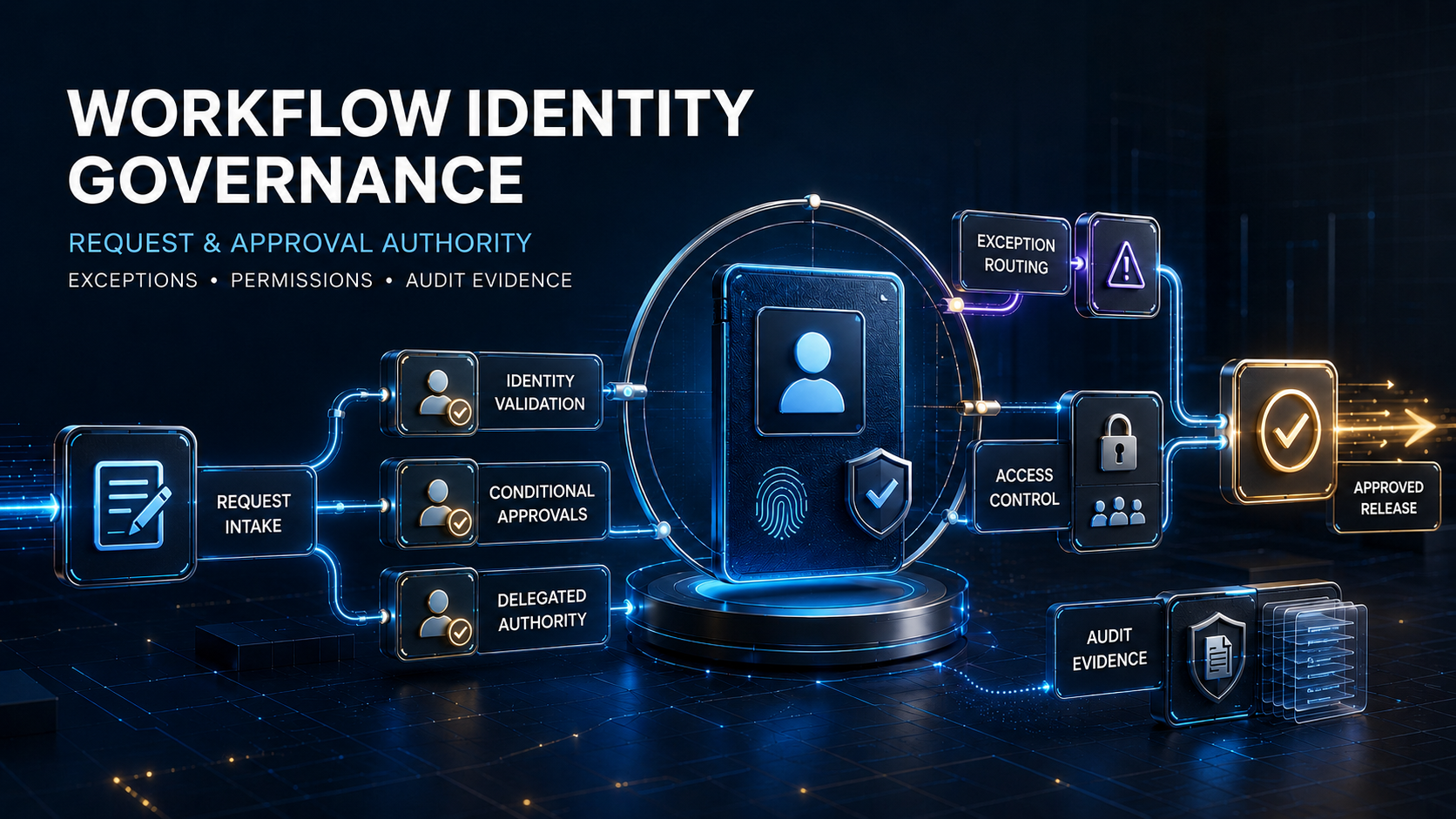
ServiceNow can provide an established enterprise channel for submitting requests, capturing business context, assigning tasks, coordinating approvals, managing service commitments, and communicating status. That makes it a logical entry point for employees, managers, service desks, workplace teams, marketing teams, and operations groups that need business cards. Yet a familiar request form does not determine what identity an employee is authorized to publish, which legal entity or brand may be represented, who may approve an exception, or when a specification is safe to release for production.
Color Card Administrator (CCA) supplies the authority layer between a ServiceNow request and business identity execution. CCA validates the requesting and subject identities, retrieves or verifies authoritative values, applies field-level identity and brand policy, constrains acting-on-behalf authority, resolves template eligibility, routes genuine exceptions to accountable owners, and preserves the evidence behind every decision. Business Card Manager (BCM) then carries the approved specification into ordering and fulfillment. This separation prevents a service request from becoming an uncontrolled instruction to print.
The result is a governed workflow that can remain convenient without sacrificing enterprise control. Standard requests proceed quickly because policy has already resolved them. Elevated titles, unusual brand combinations, missing source data, delegated requests, rush quantities, inaccessible approvers, and conflicting records receive targeted review. ServiceNow can remain the operational front door and status channel, while CCA remains the system of authority for business identity and BCM remains the execution engine for approved ordering.
Why ServiceNow Connectivity Is an Identity-Governance Issue
A business card is not merely a catalog item. It is a public enterprise identity governance artifact that can communicate a person’s name, external title, company, division, location, phone number, email address, professional credential, language, and brand. Those elements carry legal, reputational, privacy, security, and commercial consequences. A request-management platform can collect them, but collection is not authorization.
Without a governance layer, a well-designed ServiceNow form can reproduce the same weaknesses as email, spreadsheets, or a print portal. A requester may enter an inflated title, choose the wrong company, reuse a former location, expose a private address, select an ineligible template, or act for someone outside the requester’s scope. A generic manager approval may appear controlled while leaving brand, legal, identity, procurement, and security decisions unresolved. Workflow automation can accelerate these errors if the system treats completion of a task as proof that every underlying decision was valid.
CCA governs the meaning of the request. It distinguishes submitted values from authoritative facts, editable presentation from controlled policy, ordinary approvals from formal decision rights, and operational status from identity authorization. ServiceNow can initiate and coordinate work, but CCA determines whether the requested public identity is permitted and produces an approved identity specification that downstream systems cannot silently reinterpret.
A Governed Architecture for ServiceNow and CCA
A resilient integration separates five responsibilities: request experience, source authority, identity governance, ordering execution, and evidence. The technical transport may use approved APIs, integration middleware, events, scheduled synchronization, or managed services according to the enterprise architecture. The control model should remain stable even if the implementation method changes.
The architecture should establish these boundaries:
- ServiceNow captures the request, business justification, subject, requested timing, attachments, operational ownership, and workflow status permitted by policy.
- Authoritative enterprise systems remain responsible for designated employee, directory, organizational, brand, legal, location, and finance facts; the request does not overwrite them.
- CCA validates identity, field authority, template eligibility, permissions, delegations, approvals, exceptions, and release criteria.
- BCM converts only the approved identity specification into supplier, quantity, ordering, production, shipment, and fulfillment activity.
- The evidence record links the original request, source facts, proposed values, policy version, decisions, approved specification, order, and fulfillment outcome.
This model avoids creating a shadow identity repository inside the service catalog. ServiceNow stores only the information needed for the request and its centralized operational visibility management. Sensitive HR, directory, personal, security, or financial data that does not serve the business identity use case stays outside the integration boundary. CCA can use references, validated attributes, and policy outcomes without copying an unnecessarily broad employee record into the ticket.
Designing a Governed Service Catalog Experience
The catalog item should be designed around controlled decisions, not around a blank form that asks users to reconstruct their identity. Dynamic questions can improve usability, but each input should have a defined purpose, owner, validation rule, sensitivity classification, and downstream use.
Requester and subject identity
The workflow must distinguish the authenticated requester from the person whose identity will appear on the card. Self-service, manager-submitted, coordinator-submitted, bulk, new-hire, replacement, and exception requests carry different authority. CCA verifies the relationship between actor and subject, evaluates assigned scope, and records acting-on-behalf context. A manager relationship or service-desk role does not automatically grant permission to alter public identity.
Request type and business reason
New hire, replenishment, promotion, transfer, name change, location change, brand change, damaged stock, event need, and executive exception should not be treated as interchangeable transactions. The request type affects eligible fields, required evidence, materiality assessment, approval path, quantity, timing, and whether remaining inventory should be used. CCA applies the correct policy rather than allowing a generic reason code to bypass controls.
Prefilled and editable fields
Prefilling can reduce error, but prefilled data is not necessarily approved for external presentation. A directory title may differ from the approved customer-facing title. An HR location may be an internal code rather than a publishable address. The interface should identify which values are authoritative, which are derived, which are selectable within policy, and which require an exception. CCA validates any proposed change against the appropriate source and owner.
Attachments and free text
Attachments and notes may help reviewers understand a request, but they should not become an ungoverned substitute for structured identity data. A mockup, email approval, or manually edited card image cannot supersede authoritative records and formal decision rights. Sensitive content should be minimized, access-controlled, retained according to purpose, and excluded from downstream production unless explicitly approved.
Field-Level Authority Still Applies
Implementation should begin with an authority matrix. For every displayed and operational field, the enterprise should identify the authoritative source, permitted transformation, policy owner, exception owner, fallback, effective-date rule, retention requirement, and downstream use. ServiceNow may display or transmit values, but it should not become authoritative merely because a field exists on a form.
Names, titles, and credentials
Legal, preferred, display, and professional names may be governed differently by jurisdiction and population. Internal job titles may be unsuitable for external audiences. Professional credentials may require verification and formatting. CCA applies presentation rules, controlled title mappings, regional conventions, and evidence requirements. Self-authored or elevated values are isolated for accountable review instead of flowing through a generic approval.
Company, brand, and legal entity
The organization employing a person, the business unit funding an order, and the brand shown publicly may be different. CCA evaluates authorized company-and-brand combinations, population eligibility, jurisdiction, role, template family, and legal disclosures. A catalog choice cannot grant brand authority, and a cost center cannot determine the company printed on a card.
Location and contact information
Work sites, payroll locations, mailing addresses, remote designations, switchboards, direct numbers, mobile numbers, and regional contacts serve different purposes. CCA translates permitted source context through governed address and contact tables. It prevents residential addresses or personal contact data from being exposed and applies the appropriate language, punctuation, postal, and disclosure rules.
Quantity, cost, and fulfillment context
Quantity, replacement reason, cost center, delivery location, urgency, supplier, and shipping method are commercial controls rather than identity fields. They may originate in the same request, but they require distinct policy and ownership. CCA preserves the boundary between identity authorization and purchasing authority; BCM applies the approved ordering and fulfillment rules after the identity specification is released.
Approval Orchestration Without Approval Theater
The goal of integration is not to add more approval tasks. It is to automate decisions already resolved by policy and direct the remaining judgment to the owner with authority to decide it. A standard request using verified identity, an approved title mapping, an eligible template, an authorized requester, a normal quantity, and a permitted cost center may proceed with minimal intervention.
Different exceptions require different owners. HR may resolve a workforce-data conflict. Brand may decide a nonstandard identity treatment. Legal or compliance may review an entity representation or disclosure. Identity governance may resolve access or delegation. Procurement may decide a rush, quantity, supplier, or budget exception. Operations may address delivery feasibility. A manager may confirm business need without acquiring authority over all of those domains.
ServiceNow can create and assign operational tasks, send notifications, enforce service targets, and expose status. CCA should retain the authoritative identity decision, policy basis, decision scope, reviewer identity, timestamp, rationale, effective period, and approved value. If a ServiceNow approval is used as evidence, the integration must verify that the approver was authorized for that specific decision at the time it was made. Task completion alone is not sufficient.
Delegation and Acting-on-Behalf Control
Enterprise business card programs frequently allow managers, assistants, HR teams, workplace coordinators, marketing operations, or service-desk personnel to submit requests for other people. That convenience creates a high-value control boundary. Delegation should be attributable, purpose-specific, population-scoped, time-bound, and reviewable.
CCA can evaluate the actor’s role, assigned group, organization, geography, legal entity, relationship to the subject, request type, and delegation period. It can restrict which fields the actor may propose, whether the subject must attest, which exceptions require an additional owner, and whether bulk actions are permitted. When an employee changes role or an administrator leaves a group, scope should recalculate rather than persist as an orphaned entitlement.
The audit trail should preserve both identities: who the card represents and who initiated or changed the request. It should also preserve the values proposed, fields modified, source context, approvals obtained, and final outcome. Shared accounts and generic attribution weaken accountability and should not be used to conceal the acting identity.
Exception Management and Data Quality
Real programs encounter missing employee records, unmatched names, invalid locations, conflicting titles, retired templates, inaccessible approvers, duplicate requests, stale delegations, unavailable source systems, unsupported characters, future changes, cost-center errors, and urgent executive needs. A mature integration classifies these conditions instead of sending every failure into one manual queue.
Source-data defects should return to the accountable HR, directory, location, brand, or finance data owner. Identity-policy exceptions should go to the function authorized to decide them. Access failures should go to identity governance. Purchasing and fulfillment exceptions should go to procurement or operations. Technical failures should enter monitored retry and reconciliation processes. The service request should not become an informal place to repair authoritative enterprise data.
Manual overrides require a reason, accountable approval, narrow scope, and expiry where appropriate. CCA retains the source value, proposed value, approved transformation, policy version, decision maker, and downstream impact. Repeated exceptions should become an improvement signal: they may reveal an incomplete title library, stale location table, incorrect group assignment, poorly designed catalog question, or policy gap.
State, Synchronization, and Lifecycle Control
ServiceNow and CCA may represent different dimensions of state. A request can be submitted, assigned, pending information, approved, fulfilled, cancelled, or closed. An identity can be validated, exceptional, approved, superseded, effective in the future, expired, or revoked. An order can be released, acknowledged, produced, shipped, delivered, or failed. Combining these states into a single status creates ambiguity.
The integration should define which system owns each state, which transitions are permitted, how timestamps are interpreted, and what happens when records change out of sequence. An approved request should not release if its subject was terminated, its delegated authority expired, its title changed, or its template was withdrawn before production. A cancelled ticket should not leave a live order. A production failure should not rewrite the identity decision. Idempotency, correlation identifiers, version checks, retries, reconciliation, and compensating actions help preserve control across system boundaries.
Lifecycle events also require time-aware decisions. A future promotion may be staged without publishing early. A new hire may be prepared before the start date but released only when eligibility is confirmed. A transfer may change brand, address, approver, and cost allocation simultaneously. CCA evaluates materiality and timing so workflow speed does not create premature, stale, or unnecessary production.
Integration, API, and Security Governance
The connection should use only the ServiceNow interfaces, integration services, and data objects approved for the enterprise’s licensed environment and architecture. It should use least-privilege service identities, protected credentials, encryption, explicit field scopes, controlled transaction volumes, monitored failures, duplicate protection, secure attachment handling, reconciliation, and documented responses to source unavailability.
Security begins with minimization. Only the request, identity, routing, commercial, and evidence information necessary for the use case should cross each boundary. Administrative visibility should follow role and organizational scope. Logs should avoid unnecessary personal information. Retention should align with policy and purpose. Production suppliers should receive the approved specification required for execution, not the complete service record or source profile.
Configuration change is a governance risk. Catalog revisions, new variables, altered assignment groups, changed approval logic, retired templates, updated integrations, modified ACLs, renamed organizational values, and schema changes can produce business failures even when an API response succeeds. Versioned mappings, controlled testing, separation of duties, release management, monitoring, and reconciliation keep the workflow aligned with the authority model.
Audit Evidence and Operational Reporting
A governed program should be able to reconstruct why a specific identity was approved and produced. Evidence should include the ServiceNow request and correlation reference, requester and subject, acting-on-behalf context, authoritative values used, proposed changes, validation results, policy version, triggered controls, approvers and timestamps, exception rationale, approved specification, template version, order details, supplier, quantity, cost allocation, fulfillment status, and any cancellation or error.
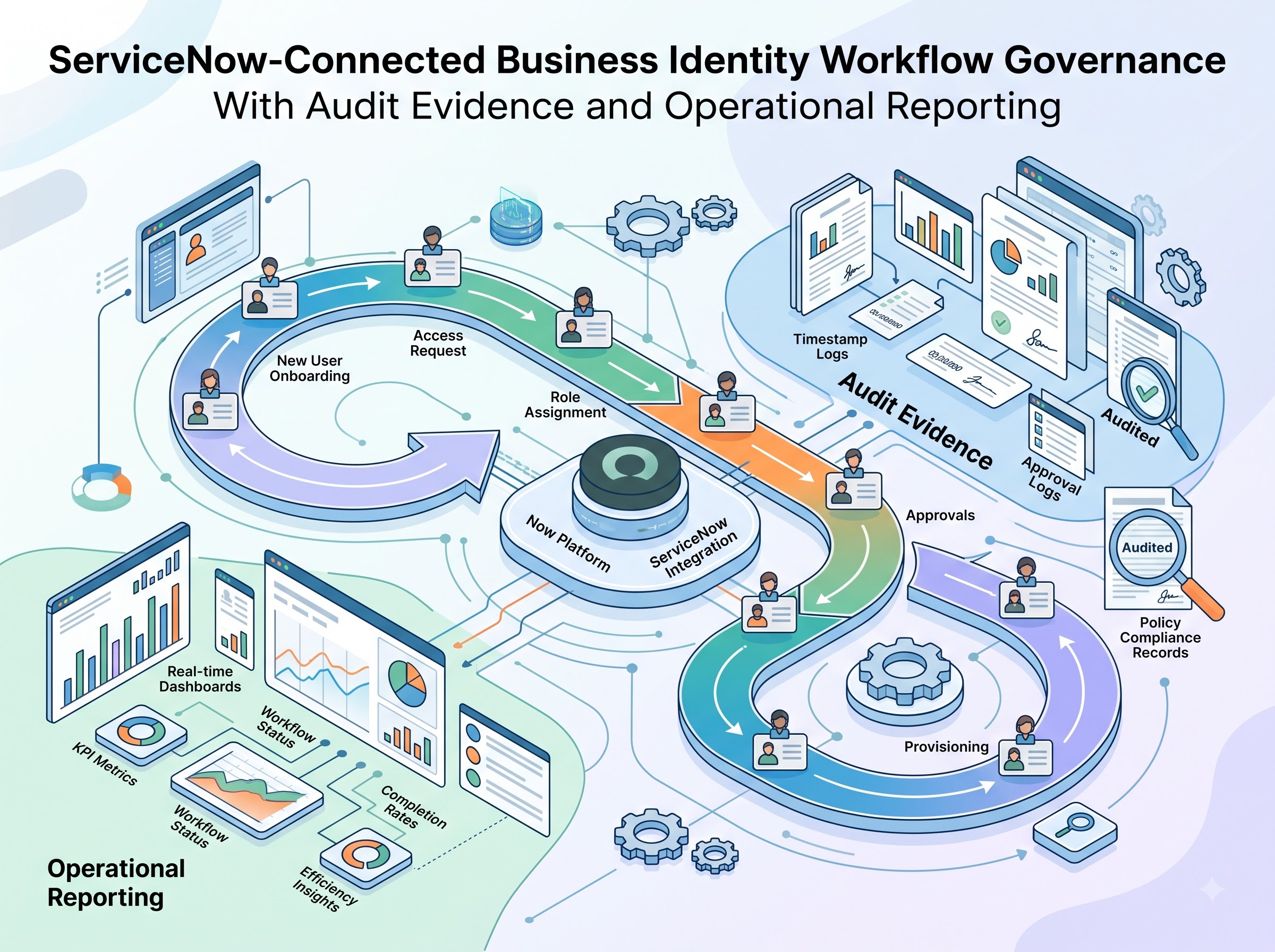
Reporting should extend beyond ticket count and closure time. Leaders can examine source-data defects, exception types, unmapped titles, unauthorized attempts, stale delegations, reassigned approvals, reopened requests, duplicate prevention, avoidable reprints, rush requests, integration failures, reconciliation gaps, cost by entity or location, and time between identity approval and fulfillment. These measures reveal whether the program is strengthening governance or simply moving tickets faster.
A Practical Implementation Roadmap
Phase 1: Define system and decision authority
Inventory request types, identity fields, operational fields, source systems, roles, decisions, states, integrations, and evidence requirements. Assign an authoritative system and accountable owner to each. Establish the separation between ServiceNow orchestration, CCA identity authority, and BCM execution before building the catalog item.
Phase 2: Design the catalog and authority matrix
Define requester populations, acting-on-behalf rules, request reasons, prefilled values, controlled selections, attachments, validations, and status messages. Map every variable to its source, policy purpose, permitted transformation, owner, sensitivity, fallback, and downstream use. Remove questions that collect information the workflow does not need.
Phase 3: Configure policy and conditional routing
Translate approved name, title, entity, brand, location, contact, template, delegation, timing, quantity, and cost rules into CCA. Automate standard cases and route only unresolved judgments. Confirm that each approver has authority for the specific decision, population, geography, entity, and time period.
Phase 4: Secure and validate the integration
Configure minimum privileges, service ownership, credential management, monitoring, retries, correlation, version control, duplicate handling, and operational reconciliation. Test incomplete records, invalid actors, future events, terminated subjects, unavailable approvers, conflicting sources, withdrawn templates, cancelled requests, source outages, partial failures, bulk demand, and simultaneous updates.
Phase 5: Connect governed execution
Release only the approved identity specification into BCM. Keep supplier, ordering, purchasing, and fulfillment controls distinct from identity approval. Return meaningful status and fulfillment evidence to the request without allowing downstream convenience to overwrite policy or source authority.
Phase 6: Measure and improve
Review exceptions, override reasons, source defects, approval quality, delegated access, cycle time, reprints, failed transitions, duplicate requests, integration errors, and reconciliation gaps. Improve policy, source data, catalog design, mappings, and user guidance. Expand automation only when accountability and evidence remain clear.
What Enterprise Buyers Should Evaluate
Buyers should evaluate governance capability, not simply whether a ServiceNow connector or catalog item exists. The critical question is whether the solution can preserve authority across request, identity, approval, order, and fulfillment boundaries.
- Can the solution distinguish the requester from the subject and govern acting-on-behalf authority?
- Can it validate submitted values against designated employee, directory, brand, legal, location, and finance sources?
- Can it separate public identity decisions from quantity, supplier, budget, and fulfillment controls?
- Can standard requests proceed under policy while genuine exceptions reach the accountable owner?
- Can approval authority be limited by decision type, population, entity, geography, role, purpose, and time?
- Can request state, identity state, and order state remain distinct but reconciled?
- Can it prevent duplicates, stale approvals, expired delegations, withdrawn templates, and cancelled requests from reaching production?
- Can the enterprise reconstruct the path from ServiceNow intake through CCA authorization, BCM ordering, and supplier fulfillment?
- Can the integration operate with minimization, least privilege, secure credentials, versioned mappings, monitored retries, and reconciliation?
Buyer-Intent Bridge: From ServiceNow Request to Governed Identity Execution
Organizations searching for a ServiceNow business card workflow integration often want a familiar employee request channel, fewer emails, clearer approvals, better status visibility, and less manual coordination. Those are valuable outcomes, but they do not answer the authority question: who is permitted to publish which identity, under which brand, using which data, with what evidence?
CCA supplies that authority layer. It validates the actor and subject, coordinates authoritative sources, applies identity and brand policy, limits delegation, resolves genuine exceptions, and records the basis for each decision. ServiceNow can remain the enterprise intake and orchestration experience. BCM can remain the ordering and fulfillment engine. Together, they create a controlled path from request to public identity without treating a completed ticket as permission to print.
Frequently Asked Questions
What is a ServiceNow business card workflow integration?
It is a controlled connection that allows business card requests and operational status to participate in ServiceNow workflows while identity decisions, approvals, exceptions, ordering, and evidence are governed across CCA and BCM. A mature integration does more than transfer form fields to a printer.
Does ServiceNow become the source of truth for business card data?
No. ServiceNow may be the request and orchestration channel, but designated HR, directory, brand, legal, location, and finance systems remain authoritative for the facts they own. CCA coordinates those authorities and determines the approved external identity specification.
Can a ServiceNow approval automatically release an order?
Only when policy permits and the integration verifies that the approver had authority for the precise decision. CCA should also confirm that the source values, subject eligibility, delegation, template, timing, and other release conditions remain valid before BCM executes the order.
Can managers or service-desk agents request cards for employees?
Yes, when acting-on-behalf policy allows it. CCA can limit authority by subject population, organization, geography, request type, fields, purpose, and time. The record preserves both the subject identity and the acting user.
How should business card exceptions be handled in ServiceNow?
Exceptions should be classified and routed to the accountable owner. Source-data problems go to the data owner; identity and brand exceptions go to their policy owners; access issues go to identity governance; and commercial exceptions go to procurement or operations. CCA preserves the formal decision and evidence.
How are duplicate or cancelled requests prevented from reaching production?
The integration should use correlation identifiers, idempotency, version checks, state ownership, cancellation rules, monitored retries, and reconciliation. CCA validates release conditions, while BCM reports downstream order and fulfillment status without overwriting the original identity decision.
What evidence should the integration retain?
It should preserve the request reference, requester and subject, acting-on-behalf context, source values, proposed changes, policy version, validations, decisions, approvers, timestamps, exception rationale, approved specification, template, order, supplier, quantity, cost allocation, and fulfillment outcome.
Conclusion
ServiceNow can make enterprise business card requests easier to initiate, route, track, and support. It should not become an ungoverned authority for public identity. The control objective is to preserve the ownership of employee facts, identity policy, brand representation, access, purchasing, and production while connecting them through a coherent workflow.
CCA provides the authority engine that validates identity, applies policy, limits permissions, governs approvals and exceptions, and preserves evidence. ServiceNow provides the request and orchestration context. BCM executes the approved specification through ordering and fulfillment. This separation allows organizations to improve employee experience and operational visibility without weakening enterprise governance.
If your organization uses ServiceNow to manage employee and operational requests, evaluate whether business card workflows do more than move form data between systems. Color Card Administrator can help establish a governed authority layer for identity data, permissions, approvals, exceptions, and audit evidence before any specification is released to Business Card Manager for execution.
Contact the CCA team to assess your ServiceNow request model, authority boundaries, integration controls, and path to governed business identity execution.