

Governance as Enterprise Infrastructure: Creating a Continuous Control Layer for Digital Business Execution
Introduction: Digital Operations Have Outgrown Application-Level Governance
Modern enterprises operate through an expanding ecosystem of cloud applications, internal platforms, outsourced providers, regional teams, and automated workflows. Human resources systems initiate employee records. Directory services establish identity. Procurement platforms authorize spend. CRM and ERP environments support commercial and operational execution. External vendors fulfil requests that originate inside the enterprise but are completed beyond its direct system boundary.
Although these platforms are essential, their governance mechanisms are usually designed around the needs of an individual application. One system may define an approval hierarchy, another may maintain a separate set of permissions, and a third may rely on manual interpretation of policy. As the enterprise grows, these disconnected controls create inconsistency. Approval logic diverges, exceptions multiply, audit trails become fragmented, and leadership loses visibility into how policy is actually being executed across the organization.
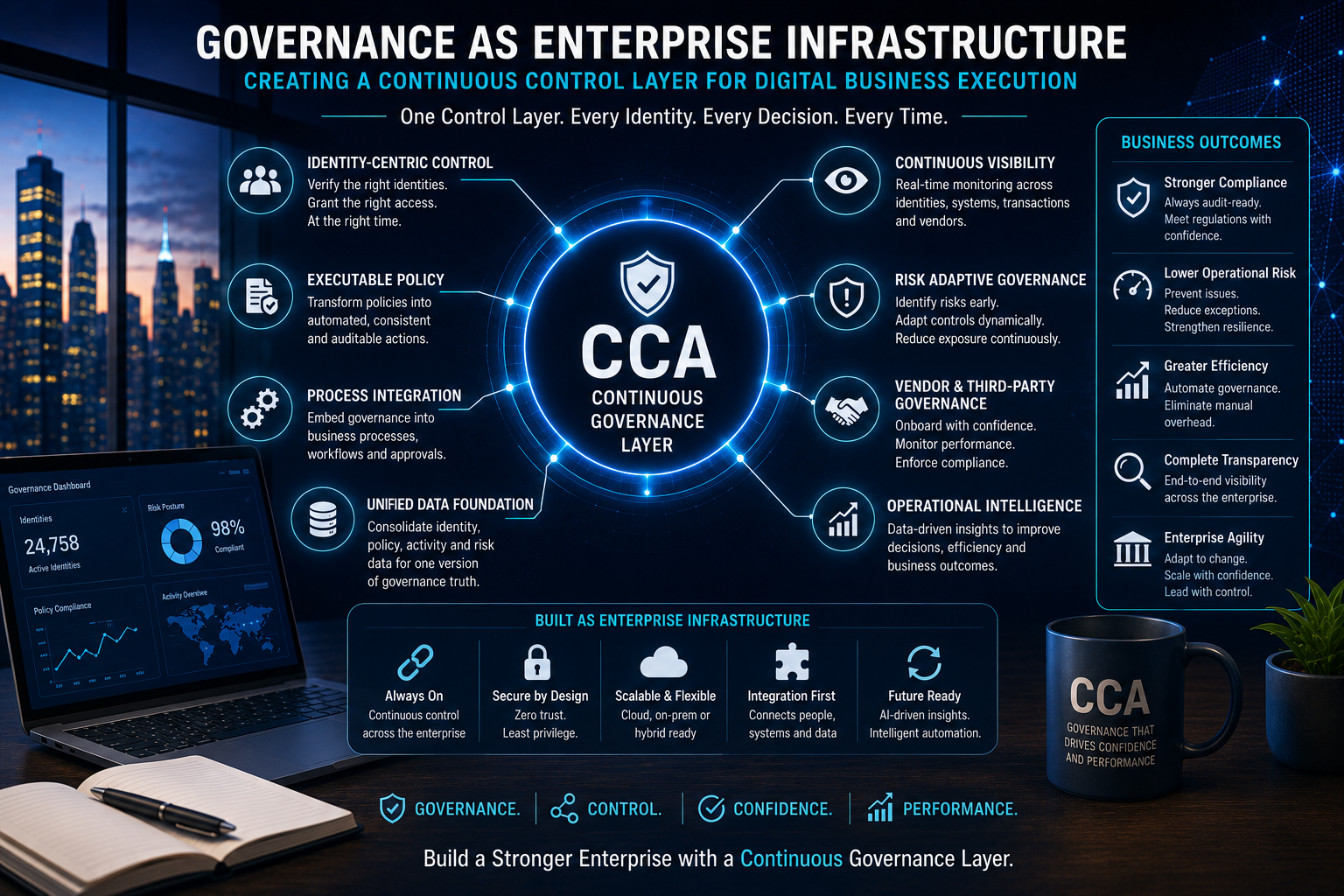
Governance as enterprise infrastructure provides a different model. Instead of embedding control independently inside every application, the organization establishes a continuous governance layer that spans identities, workflows, vendors, policies, and operational data. Color Card Administrator (CCA) represents this infrastructure-first approach.
Why Governance Must Be Treated Like Shared Infrastructure
Enterprises already recognize that networking, identity, security, data protection, and integration must be shared. Governance deserves the same architectural treatment. When governance remains embedded within individual applications, the enterprise maintains multiple versions of the same policy. Approval thresholds differ, regional rules are implemented unevenly, delegated authority becomes outdated, and vendor controls are inconsistently enforced.
A shared governance infrastructure converts enterprise policy into reusable operational services. Approval logic, role authority, lifecycle events, branding rules, vendor eligibility, data requirements, and audit obligations can be defined centrally and applied wherever relevant. Specialized applications remain in place, but they participate in one common governance model.
Identity as the Enterprise Control Point
Every governed process requires context: who is making the request, which business unit they belong to, what authority they hold, which region applies, and what lifecycle status governs the identity. CCA uses identity as the enterprise control point. Employee, contractor, partner, location, department, manager, and vendor relationships inform workflow routing and policy enforcement.
By connecting trusted identity context with operational policy, CCA applies the right rule to the right identity at the right moment. Governance becomes dynamic rather than approximate.
From Static Policies to Continuous Enforcement
Many enterprise policies exist as documents, intranet pages, spreadsheets, or procedural instructions. They describe what should happen but do not ensure that it happens. A continuous control layer makes policy executable. Required approvals are enforced before fulfilment, vendor selection follows enterprise criteria, branding standards are applied before production, exceptions are captured with accountability, and every step produces an audit record.
Governance therefore moves from retrospective review to active operational control.
CCA as the Continuous Governance Layer
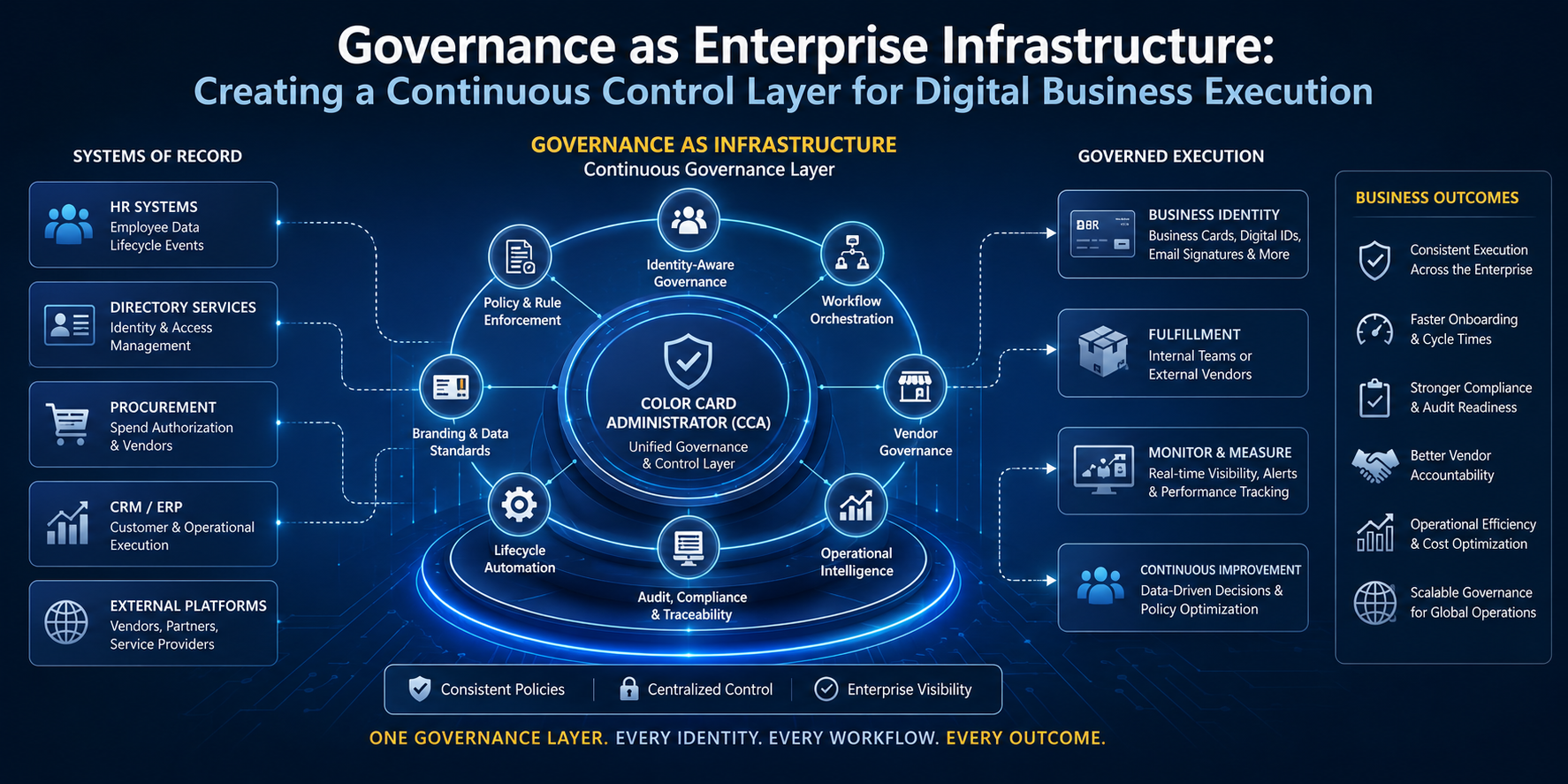
CCA sits between systems of record and the processes that execute business identity. It can receive trusted data from HR, ERP, CRM, directory, procurement, and collaboration platforms, then apply centralized governance before a request moves to fulfilment.
Its capabilities include identity-aware workflow orchestration, configurable approval chains, delegated administration, regional policy enforcement, business card and business identity governance, vendor coordination, lifecycle automation, branding control, API integration, audit logging, and operational reporting. These capabilities operate as one governance system rather than disconnected features.
Governance Across Vendors and External Fulfilment
Enterprise execution often crosses organizational boundaries. External suppliers may print, ship, provision, or support business identity assets. Without central governance, vendor processes can create inconsistent service levels, limited auditability, and unnecessary risk. CCA preserves enterprise authority even when fulfilment occurs outside the enterprise. Approved vendors, routing rules, regional restrictions, service expectations, and order data standards can be centrally controlled.
This strengthens accountability without forcing the enterprise to manage every operational detail manually.
Operational Intelligence and Executive Visibility
A continuous governance layer produces more than audit records. It generates operational intelligence. Enterprises can measure approval turnaround times, exception rates, policy adherence, vendor performance, lifecycle efficiency, regional variation, and fulfilment outcomes. Leaders gain a reliable view of how governance performs in practice.
This visibility supports better decisions. Bottlenecks can be addressed before they become systemic. Policy changes can be evaluated using evidence. Vendor relationships can be managed through measurable performance. Governance becomes a source of enterprise intelligence rather than a compliance archive.
Business Outcomes
Treating governance as infrastructure delivers consistent execution, faster onboarding, stronger compliance, improved vendor accountability, reduced administrative effort, simplified audits, better reporting, and greater resilience during organizational change. It also protects the value of existing technology investments by coordinating them instead of replacing them.
Most importantly, it allows the enterprise to scale operations without allowing governance complexity to scale at the same rate.
Implementation Roadmap
Organizations should begin by identifying authoritative identity sources and documenting high-risk operational workflows. Next, they should define reusable governance policies, standardize approval models, classify regional requirements, connect core systems through APIs, automate lifecycle events, and establish executive dashboards.
Implementation should be phased. High-value workflows can be governed first, followed by broader operational coverage. Measures such as approval speed, exception frequency, policy compliance, vendor performance, and audit readiness help demonstrate progress and guide continuous improvement.
Preparing for AI-Assisted and Autonomous Operations
AI-assisted decision-making and autonomous workflows will increase the speed and scale of enterprise execution. Without trusted identity, transparent policy, and complete traceability, automation may amplify inconsistency. Governance infrastructure provides the foundation that keeps automated decisions explainable, accountable, and aligned with enterprise policy.
Organizations that establish this foundation today will be better prepared to adopt intelligent automation without sacrificing control.
Conclusion
Enterprise governance is no longer an administrative layer added after systems are deployed. It is foundational infrastructure for secure, compliant, and scalable digital execution. Color Card Administrator (CCA) provides the continuous governance layer that unifies identity, policy, workflows, vendors, and operational intelligence.
By treating governance as shared infrastructure, enterprises can preserve flexibility while maintaining authority, consistency, and confidence across every business identity operation.