

Enterprise Governance Intelligence Fabric: Unifying Identity, Decisions, and Operational Control
Introduction
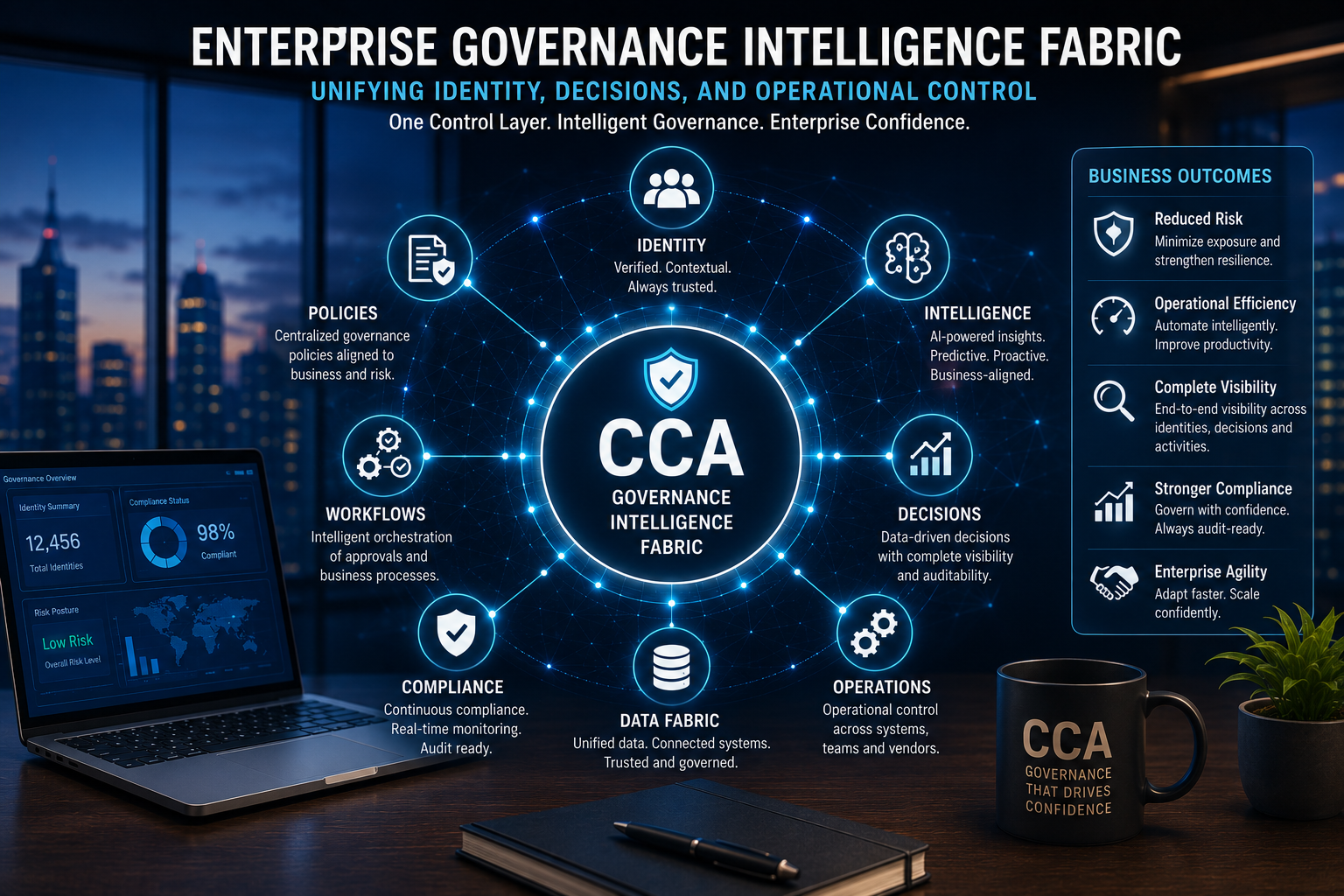
As enterprise ecosystems become increasingly interconnected, governance can no longer exist as isolated controls inside individual applications. Modern organizations require an intelligent governance fabric that continuously connects identity, policies, workflows, approvals, vendors, and operational data. Color Card Administrator (CCA) delivers this infrastructure-first approach by acting as the enterprise governance layer that standardizes execution while preserving existing technology investments.
From Governance to Governance Intelligence
Traditional governance verifies compliance after execution. Governance intelligence moves policy enforcement into the execution layer itself. Every approval, lifecycle event, business identity request, and vendor interaction becomes measurable, traceable, and policy-aware. Executives gain continuous operational insight instead of relying solely on periodic audits.
Identity as the Foundation
Identity remains the authoritative context for enterprise execution. Organizational hierarchy, employment status, delegated authority, regional requirements, and business ownership determine how policies should be applied. CCA combines trusted identity information with centralized governance rules to deliver consistent enterprise decisions across every connected platform.
Building the Governance Intelligence Fabric
The governance intelligence fabric links HR, ERP, CRM, procurement, directory services, collaboration platforms, and external fulfillment providers through standardized policy orchestration. Rather than replacing enterprise systems, CCA coordinates them using reusable governance services, centralized approval workflows, audit logging, reporting, lifecycle automation, vendor governance, and API-driven integration.

Business Impact
Organizations benefit from improved regulatory compliance, faster onboarding, standardized operational execution, stronger vendor accountability, better reporting accuracy, lower administrative overhead, and increased resilience during organizational change. Governance evolves into a strategic capability that supports innovation without compromising control.
Implementation Best Practices
Create authoritative identity sources, define reusable governance policies, classify approval models, integrate core systems, automate lifecycle events, establish executive dashboards, and continuously measure governance maturity using operational KPIs and audit metrics.
Future Enterprise Architecture
As AI-assisted operations and autonomous workflows become mainstream, governance intelligence will become the foundation that ensures transparency, explainability, and enterprise trust. Organizations with centralized governance infrastructure will adopt future technologies faster while maintaining policy consistency.
Conclusion
Enterprise success increasingly depends on governed execution rather than isolated automation. Color Card Administrator (CCA) enables organizations to establish an enterprise governance intelligence fabric that unifies identity, policy, operational intelligence, and workflow orchestration into a scalable control layer.