

Why Enterprise Governance Platforms Are Becoming the Operating System for Business Identity
Introduction
Every successful enterprise relies on specialized platforms such as ERP, CRM, HCM, IAM, and CMS. Yet business identity remains fragmented across departments, vendors, approvals, and workflows. Modern enterprises increasingly require a governance platform that serves as the operating system for business identity rather than another isolated application.
Business Identity Extends Across Every Enterprise Function

Business identity determines:
- Who represents the organization
- Who approves requests
- Which vendors are authorized
- Which brand standards apply
- How operational workflows execute
Why Traditional Enterprise Platforms Cannot Solve This Problem
ERP, CRM, IAM, procurement, and HR systems excel within their own domains but rarely coordinate governance across operational processes. A governance-first platform connects these systems through centralized policy rather than manual administration.
Governance Is Becoming Enterprise Infrastructure
Governance now functions as infrastructure supporting:
- Approvals
- Workflows
- Vendors
- Branding
- Organizational execution
Organizations embedding governance into operations achieve greater consistency, compliance, and scalability.
Enterprise Operating Systems Are Shifting Toward Governance
The next generation of enterprise software emphasizes policy-driven execution. Automation answers how work is completed, while governance determines whether and under which policies work should proceed.
The Role of Policy-Driven Decision Making
Policies should be executable rather than merely documented.
Governance should automatically enforce:
- Approval routing
- Vendor authorization
- Business card governance
- Compliance
Business Identity Requires Continuous Governance
Identity continuously changes through:
- Hiring
- Promotions
- Transfers
- Reorganizations
- Vendor updates
Governance platforms synchronize these events to maintain operational consistency.
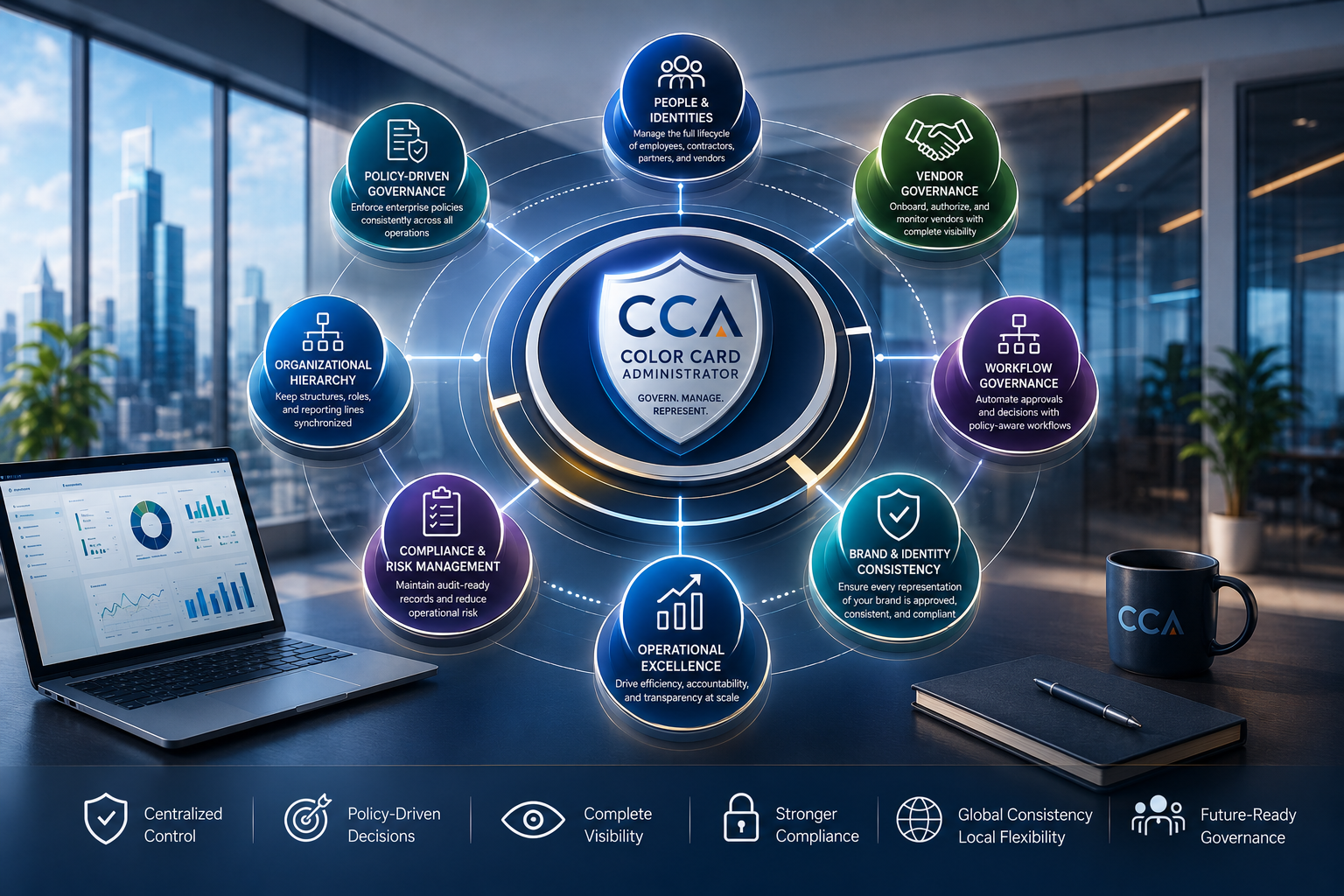
How Color Card Administrator (CCA) Enables Governance-First Operations
CCA centralizes:
- Business card governance
- Organizational hierarchy synchronization
- Approval workflow automation
- Vendor governance
- Brand compliance
- Policy-driven operational identity
Cross-link Suggestions:
- Enterprise Governance Platform
- Business Card Management Platform
- Approval Workflow Automation
- Vendor Governance
- Brand Governance
- Organizational Identity Management
- Enterprise Print Management
- Request a Demo
Looking Ahead
Enterprise governance platforms will increasingly become strategic operating systems connecting people, policies, workflows, vendors, and business identity across distributed enterprises
Conclusion
Enterprise governance platforms unify identities, workflows, approvals, policies, vendors, and organizational structures into a single operational framework. Color Card Administrator (CCA) exemplifies this governance-first approach by extending identity management into enterprise operational execution.