

Why Policy-Driven Business Identity Is the Future of Enterprise Operations
Introduction
Enterprise governance has traditionally depended on documented policies, management oversight, and administrative discipline. Organizations invested significant effort in creating governance frameworks, compliance manuals, approval matrices, organizational charts, procurement procedures, branding guidelines, and vendor policies. These documents described how the enterprise intended to operate, but they did not always determine how the enterprise actually operated.
As organizations expanded across multiple countries, business units, regional offices, outsourced service providers, print vendors, and strategic partners, the distance between documented governance and day-to-day execution continued to widen. Policies remained static while organizations became increasingly dynamic. Employees moved between departments. Managers changed. Regional offices adopted local practices. Vendors received inconsistent instructions. Brand standards gradually diverged between locations.
This mismatch created one of the most persistent governance challenges facing modern enterprises. Governance was not failing because policies were poorly written. Governance was failing because policies were not actively participating in operational execution.
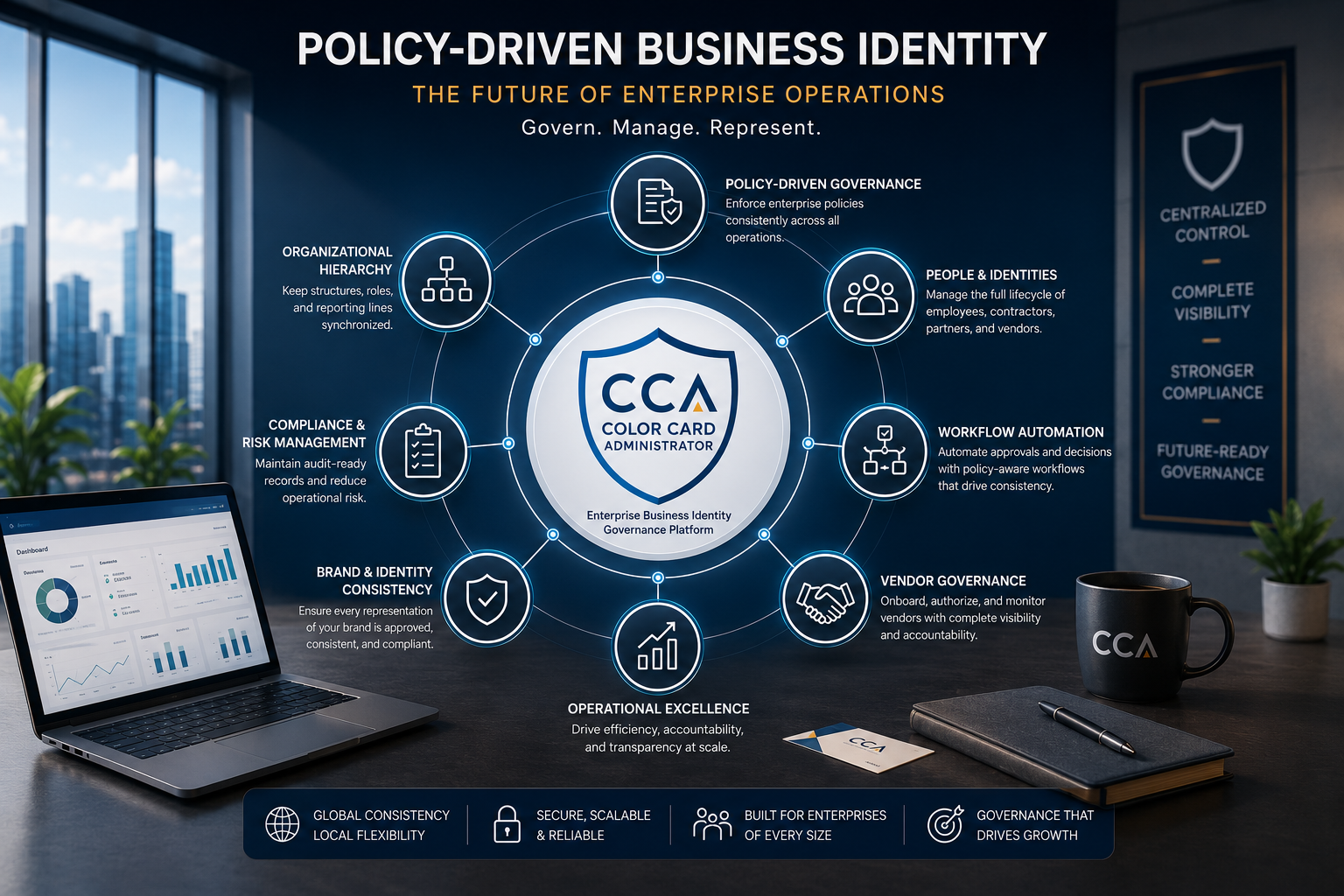
Modern enterprise governance platforms are now moving toward policy-driven business identity. Rather than treating identity as a passive record in a directory or a static employee profile, policy-driven business identity turns identity into an operational governance mechanism. Identity becomes the foundation through which enterprise policies are interpreted, enforced, audited, and continuously synchronized across business processes.
This evolution is especially important for enterprise business identity operations, where employees, vendors, administrators, approvers, departments, and regions must work together under consistent governance rules. For CCA, this reinforces a clear strategic message: business identity is not an administrative afterthought. It is enterprise infrastructure.
Why Traditional Governance Models Are No Longer Sufficient
Traditional governance models were built around assumptions that no longer reflect enterprise reality. They assumed organizational structures changed slowly. They assumed employees worked primarily from centralized offices. Assumed operational authority could be managed through static approval matrices. Assume vendors could be governed primarily through contracts and periodic reviews.
Modern enterprises operate differently. Organizational change is continuous. Business units reorganize. Employees transfer across regions. Shared service centers support multiple functions. Vendors become operational extensions of the enterprise. Hybrid work shifts responsibility across geographies. Mergers and acquisitions introduce new identities, brands, locations, and governance exceptions.
When governance remains tied to static documentation, the enterprise experiences governance lag. By the time a procedure is updated, the organization has already changed again. This lag creates outdated approval paths, inconsistent vendor usage, incorrect business card information, fragmented brand execution, and weak audit visibility.
Policy-driven business identity reduces this lag by making governance dynamic. Policies are no longer simply referenced by employees or administrators. They become active rules that guide operational execution as identity attributes change. When identity changes, governance changes with it.
Governance Must Become an Active Participant in Operations

One of the most important shifts in enterprise governance is recognizing that governance should not merely observe operational activity. It should actively participate in it. Governance should not only review whether a process was compliant after completion. It should determine whether the process is permitted before it begins.
Consider a simple but common enterprise scenario. An employee is promoted and requests updated business cards. In a manual model, HR updates the employee record, a manager approves the request, marketing checks the title and brand format, procurement confirms the print vendor, and an administrator coordinates production. Each step depends on human interpretation. Each step introduces opportunities for delay or inconsistency.
A policy-driven governance model treats the promotion as a governance event. The platform evaluates organizational hierarchy, role eligibility, approved title formats, regional branding rules, vendor assignments, approval authority, cost center allocation, and compliance records. Operational execution becomes the outcome of policy, not the result of manual coordination.
This is the foundation of policy-driven business identity. Enterprise identity is no longer passive. It becomes a control point that determines how business processes should execute.
Business Identity as Executable Enterprise Policy
A common misconception is that business identity is simply employee information. In an enterprise context, business identity is much more than a name, title, email address, and department. It represents the operational expression of enterprise policy.
Every business identity contains attributes that influence governance. Department ownership determines approval routing. Regional assignment determines branding and vendor eligibility. Cost center determines financial accountability. Role determines permissions. Manager relationships determine escalation paths. Employment status determines whether operational privileges should remain active.
When these attributes are connected to workflow logic, business identity infrastructure becomes executable policy. A business card request should automatically determine whether the employee is eligible, which template applies, which vendor is authorized, which approval chain should run, and which audit record should be created. The employee does not need to interpret policy. The governance platform applies policy automatically.
This approach improves consistency because policies are executed the same way across departments and regions. It improves compliance because operational decisions are recorded. It reduces administrative effort because governance is embedded into the process itself.
The Relationship Between Identity, Governance, and Workflow
Enterprise workflow automation often fails to deliver governance value when it is disconnected from identity. Automation can route tasks, send notifications, and accelerate approvals. But if the workflow does not understand organizational identity, it may simply accelerate inconsistent decisions.
Two employees in different regions may submit the same type of request. Without identity-aware governance, one request may use a local vendor, another may use an outdated approval chain, and a third may apply an incorrect brand template. The process is automated, but governance remains fragmented.
Policy-driven business identity reverses this relationship. Identity becomes the foundation of workflow execution. Before a workflow proceeds, the platform evaluates who initiated the request, which department owns the request, which policies apply, which regional exceptions are valid, which vendors are authorized, and what compliance evidence must be retained.
Only after governance has validated the request should automation execute the workflow. This distinction is critical. Automation improves speed. Governance ensures correctness. CCA’s value lies in connecting both.
Distributed Enterprises Need Distributed Execution – Not Distributed Governance
Large enterprises require distributed execution. Regional offices need flexibility. Country teams need localization. Business units need operational autonomy. Local administrators need the ability to support employees quickly. However, distributed execution should not mean distributed governance.
When each region develops its own business card process, its own vendor list, its own approval flow, and its own brand interpretation, the enterprise loses control over business identity. These local variations may appear minor individually, but across hundreds of departments and locations they create significant operational risk.
Policy-driven business identity allows the enterprise to separate governance from execution. Governance remains centralized through approved policies, hierarchy rules, vendor controls, and brand standards. Execution remains distributed through authorized regional users and business units. This gives the enterprise both control and flexibility.
For CCA, this distinction is central. The platform does not remove local operations. It gives local operations a governed framework in which to execute consistently.
Enterprise Governance Begins Before the Workflow Starts
Many organizations still treat governance as a retrospective activity. Compliance teams audit completed activity. Finance reviews spending after approval. Marketing checks brand output after materials are produced. Procurement reviews vendor usage after orders have occurred. Retrospective governance is necessary, but it is not sufficient.
Policy-driven governance shifts control earlier in the lifecycle. Instead of asking whether a completed request was compliant, the platform asks whether the request should proceed in the first place. This preventative model reduces operational risk because non-compliant actions are stopped before they become business problems.
A business card request should not proceed unless the employee identity is current, the organizational hierarchy is synchronized, the approved template is available, the vendor is authorized, and the required approval path is valid. A vendor-related request should not proceed unless vendor authorization, regional eligibility, and procurement rules are satisfied.
This proactive governance model turns policy into a gatekeeper for operational execution. It moves governance from review to prevention.
Policy Consistency Creates Enterprise Consistency
Consistency is one of the most valuable outcomes of mature governance. Customers expect consistent representation. Employees expect predictable processes. Vendors expect standardized instructions. Executives expect reliable reporting. Auditors expect repeatable controls.
Without centralized governance, consistency becomes difficult to maintain. A business card may follow one format in one region and another elsewhere. An approval route may depend on personal knowledge instead of organizational policy. A vendor may be approved in one location but used informally in another. These inconsistencies create operational complexity that becomes harder to manage as the enterprise grows.
Policy-driven business identity creates consistency by ensuring that every operational process references the same governance framework. The employee’s location may differ. The department may differ. The local vendor may differ. But the governance model remains aligned to enterprise policy.
This is especially important for global enterprises where business identity must remain consistent while still respecting regional requirements.
Governance Is Becoming a Competitive Advantage
Governance has historically been viewed as a cost of doing business. It was associated with controls, reviews, approvals, and restrictions. Modern enterprises increasingly recognize that governance can become a source of competitive advantage when it enables faster, safer, and more consistent execution.
Organizations with mature governance can onboard employees faster, manage organizational changes more confidently, coordinate vendors more effectively, maintain brand consistency, reduce administrative effort, and respond to audits with stronger evidence. Governance enables agility because operational decisions are guided by standardized policies rather than individual interpretation.
This advantage becomes particularly important during expansion, acquisitions, restructuring, and international growth. The more distributed the organization becomes, the more valuable centralized governance becomes. Enterprises that operationalize governance can scale without losing control.
Policy-driven business identity therefore supports both governance and growth. It provides a structured foundation for enterprise change.
The Role of Organizational Hierarchy in Policy-Driven Identity
Organizational hierarchy is more than a reporting structure. It is a governance framework. Every reporting relationship influences approval authority, budget ownership, vendor management, department administration, brand responsibility, and operational accountability.
When hierarchy changes, governance must change simultaneously. A promotion may grant new approval authority. A transfer may change branding requirements. A departmental move may alter cost center allocation. A manager change may redirect approvals. If these changes are not synchronized, outdated permissions and approval paths continue to operate as lifecycle management.
Policy-driven business identity continuously aligns operational governance with organizational reality. Hierarchy changes should automatically affect workflows, permissions, vendors, and business identity records. This reduces risk and improves administrative efficiency.
For enterprise systems such as CCA, hierarchy synchronization is foundational because business identity execution depends on knowing who belongs where, who approves what, and which organizational policies apply.
Governance Should Extend Beyond Internal Employees
Enterprise operations increasingly depend on external participants. Print vendors, marketing agencies, outsourcing providers, consultants, contractors, logistics partners, and franchise operators all influence how the organization is represented. These external participants create operational identities even when they do not exist in employee directories.
Many organizations govern external participants primarily through contracts. Contracts are necessary, but they do not enforce day-to-day behavior. A contract may state that a vendor must follow brand standards, but governance is what ensures approved templates, authorized locations, and correct approval paths are actually used.
Policy-driven business identity extends governance beyond employees to every authorized participant in business identity execution. This creates stronger vendor accountability, improved service consistency, better brand protection, simplified compliance, and reduced operational risk.
CCA’s vendor governance role is therefore not secondary. It is central to enterprise business identity governance because vendors are often responsible for producing and distributing business identity assets.
The Role of Color Card Administrator (CCA) in Policy-Driven Enterprise Operations
As enterprise governance evolves, organizations require more than disconnected applications that automate isolated tasks. They require a centralized governance platform capable of translating enterprise policies into consistent operational execution. This is where Color Card Administrator (CCA) delivers strategic value.
CCA is not positioned as a standalone business card ordering application. It functions as an enterprise business identity governance platform that connects organizational identity, approval policies, vendor governance, brand standards, and operational workflows into a unified governance framework.
When an employee requests a business card, CCA does not simply process the order. It evaluates the governance context surrounding the request. It can determine whether the requester belongs to an authorized business unit, whether the organizational hierarchy is current, whether the employee’s role permits the request, which approval workflow applies, which regional branding standards must be enforced, which print vendor is authorized, which cost center should be charged, and which audit records must be generated.
By embedding enterprise policies directly into operational workflows, CCA transforms governance into a repeatable operational capability. This minimizes administrative effort while improving consistency, audit readiness, and governance maturity.
Enterprise Governance Maturity Model
Policy-driven business identity fits into a broader governance maturity journey. Most enterprises move through a series of maturity stages as they transition from manual administration to governance infrastructure.
Level 1 is administrative governance. Processes rely on emails, spreadsheets, shared folders, and manual approvals. Governance knowledge resides with individuals rather than systems.
Level 2 is departmental governance. Individual departments improve their own controls. HR manages employee data, procurement manages suppliers, marketing governs branding, and IT governs access. Each area improves, but enterprise-wide coordination remains limited.
Level 3 is workflow governance. Organizations introduce workflow automation and approval routing. Efficiency improves, but workflows may still remain disconnected from identity and enterprise policy.
Level 4 is identity-centric governance. Identity becomes the foundation for operational control. Hierarchies, lifecycle events, vendor relationships, and permissions begin to synchronize through policy.
Level 5 is policy-driven enterprise governance. Governance becomes infrastructure. Policies govern workflows, organizational changes, vendor administration, brand compliance, approvals, and enterprise representation continuously and consistently.
The Future of Policy-Driven Enterprise Governance
Enterprise governance will continue evolving beyond traditional compliance programs. Future governance platforms will increasingly become intelligent operational control systems capable of continuously adapting to organizational change.
Emerging capabilities will include real-time policy validation, automated governance recommendations, continuous organizational synchronization, AI-assisted approval optimization, predictive governance analytics, intelligent vendor governance, dynamic organizational policy management, and automated compliance monitoring.
Rather than periodically reviewing governance through audits, organizations will continuously evaluate governance as operational activities occur. This transition represents one of the most significant shifts in enterprise architecture over the coming decade.
The enterprises that prepare for this future will treat governance not as a constraint, but as an operational advantage.
Why Business Identity Will Become Strategic Infrastructure
Business identity has traditionally been viewed as an administrative necessity. Yet it directly influences corporate reputation, brand consistency, operational efficiency, procurement governance, regulatory compliance, vendor relationships, employee productivity, and executive visibility.
As organizations expand across regions and partners, business identity becomes a strategic enterprise asset. Managing this asset requires governance rather than administration. It requires policy-driven infrastructure that connects organizational truth with operational execution.
A business identity infrastructure platform gives enterprises the ability to maintain consistent representation while still allowing distributed teams to operate. This is exactly the kind of enterprise-level control layer that CCA is designed to provide.
The future of enterprise operations will increasingly depend on systems that govern business identity as carefully as IT systems govern digital identity.
Governance Creates Enterprise Resilience
Operational resilience depends on more than technology uptime. It depends on governance consistency. Enterprises encounter continuous change: organizational restructuring, market expansion, regulatory updates, vendor changes, workforce mobility, mergers, acquisitions, and new business models.
Without governance infrastructure, every change introduces operational uncertainty. Which approval paths should change? vendors remain authorized? Which brand rules apply? Do employees retain administrative permissions? Which locations require updated business identity assets?
Policy-driven business identity enables organizations to absorb change while maintaining operational consistency. Governance becomes an essential contributor to enterprise resilience because it allows the organization to adapt without losing control.
This is why CCA’s governance-first positioning is important. The platform supports operational continuity by ensuring that business identity execution remains aligned with enterprise policy even as the organization changes.
Conclusion
The future of enterprise operations will not be defined solely by automation, digital transformation, or artificial intelligence. It will be defined by governance. Organizations that continue relying on manual interpretation of enterprise policies will increasingly struggle to maintain consistency across distributed business units, vendors, and operational processes.
Policy-driven business identity offers a more sustainable approach. By embedding governance directly into enterprise identity, workflows, organizational hierarchy, vendor administration, and operational execution, organizations establish a governance framework capable of scaling alongside business growth.
This evolution transforms governance from an administrative responsibility into strategic enterprise infrastructure. Color Card Administrator (CCA) supports this transformation by extending identity governance beyond access management into the operational execution of business identity.
Through centralized governance, policy-driven workflows, vendor administration, organizational hierarchy synchronization, and business identity management, CCA enables enterprises to establish a consistent, scalable, and audit-ready governance foundation for modern operations.