

Integrating Business Card Governance with Enterprise Systems
Introduction
Enterprise organizations do not operate in isolated systems.
They operate through interconnected platforms.
Business card governance, when treated as a standalone function, introduces fragmentation. However, when integrated into enterprise systems, it becomes part of a controlled identity infrastructure.
Integration is not a feature.
It is a requirement for enterprise execution.
Why Integration Matters
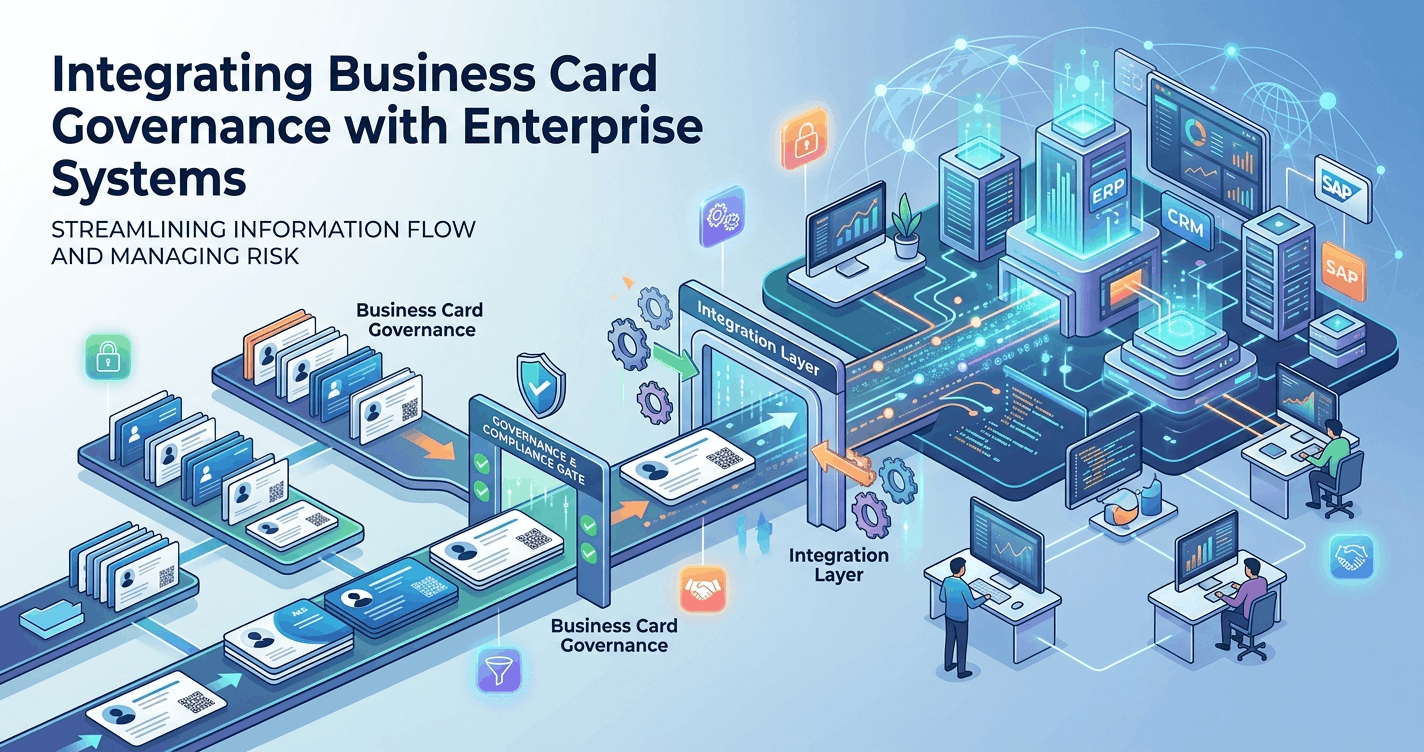
Business card workflows touch multiple enterprise systems:
– HR systems for employee data
– Procurement systems for vendor control
– Approval systems for workflow routing
– Compliance systems for audit tracking
Without integration, these systems operate independently, creating gaps in control and visibility.
Integration ensures that business card governance aligns with enterprise operations.
How Business Card Governance Integrates with Enterprise Systems

- HRIS Integration
Employee data is automatically synchronized, ensuring accuracy and eliminating manual entry.
- Procurement Integration
Vendor selection, pricing, and ordering are aligned with procurement policies.
- Workflow Systems
Approval processes are embedded into existing enterprise workflow engines.
- Identity Systems
Business cards become part of identity provisioning alongside email, access, and credentials.
- Reporting and Compliance
All activities are tracked and integrated into enterprise reporting systems.
Operational Impact of Integration
Before Integration:
– Manual data entry
– Disconnected approvals
– Vendor inconsistency
– Limited visibility
After Integration:
– Automated data flow
– Unified workflows
– Controlled vendor ecosystem
– Full auditability
Integration removes friction and enforces governance.
Integration as Infrastructure
At scale, integration transforms business card management into infrastructure.
It ensures:
– Consistent identity execution
– Alignment with enterprise systems
– Scalable workflows
– Real-time visibility
Business card governance becomes embedded within enterprise architecture.
The Role of Governance Platforms
Governance platforms enable integration by:
– Connecting with HRIS systems
– Automating workflow processes
– Enforcing policy rules
– Managing vendor relationships
– Providing centralized reporting
This creates a unified system where identity execution is controlled and consistent.
Strategic Takeaway
Enterprise organizations do not gain control through isolated tools.
They gain control through integration.
Integrating business card governance with enterprise systems ensures:
– Consistency
– Compliance
– Visibility
– Scalability
It transforms business card workflows into a governed, enterprise-wide system.