

Why Enterprise Identity Governance Must Extend Beyond Internal Systems
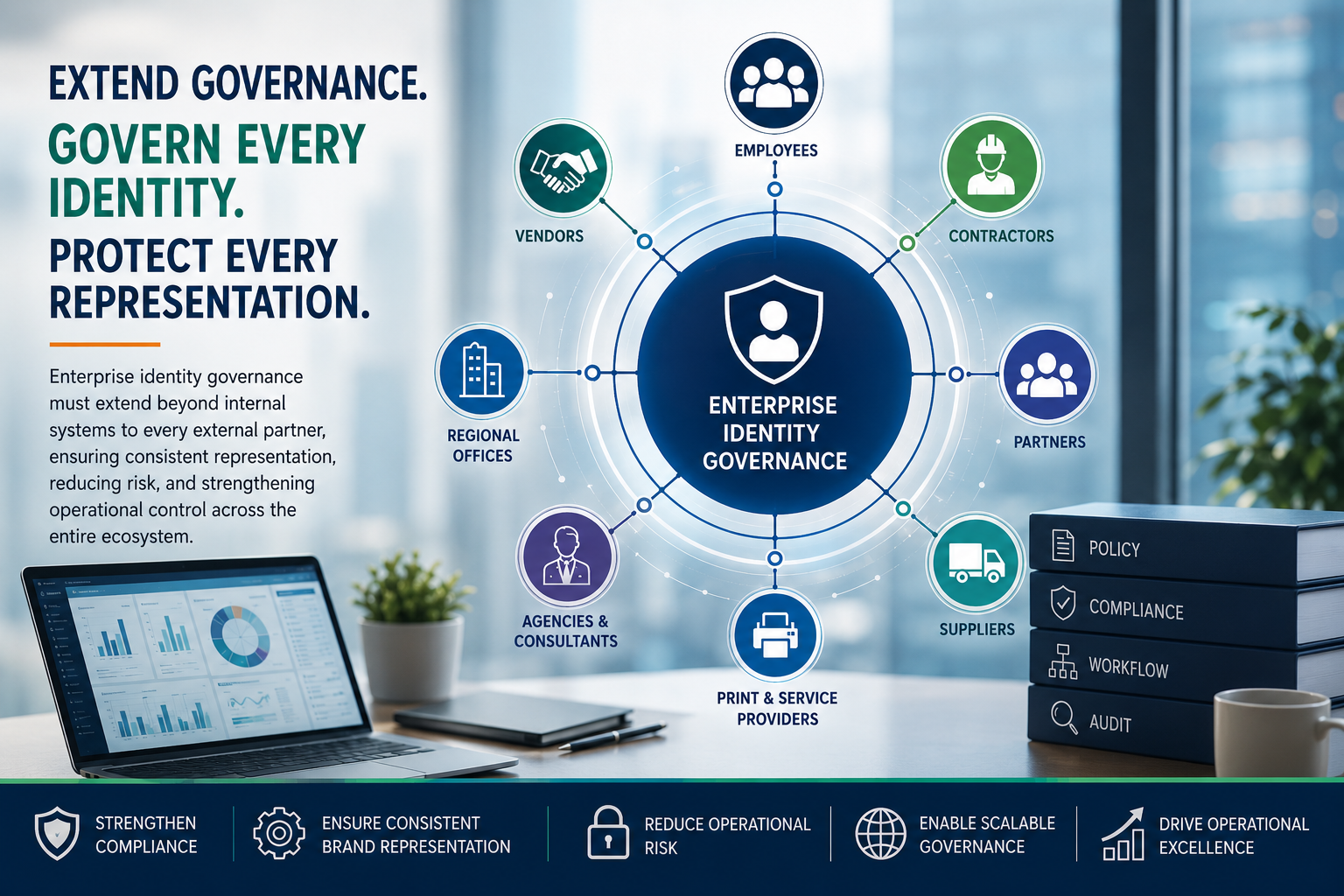
Enterprise Identity No Longer Ends at the Corporate Firewall
Enterprise identity governance has traditionally centered on employees, directories, authentication, and application access.
Modern enterprises, however, rely on extensive ecosystems of suppliers, contractors, partners, agencies, distributors, and managed service providers. Every one of these external entities represents an operational identity that influences compliance, brand consistency, procurement, and governance.
Enterprise identity must therefore extend beyond digital access into business operations.
The Expansion of Enterprise Identity

Identity now includes:
- Employees
- Vendors
- Departments
- Offices
- Executives
- Regional administrators
- Business card recipients
- Print providers
- External service organizations
Governance should consistently manage every stage of these identities.
The Hidden Governance Gap
Many organizations successfully govern application access but still manage business card ordering, vendor approvals, brand assets, and operational permissions through spreadsheets and email.
These disconnected processes create invisible governance risks.
Governance Across the Identity Lifecycle
Identity creation, modification, suspension, and termination must automatically synchronize operational permissions.
Governance should ensure that approval authority, vendor access, and representation rights always reflect the current organizational structure.
External Identities Require Equal Governance
Vendors, agencies, consultants, franchisees, and outsourcing partners represent the enterprise every day.
Contracts alone do not enforce governance.
Operational policies and centralized administration do.
Business Identity Is an Enterprise Asset
Business identity combines people, departments, locations, brands, and approved vendors into a governed operational ecosystem.
Treating business identity as enterprise infrastructure improves audit readiness, consistency, and compliance.
Internal Link Suggestion: Link “enterprise compliance” to CCA Blog Post 48 – Building Enterprise Compliance Through Identity Governance Systems.
Why Manual Governance Cannot Scale
As enterprises expand globally, manual coordination becomes increasingly expensive and error-prone.
Policy-driven automation delivers repeatable governance across locations, departments, and vendors.
The Role of Color Card Administrator (CCA)
Color Card Administrator (CCA) extends identity governance beyond authentication into business identity execution.
Through:
- Centralized approval workflows
- Vendor governance
- Organizational hierarchy management
- Business card governance
- Brand compliance
CCA enables enterprises to establish centralized governance with distributed execution.
Cross-Link Suggestions
- Enterprise Governance Platform
- Business Card Management Platform
- Approval Workflow Automation
- Vendor Governance
- Identity Lifecycle Management
- Brand Governance
- Multi-location Business Card Management
- Enterprise Print Management
- Request a Demo
- Contact CCA
Conclusion
Enterprise identity governance no longer ends at internal systems.
Organizations must govern every operational identity that represents the enterprise throughout its lifecycle.
A governance-first platform such as Color Card Administrator (CCA) enables centralized policy enforcement, operational consistency, vendor governance, and scalable business identity infrastructure.