

Identity Lifecycle Management and Business Card Governance: Building a Connected Enterprise Identity Framework
Introduction
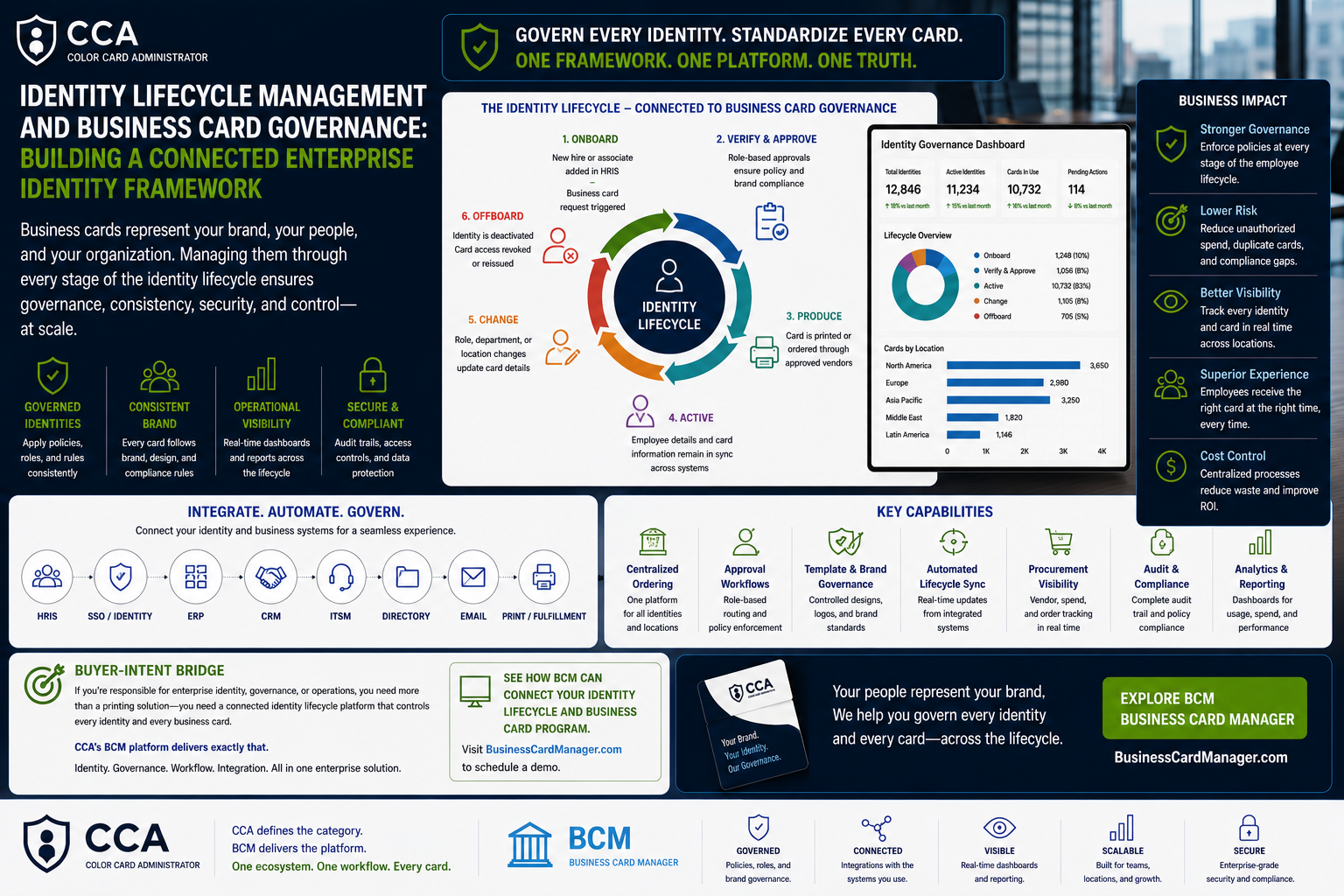
Enterprise identity is constantly changing. Employees join organizations, receive promotions, transfer between departments, relocate to new offices, assume leadership positions, and eventually leave the company. Every one of these events affects not only access to business systems but also customer-facing identity assets such as business cards.
For many organizations, business card management remains disconnected from identity lifecycle management. HR systems maintain employee records, IT manages user accounts, procurement oversees suppliers, and marketing protects brand standards. Business card requests often sit outside this ecosystem, relying on manual emails, spreadsheets, or disconnected ordering portals.
As enterprises scale, this separation creates governance gaps. Employees may continue using outdated titles, obsolete office addresses, incorrect branding, or inaccurate contact information. The issue is rarely printing itself; it is the absence of a connected operational workflow.
Identity Lifecycle Management (ILM) provides a structured framework that governs every stage of an employee’s relationship with the organization. When business card management becomes part of that framework, organizations gain consistency, visibility, and stronger governance across the enterprise.
Business card printing is the transaction.
Business card management is the workflow.
Governance is the control layer.
API integration is the differentiator.
Identity Lifecycle Management Beyond User Accounts

Identity Lifecycle Management extends beyond user accounts. It governs every business process influenced by employee identity. New hires require approved templates during onboarding. Promotions trigger updated titles. Department transfers may require new branding rules. Office relocations change contact information. Offboarding requires the retirement of outdated identity assets.
A centralized business card management platform enables organizations to automate these changes rather than relying on manual intervention. Employee data synchronizes with ordering workflows, approval rules adjust automatically, and reporting provides complete visibility into every lifecycle event.
Approval Workflow Automation
Approval workflow software plays a crucial role in this process. Every lifecycle event can trigger different approval paths based on department, location, business unit, or governance policy. Automation reduces administrative effort while improving auditability and accountability.
Brand Governance
Brand governance also becomes significantly stronger when business cards are managed as identity assets rather than printed products. Templates, logos, typography, legal disclaimers, and regional requirements can all be centrally managed while still allowing local operational flexibility.
Operational Reporting and Visibility
Operational reporting gives HR, procurement, marketing, compliance, and executive leadership a shared view of employee identity activity. Organizations can monitor request volumes, approval performance, fulfillment timelines, policy compliance, and vendor performance through one connected dashboard.
API Integration
API integration connects HRIS platforms, identity providers, ERP environments, CRM systems, procurement platforms, onboarding software, and reporting tools. Instead of duplicate data entry, organizations establish one connected workflow where identity changes automatically drive business card governance.
Buyer-Intent Bridge
Traditional business card programs react to employee changes. Identity Lifecycle Management proactively governs every change through connected workflows, automation, centralized approvals, reporting, and policy enforcement.
Enterprise buyers evaluating modern business card platforms should prioritize identity lifecycle integration, centralized ordering, approval automation, governance, API connectivity, reporting, auditability, procurement visibility, and scalability.
Strategic Takeaway
Organizations that connect Identity Lifecycle Management with business card governance reduce administrative effort, strengthen compliance, improve employee experience, and maintain a consistent enterprise identity throughout every stage of the employee lifecycle.