

API Rate Limit and Capacity Governance for Enterprise Business Card Integrations
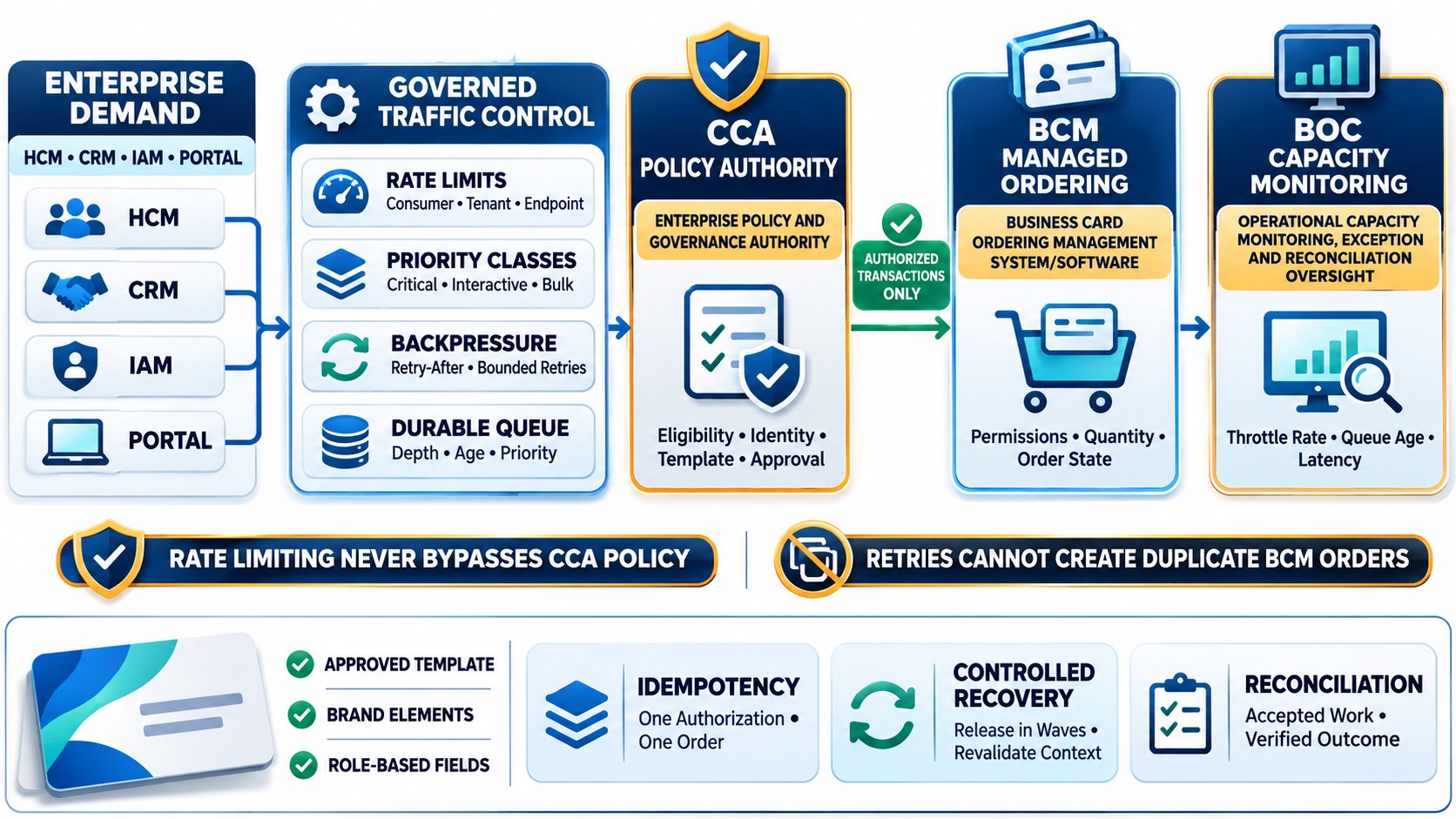
Business card API rate limit governance: protecting governed identity decisions and ordering workflows during bursts, retries, and sustained demand.
Capacity Is a Governance Concern
In general, API capacity is often discussed as an infrastructure calculation: requests per second, concurrent connections, queue depth and response time. In an enterprise business card program, business card API rate limit governance protects a governed business process. For example, if traffic is admitted without policy, a noisy consumer can delay employee onboarding, repeated retries can create duplicate orders, and bulk synchronization can crowd out urgent corrections or cancellations.
Business card API rate limit governance defines how the platform measures demand, allocates service, rejects or delays excess work, preserves priority and proves recovery. However, the objective is not maximum throughput at all times. Instead, it is predictable, fair and safe execution of approved business card activity under normal demand, seasonal peaks, integration failures and enterprise-wide changes.
Keep CCA, BCM, and BOC Responsibilities Clear
To begin with, Color Card Administrator, or CCA, is the enterprise policy and orchestration authority for API-connected business card programs. First, CCA receives trusted facts and requests, then applies eligibility, identity, template, quantity, approval, routing and exception rules. Therefore, capacity controls must protect this decision boundary rather than allow high request volume to bypass validation or force permissive fallback behavior.
Second, Business Card Manager, or BCM, is the business card ordering management system or software. Meanwhile, BCM manages permissions, approvals, templates, quantities, orders, fulfillment coordination and reporting for authorized transactions. Finally, Business Ops Center, or BOC, provides operational visibility, exception ownership and reconciliation across source events, CCA decisions, BCM orders and fulfillment outcomes.
In summary, CCA decides whether a transaction is allowed. Then, BCM manages the authorized ordering transaction. Finally, BOC shows whether the process completed correctly. In short, rate limiting supports all three roles but does not replace any of them.
Understand the Demand Profile
| Demand source | Typical traffic pattern | Primary risk |
|---|---|---|
| HCM lifecycle feed | Daily changes plus onboarding or reorganization bursts | Many employee events arrive together |
| CRM update stream | Territory and role changes throughout the day | Frequent low-value updates displace material changes |
| Employee portal | Interactive requests with local peaks | Poor experience triggers repeated submissions |
| Bulk administration | Template, entity or location migration | Large batch consumes shared capacity |
| BCM status polling | Repeated order and delivery queries | Read traffic grows without business value |
| Provider callbacks | Bursty proof, production and shipment events | Return evidence arrives faster than processing |
| Recovery replay | Backlog released after an outage | Duplicate or out-of-order processing |
Accordingly, measure demand by consumer, tenant, environment, endpoint, operation, event family and business journey. Otherwise, a single global request count hides whether one integration is using most of the capacity or whether a low-volume approval endpoint is being delayed by a large status export.
Define Capacity in Business Terms
Above all, technical capacity should be connected to expected business outcomes. To do this, estimate active employees, eligible populations, card programs, daily lifecycle events, portal concurrency, bulk change size, order volume, status events and peak periods. In addition, include retries and recovery traffic rather than assuming every request succeeds once.
Next, document a normal baseline, expected peak, tested maximum and protected minimum for critical journeys. Also, capacity planning should include CCA decisioning, BCM order creation, databases, queues, provider interfaces, reporting and BOC monitoring. As a result, the slowest governed dependency determines safe end-to-end capacity.
Choose the Correct Limiting Dimension
| Limit dimension | What it protects | Use when |
|---|---|---|
| Consumer | One integration registration | A single client can generate excessive traffic |
| Tenant | One enterprise or legal boundary | Shared service must preserve fair allocation |
| Endpoint | A specific API operation | Expensive writes need tighter control than reads |
| Action | Order, cancel, reprint or status retrieval | Business consequences differ by operation |
| Population | Entity, location or card program | A bulk change should not affect unrelated groups |
| Concurrency | Simultaneous in-flight work | Downstream resources have finite parallel capacity |
| Volume window | Requests or units per period | Sustained consumption must remain predictable |
Therefore, layer limits instead of relying on one counter. For example, a consumer may remain within its total allowance while overwhelming an expensive order endpoint. Similarly, a tenant may be within its normal rate while a retry storm produces unsafe concurrency. Therefore, the admission decision should consider all relevant boundaries.
Protect Critical Business Journeys
Of course, not every request has the same urgency or consequence. For example, a new order request can usually wait briefly, while a cancellation before production may be time sensitive. Likewise, an identity correction may need priority over a large reporting export. Therefore, define classes that reflect business impact, then reserve enough capacity for critical control actions.
| Traffic class | Examples | Governance treatment |
|---|---|---|
| Critical control | Cancel, revoke, security response, production hold | Reserved capacity and immediate ownership |
| Interactive decision | Portal eligibility, template and approval lookup | Low latency with bounded retries |
| Authorized transaction | CCA decision to BCM order creation | Durable queue and idempotent execution |
| Lifecycle update | HCM, IAM or CRM change event | Effective-date aware processing |
| Operational evidence | Proof, shipment, delivery and rejection status | Reliable ingestion and reconciliation |
| Bulk or analytical | Exports, migrations, historical reporting | Scheduled and capacity-capped |
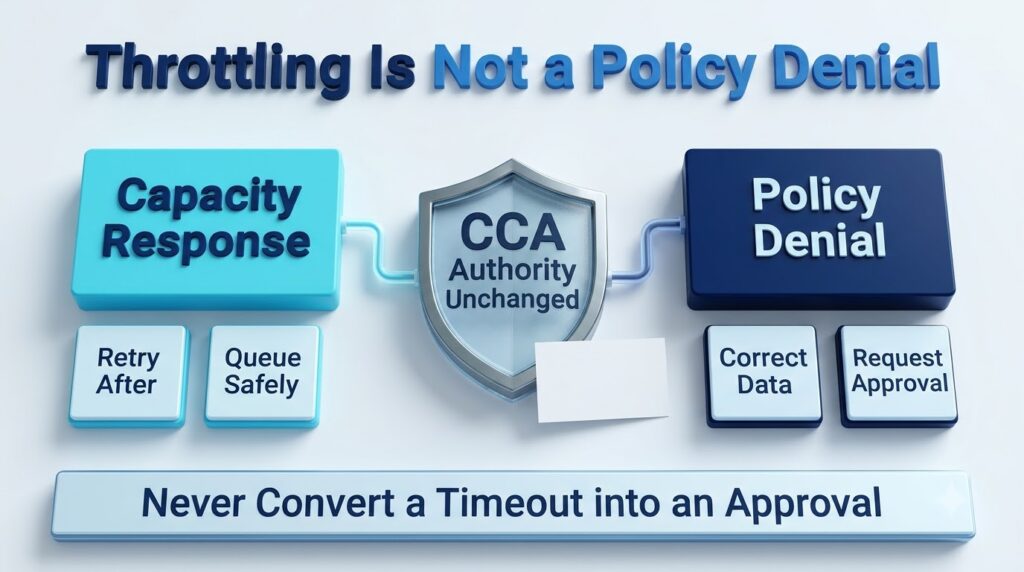
Rate Limits Must Not Change Authority
First of all, a throttled request is not denied by policy, and a policy denial is not a capacity error. Therefore, return distinct responses so consumers know whether to retry, correct data, request approval or stop. Above all, never convert a timeout into an automatic approval, default template or unvalidated order.
Consequently, when capacity is constrained, preserve the original CCA decision context. In particular, a queued transaction should retain the request identifier, identity version, policy version, approval evidence, quantity and expiry. Moreover, if material context changes before execution, return the transaction to CCA for reevaluation rather than executing a stale authorization.
Publish a Usable Rate Limit Contract
| Contract element | Required definition | Consumer behavior |
|---|---|---|
| Limit scope | Consumer, tenant, endpoint or action | Track the correct shared allowance |
| Window | Fixed, sliding, token bucket or concurrent | Predict replenishment behavior |
| Response | Status, error code and human-readable reason | Separate throttling from functional failure |
| Retry guidance | Retry after time or reset indicator | Wait instead of immediate repetition |
| Idempotency | Stable key and retention period | Repeat safely after uncertainty |
| Quota visibility | Remaining, reset and usage telemetry | Shape traffic before rejection |
| Support route | Owner and escalation threshold | Escalate sustained constraint with evidence |
In general, consumers should not reverse engineer limits through failure. Instead, publish enough information for responsible traffic shaping without exposing sensitive infrastructure. In addition, contract changes require notice and compatibility testing because an apparently small limit reduction can disrupt a scheduled integration.
Use Backpressure Instead of Retry Storms
In practice, backpressure tells a producer to slow down when downstream capacity is constrained. Next, the consumer should honor retry guidance, apply exponential delay with controlled jitter and cap attempts. In contrast, immediate loops multiply load at the worst possible time and can turn a small dependency issue into a platform-wide incident.
Accordingly, retries should be reserved for transient conditions. By contrast, validation errors, unauthorized requests, policy denials and unsupported versions require correction, not repetition. Meanwhile, record the original attempt, retry count, last failure and next eligible time so BOC can distinguish controlled recovery from uncontrolled noise.
Queue Authorized Work Safely
Admittedly, a durable queue can absorb short bursts, but it is not unlimited capacity. Therefore, define maximum age, depth, priority, visibility timeout, retry policy, dead-letter handling and ownership. For example, queue depth without age can hide that a critical employee request has waited too long.
Furthermore, the message should contain a reference to the governed resource and only the data needed for execution. In addition, protect confidentiality, validate the contract again at consumption and use idempotency so redelivery does not create a second BCM order. However, a message that exceeds its authorization lifetime should be reviewed or reevaluated rather than executed automatically.
Protect BCM From Duplicate and Excess Orders
Above all, BCM should accept only CCA-authorized transactions and enforce idempotency on order creation, cancellation and reprint actions. In particular, rate limits should be stricter for actions that can create physical production or cost. Moreover, a successful authentication and available quota do not prove that an order is authorized.
Similarly, bulk campaigns, organizational changes and recovery replays should be converted into controlled BCM work at a sustainable pace. Meanwhile, the ordering system must preserve quantities, approvals and order states while providing clear acknowledgments. Finally, if response uncertainty occurs, query or reconcile the original transaction before submitting again.
Make BOC the Capacity Control View
| BOC signal | What it reveals | Operational response |
|---|---|---|
| Admission rate | Traffic accepted by class and consumer | Compare with allocation and baseline |
| Throttle rate | Requests delayed or rejected for capacity | Identify noisy consumers or undersized limits |
| Queue depth and age | Backlog size and business delay | Protect priority and add recovery ownership |
| Retry amplification | Attempts per original request | Correct consumer behavior or dependency failure |
| CCA decision latency | Delay in governed authorization | Scale or isolate policy dependencies |
| BCM order latency | Delay from authorization to managed order | Protect execution and provider capacity |
| Reconciliation gap | Expected outcome lacks confirmed evidence | Open an owned exception |
To that end, dashboards should segment results by tenant, consumer, endpoint, journey, card program and priority. For instance, an acceptable average can conceal a blocked region or legal entity. Above all, BOC should connect technical saturation to the employees, approvals and orders affected.
Recover Without Releasing an Uncontrolled Flood
For instance, after an outage, the backlog can exceed normal production capacity. Therefore, reopen traffic in waves, preserve priority and keep live critical actions from being displaced by historical recovery. In addition, coordinate CCA processing, BCM order intake, provider capacity and BOC monitoring before releasing the next batch.
Furthermore, recovery should account for changed facts. For example, a delayed hire may have a new start date, an approved title may have changed, or a cancellation may have overtaken the original order. Therefore, compare resource versions and effective dates before acting. Finally, reconciliation must confirm that accepted work produced one correct outcome.
Plan for Enterprise Events
| Enterprise event | Capacity effect | Preparation |
|---|---|---|
| Acquisition or merger | New populations, brands and legal entities | Model volume and isolate migration waves |
| Reorganization | Large role, manager and location changes | Filter material changes and sequence decisions |
| Brand refresh | Template migration and reorders | Reserve bulk capacity without blocking daily work |
| Office move | Address changes across many employees | Use effective dates and controlled batches |
| Annual replenishment | Predictable order peak | Preapprove schedules and provider capacity |
| Integration recovery | Replay of missed events | Deduplicate and release by priority |
| Provider disruption | Statuses and exceptions accumulate | Retain evidence and reconcile after restoration |
Implement Business Card API Rate Limit Governance in Practical Stages
- First, inventory consumers, endpoints, event families, business journeys and downstream dependencies.
- Next, measure normal, peak, retry and recovery traffic using stable correlation identifiers.
- Then define capacity in employee, decision, order and lifecycle-event terms.
- After that, classify traffic by business impact and reserve capacity for critical control actions.
- Next, set layered limits by consumer, tenant, endpoint, action and concurrency.
- In addition, publish rate limit responses, retry guidance, quota visibility and support ownership.
- Also implement backpressure, bounded retries, durable queues and dead-letter handling.
- Furthermore, protect BCM order creation with authorization, idempotency and sustainable pacing.
- Then use BOC to monitor throttling, queue age, latency, affected outcomes and reconciliation.
- Finally, run burst, dependency-failure and backlog-recovery tests before major enterprise events.
Measure Capacity Governance
| Measure | What it proves | Target direction |
|---|---|---|
| Peak headroom | Tested capacity exceeds expected governed demand | Maintain approved margin |
| Throttle accuracy | Limits constrain the intended traffic class | Complete and explainable |
| Retry amplification | One request does not create excessive repeated load | Decrease |
| Queue age | Authorized work completes within its business window | Within target |
| Critical availability | Control actions retain protected capacity | Complete |
| Duplicate BCM orders | Retries and replay do not repeat production | Zero |
| Reconciliation completion | Accepted work produces a verified outcome | Complete |
Frequently Asked Questions
What is API capacity governance?
In short, it is the controlled allocation, shaping, monitoring and recovery of integration traffic according to business impact and safe system capacity.
What is CCA?
In brief, CCA is the enterprise policy and orchestration authority that governs eligibility, identity, templates, approvals, quantities and routing.
What is BCM?
Similarly, BCM is the business card ordering management system or software that manages authorized ordering, fulfillment coordination and reporting.
What is BOC?
Likewise, BOC provides capacity visibility, exception ownership and reconciliation across source events, CCA decisions, BCM orders and outcomes.
Is a throttled request a policy denial?
No. Instead, throttling is a capacity response; policy denial means the requested action is not authorized.
Should every request use the same limit?
No. Instead, limits should reflect the consumer, tenant, operation, cost and business priority.
How should consumers retry?
First, honor retry guidance, use exponential delay with controlled jitter, cap attempts and preserve the original idempotency key.
Can queues solve all capacity problems?
No. Admittedly, queues absorb bursts but still require maximum age, depth, priority, ownership and safe consumption capacity.
How are duplicate orders prevented?
Specifically, CCA authorization identifiers and BCM idempotency ensure repeated delivery does not create another order.
What should happen after an outage?
First, release backlog in controlled waves, revalidate stale context, protect live critical work and reconcile every accepted transaction.
The Strategic Outcome
Business card API rate limit governance lets the enterprise scale integration without allowing traffic volume to redefine authority. As a result, CCA continues to make governed decisions, BCM continues to manage authorized ordering and BOC connects technical capacity to the final business outcome.
As a result, the organization gains predictable service during daily demand, planned bulk events and failure recovery. In other words, every consumer has an allocation, every retry has a boundary, every backlog has an owner and every accepted transaction can be reconciled.
To begin, select the busiest business card integration and map its consumers, endpoints, normal rate, peak rate, retry behavior, queue age, CCA decision latency, BCM order latency and BOC reconciliation gaps. Then test a realistic burst and dependency failure, then correct any path that responds with uncontrolled retries, duplicate orders or invisible backlog.