

Business Card API Consumer Onboarding Governance
Consumer Onboarding Governance for Business Card APIs: Approve HR, CRM, and ERP Access Before Launch
Connecting HR, CRM and ERP systems to a business card API needs more than a credential. This video explains how to onboard each system safely, with CCA as the governance layer: confirm its purpose and owner, set roles and data boundaries, test thoroughly and activate gradually, then review access regularly and plan for clean offboarding.
Connecting enterprise systems to CCA with controlled access, policy and operational ownership.
An API Consumer Needs More Than Credentials
A new HCM, identity platform, CRM, ERP, procurement application, service portal or workflow system may have a valid reason to connect to enterprise business card operations. Granting a credential is not the same as authorizing that system to influence public business identity or create an order. The enterprise must establish the consumer, purpose, authoritative data, permitted actions, policy boundary, test evidence and operational owner before production access begins.
Consumer onboarding creates that control. It turns an integration request into a registered relationship with CCA, defines how approved inputs may affect governance, proves how BCM will manage the resulting transaction and establishes BOC monitoring before activation. The process reduces unauthorized access, hidden dependencies, duplicate orders and integrations that nobody owns after launch.
Keep the Purpose of CCA at the Center
Color Card Administrator is the enterprise orchestration and governance layer for API-integrated business card programs. CCA connects approved enterprise data to centralized eligibility, identity, template, permission, approval, quantity and routing decisions. A consumer may supply facts or initiate a request, but it should not bypass the controls that determine whether and how a business card action is authorized.
BCM is the business card ordering management system or software. It manages permissions, approvals, templates, quantities, orders and reporting for authorized transactions. Business Ops Center, or BOC, provides operational visibility, exception handling and reconciliation. Onboarding should preserve these boundaries from the first design decision through production activation.
Define the Consumer Before the Interface
| Registration field | Question answered | Required outcome |
|---|---|---|
| Business purpose | Why does this system need access? | Approved journey and measurable outcome |
| Consumer owner | Who is accountable for use and change? | Named business and technical owners |
| System identity | Which workload, tenant and environment connect? | Unique nonhuman identity per environment |
| Population | Which entities, regions, workers or programs are in scope? | Explicit data and action boundary |
| Interface role | Does it provide data, request action or receive status? | Producer and consumer responsibilities |
| Service level | What volume, timing and availability are required? | Capacity and support expectation |
| Lifecycle | When should access change or end? | Review, renewal and offboarding triggers |
Classify the Integration Journey
Onboarding should begin with one complete business journey. An HCM event may identify a new eligible employee. An identity provider may authenticate a requester. CRM may supply a governed customer-facing role. ERP may validate a cost center. A portal may present a request while CCA remains the authority behind the experience. Each pattern creates different access and evidence requirements.
| Journey type | Consumer contribution | CCA responsibility |
|---|---|---|
| Workforce event | Status, role, entity, location or lifecycle change | Evaluate eligibility and governed identity action |
| Authenticated request | Verified actor and approved identity claims | Determine permitted program, fields and actions |
| Customer-facing role | Approved sales role, team or territory context | Apply presentation, template and approval rules |
| Financial validation | Cost center, entity, budget or purchase context | Apply ordering and routing controls |
| Embedded portal | User experience and request context | Return policy-constrained options and decision |
| Operational status | Production, shipment, delivery or failure event | Normalize, correlate and reconcile outcome |
Confirm Authoritative Data Ownership
For every attribute the consumer supplies, document the source system, object, field, meaning, format, effective date, allowed transformation and conflict rule. The consumer should transmit only the data required for the approved journey. CCA should know whether a value is authoritative, advisory or user-selectable before it influences a business card decision.
If another system owns a field, the new consumer should not silently override it. For example, CRM may contribute a governed market-facing descriptor but should not redefine employment status owned by HCM. A portal may display an approved phone number but should not become the master source merely because the user edited it there. Clear authority prevents convenience from becoming policy.
Design Least Privilege Access
| Access dimension | Onboarding decision | Control evidence |
|---|---|---|
| Environment | Development, test and production are isolated | Separate identity and credential records |
| Tenant | Consumer reaches only the approved enterprise boundary | Tenant restriction test |
| Population | Records are limited by entity, region or program | Scope and negative-access test |
| Data | Only required fields can be read or submitted | Allowlist and minimization review |
| Action | Consumer may invoke only approved operations | Permission matrix and denied-action test |
| Time | Access has review, expiry and revocation conditions | Lifecycle owner and renewal date |
| Administration | Credential management is separated from business approval | Accountable roles and audit record |
Choose the Workload Identity and Credential Model
Use a dedicated nonhuman identity for each consumer and environment. Avoid shared credentials that hide ownership or allow one integration to impersonate another. Select the authentication model supported by the enterprise security architecture, then define issuance, storage, rotation, monitoring, emergency revocation and recovery. The credential should identify the workload; CCA authorization should determine what that workload may do.
Record who owns the secret or identity lifecycle and who approves scope. A credential must never appear in source code, documentation, tickets or logs. Production activation should require proof that the identity is stored in an approved mechanism, rotation has been tested and revocation does not depend on an unavailable individual.
Map Consumer Inputs to CCA Decisions
| CCA decision | Approved consumer inputs | Onboarding proof |
|---|---|---|
| Eligibility | Status, role, entity, worker type and lifecycle state | Allow, deny and review scenarios |
| Identity fields | Authoritative values, presentation rules and overrides | Locked, selectable and exception behavior |
| Template | Entity, region, language, brand and card type | Permitted family and version selection |
| Permission | Actor, delegate, approver and administrator context | Role and scope enforcement |
| Approval | Risk, quantity, field change and organizational hierarchy | Route, escalation, rejection and expiry |
| Quantity | Role, event, inventory and policy thresholds | Default, maximum and exception tests |
| Provider route | Product, location, service level and capacity | Authorized production and fulfillment path |
Create a Policy Constrained Contract
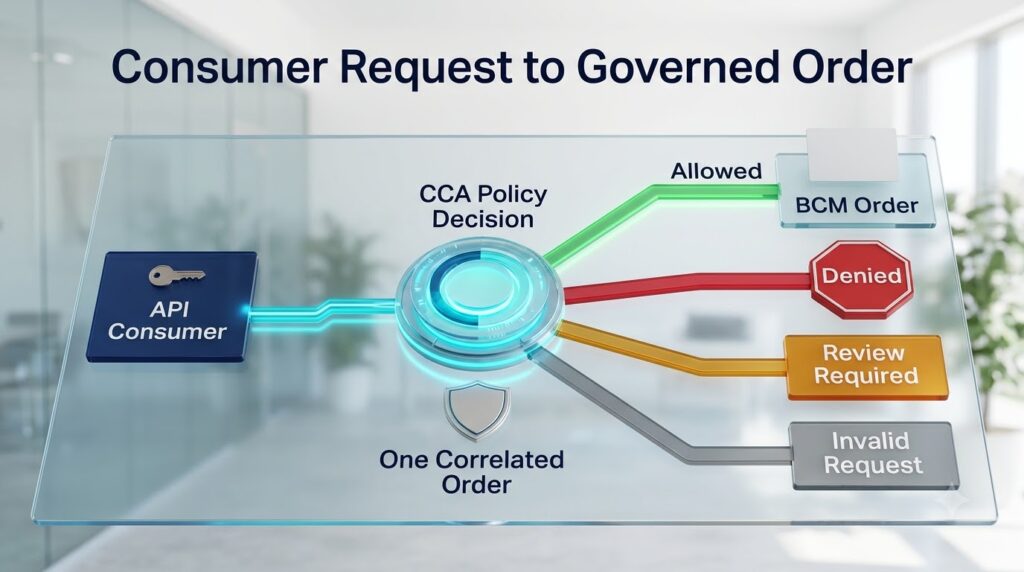
The API contract should expose only what the approved journey needs. A consumer should receive permitted programs, fields, templates and actions rather than unrestricted internal configuration. Requests should carry stable business identifiers, correlation keys and enough context for CCA to make an explainable decision. Responses should distinguish allowed, denied, review-required and invalid outcomes.
Define validation and error behavior as part of governance. Missing authoritative data should not default to an order. Unknown values should not be accepted because they fit a string field. Consumers need clear error categories, safe retry guidance and an identifier that support teams can trace across CCA, BCM and provider events without exposing unnecessary personal information.
Protect BCM Ordering Integrity
After CCA authorizes the action, BCM should receive a complete ordering specification: business key, subject, program, approved fields, template, quantity, approval state, provider route, policy version and correlation identifier. The onboarded consumer should not create an alternative direct path to production or reinterpret the authorized specification.
Test one-order behavior before activation. Retries, duplicate events, concurrent requests and delayed acknowledgements must not create duplicate business card orders. Denied or review-required decisions must not become executable BCM transactions. Amendments, cancellations and reprints should preserve their relationship to the original decision and managed order.
Build an Onboarding Test Package
| Test family | Purpose | Representative scenario |
|---|---|---|
| Identity | Verify the correct workload and environment | Wrong credential or tenant is denied |
| Authorization | Prove least-privilege data and actions | Out-of-scope record and operation are blocked |
| Contract | Validate schema, values, errors and compatibility | Missing field and unknown value are handled safely |
| CCA policy | Verify allow, deny, review and exception decisions | Eligible, inactive and conflicting source records |
| BCM workflow | Verify controlled order states and approvals | Hold, approve, submit, cancel and reprint |
| Reliability | Challenge timeout, retry, replay and concurrency | One correlated order after repeated delivery |
| Operations | Prove monitoring, alerting and reconciliation | Failed provider event reaches the named queue |
Use Production Like Data Without Exposing People
Nonproduction tests should represent the structures and edge cases that matter without copying unnecessary personal data. Create synthetic subjects that exercise entities, regions, languages, roles, approvals, quantities and exceptions. Use privacy-safe card templates and controlled fulfillment destinations. Redact sensitive values from logs while retaining correlation and decision evidence.
If a limited production pilot is necessary, define the population, duration, approvers, permitted products and stop conditions. Ensure that every test order is identifiable and reconciled. The pilot should demonstrate real operating behavior without turning a temporary exception into an ungoverned permanent connection.
Make Activation a Formal Gate
| Activation gate | Approval question | Required evidence |
|---|---|---|
| Purpose | Is the business journey and owner approved? | Consumer registration and scope |
| Data | Are source authority and minimization complete? | Field map and privacy review |
| Security | Are identity, scope, storage and revocation approved? | Access tests and credential record |
| Governance | Do CCA policies produce expected decisions? | Policy scenarios and accountable signoff |
| Ordering | Does BCM preserve one authorized managed transaction? | State, approval and idempotency tests |
| Operations | Can BOC detect, route and reconcile exceptions? | Dashboards, alerts and runbook |
| Support | Are service levels, escalation and change ownership ready? | Operational acceptance and contacts |
Activate Gradually and Observe the Full Chain
Choose a controlled activation pattern based on risk. A canary population, one entity, one program or a limited request type can provide useful evidence before wider access is granted. Record the activation time, consumer version, CCA policy version, credential, scope and approving authority. Maintain a stop condition and a safe way to hold new BCM execution.
Observe more than API availability. Monitor authentication, authorization, validation, CCA decisions, BCM order creation, approval timing, provider acceptance, production status and reconciliation. Compare the activated population with expected behavior. Investigate unusual changes in eligibility, template selection, duplicate rate, approval volume and fulfillment exceptions before expanding scope.
Establish Operational Ownership Before Handoff
An integration is not ready when only the project team knows how it works. The onboarding package should identify business, source-system, CCA, BCM, security, integration, provider and support owners. It should document alerts, severity, first response, escalation, replay authority, manual holds, recovery procedures and evidence retention.
BOC can make cross-system status and exceptions visible after activation. Each alert should have an actionable owner and enough correlation to locate the source event, CCA decision, BCM order and provider response. Operational acceptance should confirm that the team can diagnose a controlled failure, not simply view a green dashboard.
Review, Renew and Offboard Consumers
Consumer authorization should not be permanent by default. Review the business purpose, owner, data scope, permissions, traffic, exception pattern and support readiness at a defined interval or after material change. Reduce unused scopes and remove dormant credentials. A system replacement, organizational transfer, contract change or discontinued journey should trigger reassessment.
Offboarding must block new access, revoke identities and secrets, remove routing and schedules, preserve historical evidence and reconcile in-flight orders. Update the service catalog, architecture records and support documentation. An inactive integration with a valid credential remains an enterprise risk.
Implement Consumer Onboarding in Practical Stages
- Register the consumer, business journey, accountable owners and measurable outcome.
- Define environments, populations, data boundaries, actions, volume and service levels.
- Map every field and event to an authoritative source and conflict rule.
- Create a dedicated workload identity with least-privilege scopes and lifecycle ownership.
- Connect consumer inputs to explicit CCA decisions and policy versions.
- Define the authorized BCM handoff, state behavior and duplicate prevention controls.
- Execute security, contract, policy, workflow, reliability and operational tests.
- Approve activation gates and launch through a bounded population or program.
- Monitor the full source-to-CCA-to-BCM-to-fulfillment evidence chain in BOC.
- Schedule access review, change governance and eventual consumer offboarding.
Measure Onboarding Quality
| Measure | What it proves | Target direction |
|---|---|---|
| Registration completeness | Purpose, owner, scope and lifecycle are known | Complete before design approval |
| Authority coverage | Required fields have approved provenance and conflict rules | Complete before testing |
| Scope exceptions | Consumer attempts unauthorized data or actions | Approach zero |
| Policy coverage | Material CCA decisions have positive and negative tests | Complete before activation |
| Duplicate order rate | BCM idempotency protects the business transaction | Approach zero |
| Exception ownership | Operational failures reach an accountable queue | Complete for critical journeys |
| Dormant access | Unused consumers or credentials retain authorization | Decrease to zero |
Frequently Asked Questions
What is business card API consumer onboarding governance?
It is the controlled process for registering, authorizing, testing, activating, operating and eventually offboarding a system that connects to CCA.
Why is CCA central to onboarding?
CCA is the governance and orchestration layer that determines how approved enterprise facts may influence business card identity and ordering.
What is BCM?
BCM is the business card ordering management system or software that manages permissions, approvals, templates, quantities, orders and reporting.
Which systems can be onboarded?
Approved HCM, IAM, directory, CRM, ERP, procurement, service portal, workflow and provider systems can connect for defined journeys.
Why should each consumer have its own identity?
A dedicated workload identity makes ownership, scope, monitoring, rotation and revocation specific and auditable.
Can a portal order directly from a printer?
A governed design keeps CCA policy and BCM order management in the path instead of creating an uncontrolled execution route.
What should be tested before activation?
Test identity, authorization, contract behavior, CCA policy, BCM workflow, retries, duplicates, exceptions and reconciliation.
How should personal data be protected in testing?
Use synthetic or minimized data, privacy-safe templates, redacted logs and controlled test fulfillment.
When should access be reviewed?
Review it periodically and after changes to purpose, owner, source, scope, interface, policy, provider or contract.
How is a consumer offboarded?
Block new access, revoke identities, remove routes and schedules, reconcile in-flight orders and preserve historical evidence.
The Strategic Outcome
Consumer onboarding governance gives enterprises a repeatable way to expand business card API integrations without expanding uncontrolled access. Source systems remain authoritative for their data, CCA remains authoritative for business identity and ordering decisions, and BCM manages only complete, authorized transactions. BOC makes ongoing operation and exception ownership visible.
The result is faster integration delivery with clearer boundaries, stronger security and less operational ambiguity. New systems can be added through a standard that protects brand, identity, spending and fulfillment while creating evidence for every production action.
Select the next enterprise system that needs to connect to business card operations. Register its purpose, owners, data, scope and lifecycle; map inputs to CCA decisions; define the BCM handoff; design the test package; and approve production activation only after BOC monitoring and support ownership are ready.