

Business Card Integration Requirements Traceability
Linking enterprise requirements to CCA decisions, BCM behavior, tests and evidence
Traceability Turns Discovery into Controlled Delivery
An integration discovery can establish the right journey, systems, fields and owners, but implementation still fails when those decisions become disconnected from configuration, code, testing and production evidence. A workshop may agree a requirement, a developer may interpret it differently, testers may cover only the happy path, and then nobody can prove it after launch.
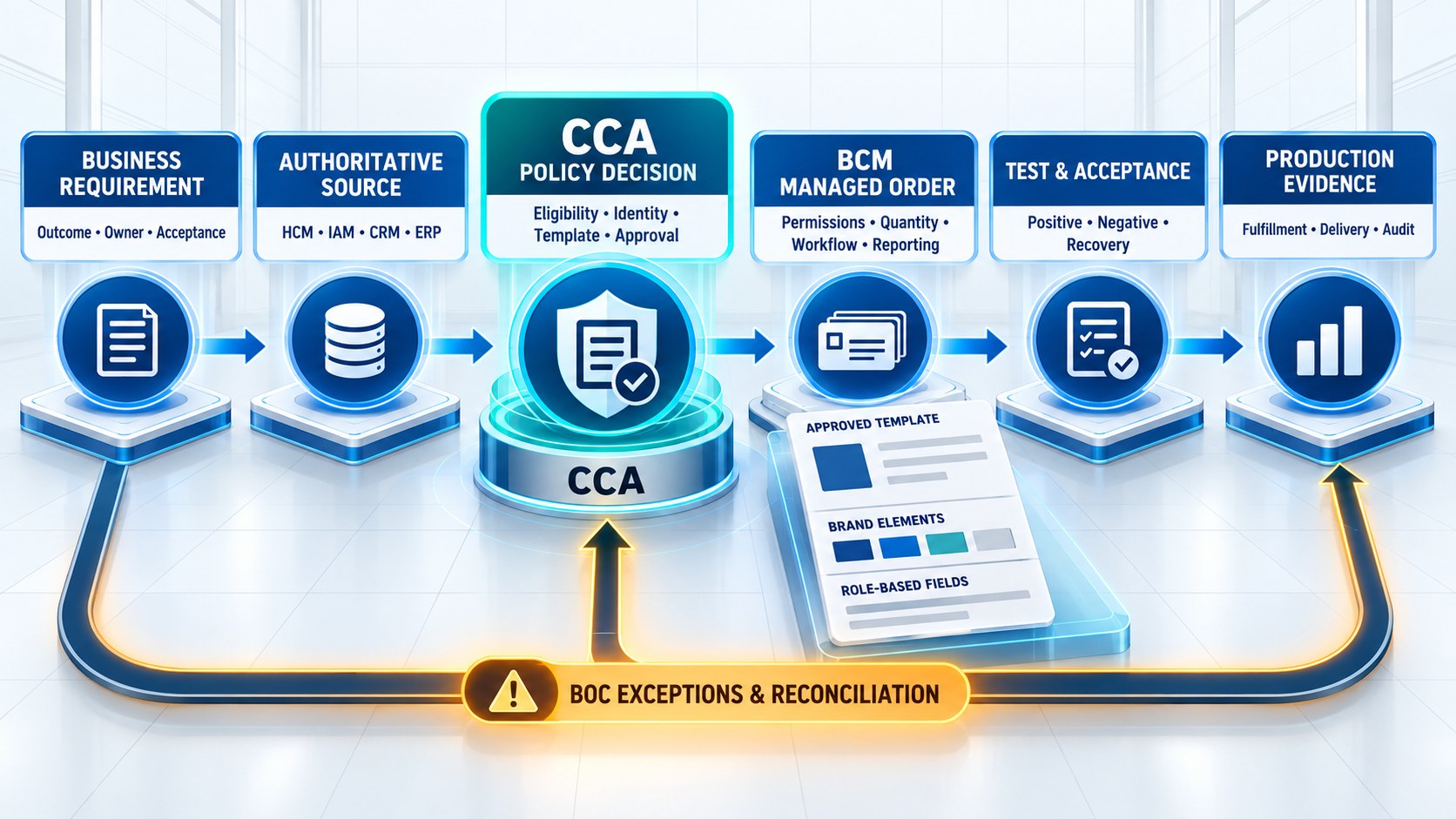
Requirements traceability therefore prevents that drift. In practice, it gives every material business need a durable identifier and connects it to an authoritative source, a CCA policy decision, a BCM ordering behavior, one or more test cases, an acceptance result and the evidence used to monitor the live service. However, the result is not more paperwork. Instead, it is a controlled chain from intent to outcome.
Keep the Purpose of CCA at the Center
Color Card Administrator is the enterprise orchestration and governance layer for API-integrated business card programs. In practice, CCA receives approved facts and events from connected enterprise systems, applies centralized eligibility, identity, template, permission, approval, quantity and routing rules, and releases only authorized work for execution. Traceability must therefore show how every external signal becomes a governed CCA decision rather than allowing a source application to order cards directly.
BCM is the business card ordering management system or software. In addition, it manages the controlled ordering transaction, including permissions, approvals, templates, quantities, orders and reporting. Meanwhile, Business Ops Center, or BOC, supports operational visibility, exception handling and reconciliation. Together, these boundaries make it possible to prove who supplied a fact, which rule authorized the action, how BCM managed the order and what the provider ultimately produced or delivered.
Why Integration Requirements Get Lost
| Failure pattern | What happens | Control response |
|---|---|---|
| Ambiguous language | Terms such as active employee or approved card have different meanings | Define the condition and source, as well as timing and expected decision |
| Disconnected artifacts | Requirements, mappings, rules and tests use different names | Use one identifier across every delivery artifact |
| Happy-path testing | Eligible requests pass while denial and exception paths remain unknown | Require positive and negative tests, as well as boundary and recovery tests |
| Late policy change | A rule changes without impact analysis across interfaces and orders | Trace dependencies before approving the change |
| Weak production proof | Teams treat an API success response as a delivered outcome | Correlate source and decision, as well as order and fulfillment evidence |
Define the End to End Traceability Chain
First, a useful trace begins with a business statement that can be accepted or rejected. For example, an active employee in an eligible sales role may request the current regional template, up to a governed quantity, after manager approval. The trace then identifies the system that proves status and role, the CCA rules that evaluate eligibility and template choice, the BCM state transitions that manage approval and ordering, the tests that challenge each condition and the production records that demonstrate the result.
| Trace element | Question answered | Typical evidence |
|---|---|---|
| Business requirement | What outcome or control does the business require? | Approved requirement as well as owner |
| Authoritative source | Which system and field establish the fact? | Field map and event schema, as well as source owner |
| CCA decision | Which policy permits, denies or routes the action? | Rule identifier and version, as well as decision log |
| BCM behavior | How does BCM manage the approved order? | State model and approval, as well as order record |
| Test case | How do teams verify expected behavior? | Input and precondition, as well as expected result |
| Acceptance result | Who approved the observed result? | Test run and defect status, as well as signoff |
| Production evidence | What proves continuing conformance? | Correlated events and reports, as well as reconciliation |
Create Stable Requirement Identifiers
First, assign a unique identifier before design begins and preserve it when wording changes. For example, a simple pattern can distinguish identity, eligibility, brand, approval, finance, fulfillment and audit requirements. The identifier should also appear in process maps, interface mappings, CCA policy configuration, BCM workflow definitions, test cases, defect records, release notes and operational dashboards.
However, the identifier is not a substitute for clear writing. Instead, each requirement should name the subject, trigger, condition, action, exception and evidence. Therefore, avoid statements such as the system should support approvals. Instead, state which transactions require approval, who may approve them, what happens on expiry or rejection and which record proves the decision.
Cover Every Requirement Class
| Requirement class | CCA or integration decision | Evidence needed |
|---|---|---|
| Identity | Approved fields and ownership, as well as transformations and override rules | Source values as well as authorized presentation |
| Eligibility | Population and role, as well as entity and lifecycle conditions | Allow, deny or review decision |
| Access | Requester and delegate, as well as approver and administrator permissions | Authenticated actor and authorized scope |
| Brand and template | Permitted template family and language, as well as region and version | Selected approved template |
| Approval | Route and escalation, as well as expiry and separation of duties | Complete approval history |
| Quantity | Default and maximum, as well as exception thresholds | Requested and authorized quantity |
| Finance | Cost center and entity, as well as purchase controls and reconciliation | Validated accounting assignment |
| Provider route | Product and location, as well as service level and supplier selection | Authorized execution path |
| Lifecycle | Order and proof, as well as production, shipment and delivery states | Normalized and correlated status |
| Audit | Retention and reporting, as well as exceptions and control ownership | Searchable evidence chain |
Translate Business Language into Acceptance Criteria
Above all, acceptance criteria should make the expected decision observable. To do this, use concrete preconditions, inputs and outcomes. For example, if the requirement limits a quantity to 250, test 249, 250 and 251. Similarly, if a manager must approve a regional template, test the correct manager, an unauthorized approver, an expired request and a change after approval. Likewise, if a source can replay an event, verify that BCM creates no duplicate order.
Criteria should also state what must not happen. For example, an ineligible worker must not receive an order, an unapproved field must not enter the card specification and reports must not show a failed provider submission as completed. As a result, negative criteria protect CCA as the policy boundary and stop teams from confusing connectivity success with business success.
Trace Source Data to CCA Policy
First, for each input, document the source system, tenant, object, field, meaning, format, effective date, allowed values, refresh method and conflict rule. Then connect that input to the exact CCA decision it supports. For example, employment status may influence eligibility, legal entity may select a program, location may choose a template and cost center may determine financial routing.
The mapping should also state what CCA does when data is missing, late, stale or contradictory. In that case, safe behavior may be denial, hold, review or use of a documented fallback. As a result, traceability makes that behavior testable and prevents an integration layer from silently inventing policy.
Trace CCA Decisions to BCM Ordering Behavior
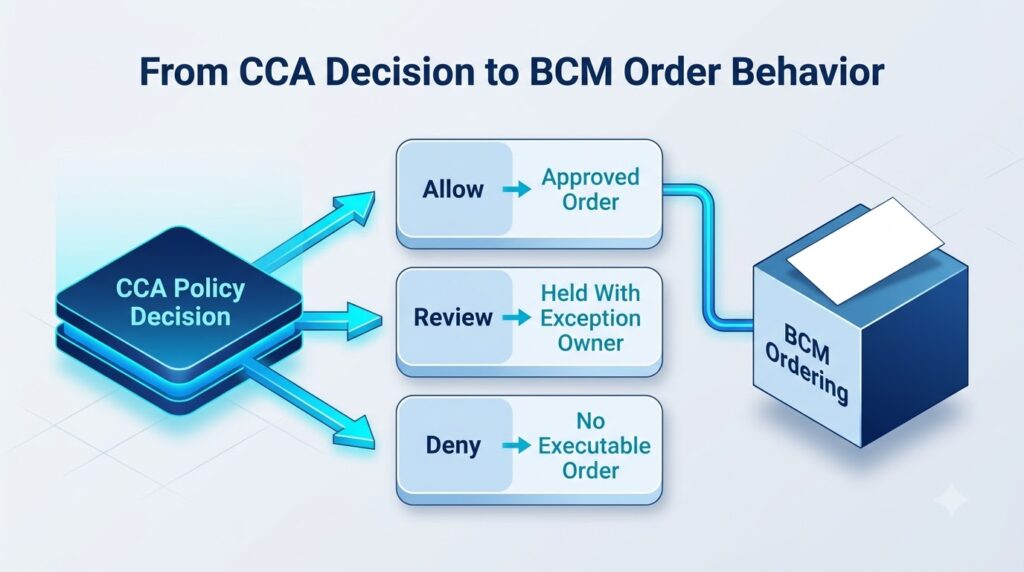
Next, CCA should hand BCM a complete authorized order specification: the subject and business key, program, approved fields, template, quantity, approval state, provider route, correlation identifier and policy version. As a result, BCM should not need to reinterpret source attributes or choose among unapproved alternatives. Instead, its role is to manage the ordering transaction according to the authorization it receives.
Then trace each CCA outcome to the permitted BCM action. For example, an allow decision may create a draft or approved order. Similarly, a review decision may create a held transaction with a named exception owner. However, a deny decision must create no executable order. Finally, cancellation, amendment and reprint requirements also need equally explicit state behavior so the audit trail remains intact.
Use a Requirements Traceability Matrix
| ID | Requirement | CCA and BCM control | Tests and evidence |
|---|---|---|---|
| ELG 014 | Only active eligible roles may order | CCA evaluates status and role; BCM accepts only an allow decision | Eligible, inactive and unknown roles, as well as decision and order correlation |
| BRD 022 | Use current regional template | Approved version selected by CCA; BCM locks order to that version | Region, retired template and version change, as well as template IDs |
| APR 031 | Manager approval above threshold | Approval routed through CCA; BCM holds until authorized | Below, at and above threshold, as well as approval history |
| ORD 044 | Duplicate events create one order | Correlation key and idempotent BCM creation | Replay and concurrent delivery, as well as a single order record |
| FUL 057 | BCM normalizes returned provider status | BCM correlates provider event; BOC exposes exception | Known, late and unknown status, as well as a reconciliation record |
Test More Than the Happy Path
| Test family | Purpose | Example |
|---|---|---|
| Positive | Prove an authorized journey completes | Eligible subject produces the expected managed order |
| Negative | Prove prohibited behavior is blocked | Inactive subject produces no executable order |
| Boundary | Challenge thresholds and dates | Quantity maximum as well as policy effective time |
| Exception | Verify controlled human review | Conflicting field enters a named queue |
| Security | Verify identity, scope and tenant isolation | Unauthorized token cannot view or create an order |
| Reliability | Verify retry, replay and recovery behavior | Repeated event produces one correlated transaction |
| Reconciliation | Verify the physical outcome matches authorization | Delivered item matches approved template and quantity |
Control Change Through Impact Analysis
In practice, requirements change as organizations add entities, revise brands, adjust approval thresholds or replace source systems. Before anyone approves a change, the traceability matrix should reveal every affected field mapping, CCA rule, BCM state, interface payload, test case, report and support procedure. As a result, that impact view reduces accidental breakage and makes regression testing proportionate to risk.
Teams should therefore effective-date policy and interface versions. In addition, store the version used for each decision and order so a later reviewer can explain historical behavior. Similarly, when the team retires a requirement, preserve its evidence and identify the replacement rather than erasing the delivery history.
Link Defects, Exceptions and Decisions
First, every defect should reference the failed requirement and test. Similarly, every production exception should reference the requirement, CCA decision, BCM order and provider event when applicable. This linkage therefore reveals whether the problem came from source data, policy configuration, authorization, ordering execution, fulfillment or monitoring. It also prevents teams from fixing a symptom in the wrong layer.
Meanwhile, BOC can support this operational chain by surfacing exceptions, status gaps and reconciliation outcomes. Governance owners can then analyze recurring exceptions against requirement classes and policy versions, which gives them evidence for controlled improvement rather than informal workarounds.
Make Traceability a Release Gate
However, teams should not accept a release only because planned test cases passed. Instead, the acceptance package should show that every in-scope requirement has an owner, mapped source, configured CCA control, defined BCM behavior, completed tests, resolved defects and an operational evidence path. Moreover, a named owner should explicitly accept any gap and set a remediation date.
The release record should also include interface versions, policy versions, environment evidence, data minimization review, credential ownership, rollback conditions, monitoring thresholds and support escalation. As a result, this gives business, security, architecture and operations one coherent basis for approval.
Implement Traceability in Practical Stages
- First, create a controlled requirement register from the approved discovery blueprint.
- Next, assign durable identifiers, accountable owners and measurable acceptance criteria.
- Then map every required field and event to its authoritative enterprise source.
- After that, connect each requirement to the applicable CCA decision, policy and version.
- Next, define the resulting BCM ordering action, state transition and prohibited behavior.
- Then design positive, negative, boundary, exception, security and recovery tests.
- Similarly, record test executions, defects, decisions and formal acceptance against requirement IDs.
- Next, verify production evidence across source events, CCA decisions, BCM orders and fulfillment.
- Then establish change-impact analysis and regression selection before approving revisions.
- Finally, review exceptions and reconciliation trends to improve controls without bypassing governance.
Measure Traceability Quality
| Measure | What it proves | Target direction |
|---|---|---|
| Requirement coverage | In-scope needs map to design and tests, as well as evidence | Complete before release |
| Test coverage | Every control has positive and negative verification | Complete for material risks |
| Orphan rate | No configuration or test lacks a business requirement | Zero unexplained orphans |
| Defect linkage | Failures identify the affected requirement and layer | Complete linkage |
| Change impact time | Teams can identify affected assets quickly | Decrease over time |
| Evidence completeness | Source and decision, as well as order and outcome, remain correlated | Complete critical journeys |
| Exception recurrence | Resolved causes do not return through ungoverned paths | Decrease over time |
Frequently Asked Questions
What is business card integration requirements traceability?
In short, it is the controlled linkage from an enterprise requirement through source data, CCA policy, BCM ordering behavior, tests, acceptance and production evidence.
Why is CCA central to the model?
Simply put, CCA is the governance and orchestration layer that converts approved enterprise facts into authorized business card decisions before execution.
What is BCM?
Simply put, BCM is the business card ordering management system or software that manages permissions, approvals, templates, quantities, orders and reporting.
Is a spreadsheet enough?
A matrix can be the register, but its identifiers must also appear in configuration, tests, defects, releases and operational evidence.
Should every requirement have a test?
In short, every material requirement needs observable verification. In fact, some requirements require several positive, negative, boundary and recovery tests.
How does traceability reduce API risk?
Above all, it exposes missing authority, ambiguous behavior, untested exceptions and downstream evidence gaps before they become production failures.
How should changes be handled?
First, trace the affected sources, policies, BCM states, payloads, tests and reports before approval, then preserve the effective version.
What proves end to end success?
Ultimately, a correlated chain showing the source fact, CCA decision, BCM order and fulfillment outcome matched the approved requirement.
Who owns the traceability matrix?
In general, a named delivery or governance owner maintains it, while business, data, CCA, BCM, security and operations owners approve their areas.
When is the release ready?
When all in-scope requirements have accepted controls, tests and evidence paths, and any residual gaps have explicit accountable approval.
The Strategic Outcome
In short, requirements traceability gives the enterprise a defensible connection between what the business approved and what the integrated business card service actually does. It also preserves CCA as the centralized governance layer, keeps source systems authoritative for their data domains and ensures BCM executes only complete, authorized ordering instructions.
As a result, the organization gains faster impact analysis, safer releases, clearer acceptance and stronger audit evidence. Most importantly, teams can improve the service without losing control as integrations, policies, suppliers and business structures change.
To begin, select one high-value business card API journey and build its traceability chain from requirement to production evidence. Then confirm the source fields, CCA decisions, BCM states, test coverage, exception ownership and acceptance record. Finally, use the completed chain as the standard for every subsequent integration release.