

The Unified Business Card API Control Plane
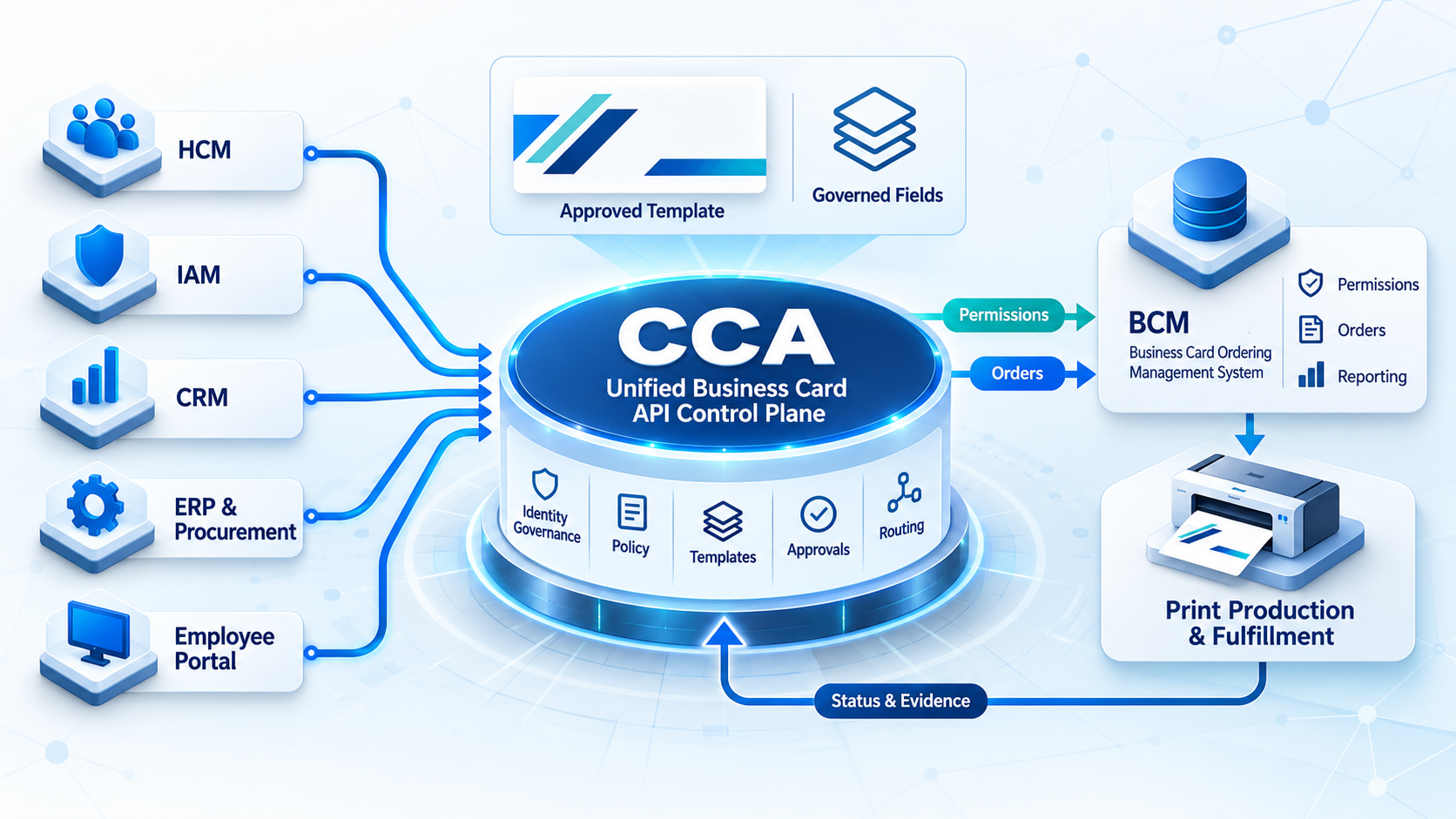
How does CCA connect enterprise systems to governed ordering and fulfillment?
The Purpose of CCA in a Connected Enterprise
Color Card Administrator (CCA) exists to centralize the administration, governance and orchestration of enterprise business card programs. It gives an organization one controlled layer for translating approved business identity into the correct card program, template, fields, quantity, approval path, provider route and auditable outcome. CCA is not intended to replace systems such as HCM, IAM, CRM or ERP. Its purpose is to make their approved data actionable within a governed business card process.
Business card API integrations extend that purpose across the enterprise. They allow workforce events, access context, sales assignments, cost controls and employee requests to move into CCA without recreating card rules in every source application. CCA validates the incoming context, determines what is allowed and sends a controlled transaction to the appropriate ordering and fulfillment services. Returned status and evidence complete the lifecycle.
Why Point-to-Point Integrations Weaken Control
A business card workflow may appear simple until every system creates its own direct connection. An employee portal might choose a template. A CRM connector might rewrite a title. A procurement workflow might bypass eligibility. A print provider might receive an order without the approval evidence that justified it. Over time, rules become duplicated, inconsistent and difficult to audit.
Point-to-point connections also bind source-system changes to downstream production logic. A new HCM field, CRM territory model, legal entity or print provider can require changes across several interfaces. CCA provides a stable control boundary: source systems supply facts, CCA interprets those facts through business-card policy, and downstream systems execute only an authorized instruction.
CCA as the Unified API Control Plane
A control plane does not mean that CCA owns every record or performs every operational task. It means that CCA coordinates how trusted data becomes an approved business card action. It standardizes validation, field authority, eligibility, template selection, approval routing, ordering rules, provider routing, event correlation, and evidence. That unified decision layer lets enterprises add integrations without fragmenting governance.
The model is intentionally modular. HCM can remain authoritative for employment and organizational facts. IAM can remain authoritative for authentication and access. CRM can provide governed customer-facing context. ERP and procurement integration can own financial controls. Employee portals can remain the user-facing entry point. CCA connects those systems to a controlled card lifecycle.
Define Responsibilities Across the Ecosystem
| System or layer | Primary responsibility | What CCA governs |
|---|---|---|
| HCM | Employment, organization, role and lifecycle facts | Which signals may influence eligibility and card fields |
| IAM or directory | Authentication, account state and approved access claims | Who can request, approve or administer |
| CRM | Territory, team and customer-facing context | Whether approved sales context may affect identity or routing |
| ERP and procurement | Cost center, entity, budget, purchase order and invoice controls | How financial context constrains the request |
| Employee portal | Request experience inside the enterprise front door | Which CCA-approved choices the user may see |
| CCA | Orchestration, policy, field authority, templates, approvals and routing | The complete governed decision and evidence |
| BCM | Business card ordering management system/software | Execution of permissions, approvals, templates, quantities, orders and reporting |
| Print and fulfillment | Proof, production, shipment and delivery | Release conditions, provider route and returned status |
BCM Turns the CCA Decision into a Managed Order
BCM is the business card ordering management system or software in the CCA ecosystem. Once CCA has established the authorized identity context and route, BCM manages the ordering workflow: user and administrator permissions, approval status, template use, quantity rules, order creation, progress and reporting. This separation keeps CCA focused on centralized orchestration and governance while BCM provides disciplined transaction management.
The distinction matters for integrations. An API consumer should not infer that a valid identity record automatically authorizes production. CCA must first apply the enterprise decision model, and BCM must preserve the managed order state. Print and fulfillment services then execute the approved physical outcome and return evidence for reconciliation.
A Common Contract for Business Card APIs
| API capability | Input | Governed output |
|---|---|---|
| Identity intake | Approved workforce, directory or CRM attributes | Normalized identity context with provenance |
| Eligibility decision | Role, entity, location and program rules | Allowed, denied or review-required decision |
| Field governance | Candidate values from multiple sources | Authorized value, transformation and ownership evidence |
| Template selection | Brand, entity, language and location context | Permitted template and version |
| Approval routing | Risk, quantity, exception and organizational context | Required approvers and decision status |
| Order submission | Authorized CCA decision and business key | One managed BCM order |
| Lifecycle status | BCM, production, shipment and delivery events | Normalized state and accountable exception |
| Reconciliation | Source, decision, order and fulfillment records | Matched outcome with audit evidence |
Keep Authoritative Systems Authoritative
The best integration does not create a second master record inside the business card ordering process. Instead, each field has a documented authority and fallback. Legal name may come from HCM, sign-in identity from IAM, sales territory from CRM, cost center from ERP, and delivery location from an approved directory. CCA records the source, version, and transformation used in its decision.
User-entered changes should be constrained by policy. A person may select among permitted office formats or delivery options without rewriting authoritative employment data. When systems disagree, CCA should hold, resolve or route the exception according to field ownership—not silently accept the last value received.
Business Card API Use Cases
| Enterprise event | Integration signal | CCA-controlled action |
|---|---|---|
| New hire | HCM worker becomes eligible | Select program, fields, template and approval route |
| Promotion or transfer | Role, manager, entity or location changes | Reevaluate identity, eligibility and existing card state |
| Sales territory change | CRM assignment becomes effective | Apply only approved customer-facing context |
| Office move | Authoritative address changes | Select the correct location format and fulfillment route |
| Rebrand | New template version and effective date | Control migration, exceptions and old-template retirement |
| Acquisition | New entity, data mappings and provider coverage | Onboard through a governed program boundary |
| Reorder | Authorized request with current context | Revalidate quantity, identity and approval requirements |
| Offboarding | HCM or IAM status changes | Remove ordering authority and stop pending work when required |
Design Integration Boundaries That Can Evolve
Use a canonical contract between enterprise sources and CCA instead of exposing every downstream system to source-specific schemas. The contract should include a stable business identifier, event type, effective time, source provenance, legal entity, requested action, and correlation key. Optional attributes should be explicitly governed rather than accepted as free-form payload content.
Version schemas and policy independently. A source payload can remain valid while CCA changes a template rule or approval threshold. Likewise, a new integration version should not retroactively alter an existing order. Preserve the exact schema, mapping, policy, template, and route versions used for each decision.
Protect Security and Privacy
| Control | Purpose | Implementation expectation |
|---|---|---|
| Least-privilege scopes | Limit each client to required actions and programs | Separate read, request, approve and administer permissions |
| Strong authentication | Verify the calling workload | Use managed credentials, rotation and short-lived tokens where possible |
| Data minimization | Reduce personal information exposure | Transmit only fields required for the governed action |
| Field allowlists | Prevent unauthorized content injection | Reject or hold undeclared attributes |
| Idempotency | Prevent duplicate physical orders | Reuse a stable business transaction key |
| Signed events | Protect returned lifecycle evidence | Verify origin, integrity, timestamp and replay window |
| Audit evidence | Explain every decision and change | Record source, actor, versions, approvals and outcomes |
Manage Events, Retries and Exceptions
Business card APIs must assume that events can arrive late, out of order or more than once. CCA should evaluate effective dates and current authoritative state before applying a change. Idempotency prevents a repeated request from creating a second BCM order. Ordered state rules prevent an old callback from moving a delivered order back to production.
Exceptions should be first-class states rather than unstructured error messages. A missing field, conflicting authority, denied eligibility, unavailable route or uncertain production state requires a named owner, safe next action and preserved evidence. Automatic retry is appropriate only when the action cannot bypass continuous operational governance or duplicate a physical result.
Implement the Control Plane in Stages
- Define the CCA purpose, program boundaries and accountable business owners.
- Inventory HCM, IAM, CRM, ERP, portal, BCM, print and fulfillment interfaces.
- Assign authoritative ownership for every business card field and lifecycle state.
- Create the canonical request, decision, order, status and reconciliation contracts.
- Model eligibility, template, quantity, approval and provider-routing policies in CCA.
- Integrate one representative source and one controlled BCM workflow first.
- Add authentication, authorization, data minimization, idempotency and evidence controls.
- Test normal, exception, duplicate, delayed and out-of-order scenarios.
- Pilot with a bounded program, template set and fulfillment route.
- Measure decision accuracy, order integrity, exception ownership and reconciliation.
- Expand integrations while preserving the same centralized governance model.
Measure the Business Outcome
| Measure | What it reveals | Desired direction |
|---|---|---|
| Automated decision rate | Requests resolved without manual interpretation | Increase within approved policy |
| First-pass data quality | Requests accepted without correction | Increase |
| Unauthorized order prevention | Requests stopped before BCM or production | Complete control coverage |
| Duplicate order rate | Repeated requests creating extra physical output | Zero |
| Exception resolution time | Speed of accountable remediation | Decrease |
| Reconciliation completeness | Orders matched from source to delivery | Complete coverage |
| Integration change effort | Work required to add or modify a source/provider | Decrease through shared contracts |
Frequently Asked Questions
What is the purpose of CCA?
CCA centralizes the administration, governance and orchestration of enterprise business card programs, turning approved identity context into controlled ordering decisions.
What is a business card API control plane?
It is the common integration and policy layer that coordinates enterprise data, governed decisions, managed orders, fulfillment status and evidence.
Does CCA replace HCM, IAM, CRM or ERP?
No. Those systems remain authoritative for their domains; CCA uses approved signals to govern the business card lifecycle.
What is BCM?
BCM is the business card ordering management system or software that manages permissions, approvals, templates, quantities, orders, and reporting.
How do CCA and BCM work together?
CCA applies enterprise governance and produces an authorized decision; BCM executes and tracks the controlled ordering workflow.
Can an employee portal use CCA APIs?
Yes. The portal can remain the user experience while CCA governs the choices, approvals and downstream order.
Why are idempotency keys important?
They help ensure a retry or duplicate event does not create a second physical order.
How should conflicting data be handled?
CCA should follow documented field authority, effective-date and exception rules rather than accepting whichever value arrived last.
Can multiple print providers connect to the same model?
Yes. CCA can govern provider routing while shared contracts normalize order and status behavior.
What makes the architecture auditable?
Correlation identifiers, source provenance, policy and template versions, approvals, BCM order state and fulfillment evidence create an explainable chain.
The Strategic Outcome
A unified business card API control plane allows the enterprise to connect more systems without multiplying business rules. HCM, IAM, CRM, ERP and portals continue to do what they do best. CCA becomes the consistent authority for translating approved context into governed business card decisions. BCM manages the authorized ordering transaction, and production and fulfillment services execute the physical result.
The result is not merely faster integration. It is a controlled enterprise capability: accurate identity, consistent brand expression, accountable approvals, predictable ordering, adaptable provider routing and evidence from source event through delivery.
Map one complete business card journey from source event to delivered order. Identify every place where a system selects a field, template, approver, quantity or provider. Move those decisions into the CCA governance model, connect BCM as the business card ordering management system, and require correlated status evidence from every downstream service.