

API Versioning and Contract Governance For Enterprise Business Card Ordering
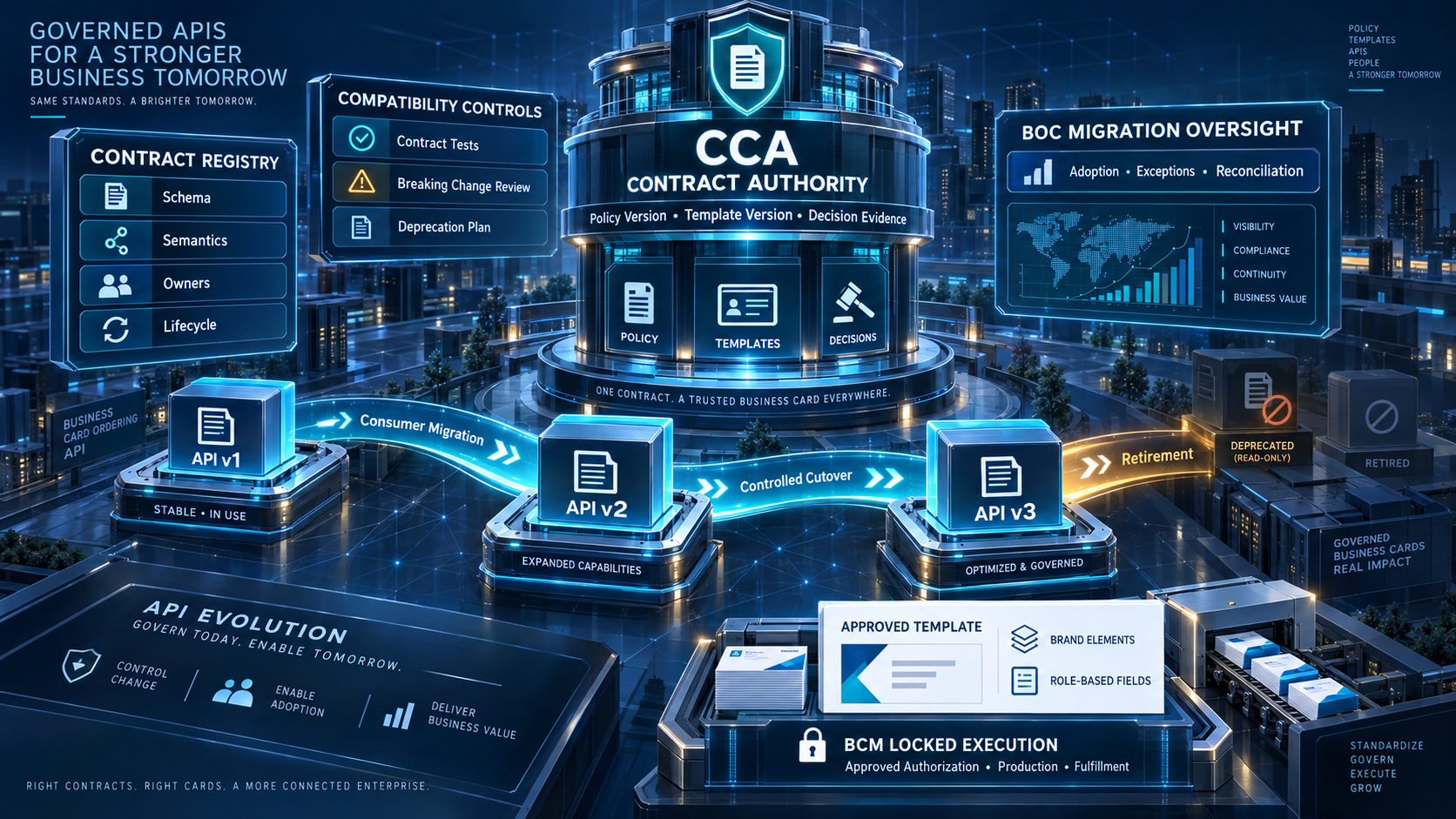
Evolving connected systems without weakening CCA authority. A governed lifecycle for schema compatibility deprecation migration and evidence.
An Available API Can Still Break Governance
Enterprise integrations rarely remain static. HCM platforms add fields, procurement systems change cost-object rules, employee portals adopt new user experiences, providers introduce status codes, and security teams replace authentication patterns. An endpoint may continue returning a successful response while a changed field meaning, default, enumeration, or validation rule produces the wrong business outcome. For a governed API business card program, that is more dangerous than a visible outage because the transaction can look technically valid while violating enterprise policy.
API versioning and contract governance give every producer and consumer a controlled way to evolve. The contract defines structure, meaning, constraints, errors, security expectations and lifecycle status. Color Card Administrator (CCA) remains the authority that interprets enterprise policy and determines eligibility, approved identity, template, approval route, quantity, destination and provider route. Business Card Manager (BCM) executes the locked authorization. Business Ops Center (BOC) monitors migration, exceptions, and reconciliation. A version change must preserve these boundaries rather than quietly transfer them to connected systems.
Version the Contract, Not Only the URL
A path such as v2 is useful, but it is not a complete versioning model. The enterprise also needs to identify the schema revision, policy context, template definition, event contract, error model, and security profile that governed the interaction. A request and its resulting order should be explainable later even after the active interface has changed.
The contract record should name the API product, version, status, owner, effective date, supported environments, compatible consumers, data classification, and retirement date. It should link to machine-readable schemas and human-readable semantics. CCA decisions should record the contract version received and the policy and template versions applied. BCM should retain the immutable execution package, while BOC keeps operational evidence across the migration window.
The Governed Contract Stack
| Contract layer | What is versioned | Authority boundary | Evidence |
|---|---|---|---|
| Transport and security | Endpoint protocol authentication, audience signature and retry expectations | Controls trusted connection but cannot grant business-card eligibility | Gateway policy credential profile and request correlation |
| Request schema | Fields types required values formats and conditional rules | Describes admissible input to CCA rather than the final order | Schema identifier validation result and rejected fields |
| CCA decision | Policy template approval limits routing and validity window | CCA alone authorizes the governed business action | Decision ID policy version authorization hash and expiry |
| BCM execution | Production payload proof order and fulfillment commands | BCM executes without reinterpreting or expanding authority | Order ID accepted authorization and state history |
| Event contract | Provider milestones exception codes timestamps and signatures | Events report outcomes and cannot rewrite the CCA decision | Event version source state transition and reconciliation result |
| Oversight model | Cases metrics retention and review classifications | BOC manages operations without replacing CCA enterprise governance platforms | Owner actions exception history closure and audit record |
Classify Changes by Semantic Risk
Teams often call a change backward compatible because existing JSON still parses. Parsing is only the first test. A new optional field may alter routing when populated. A renamed status may break a reconciliation rule. A wider quantity range may conflict with CCA policy. Contract governance therefore assesses structural, behavioral, security, privacy and business-governance impact.
| Change class | Example | Default treatment | Required control |
|---|---|---|---|
| Additive low risk | New optional diagnostic field with no decision effect | May remain within the current version | Schema validation documentation and consumer regression tests |
| Additive governed | New destination type provider option or identity attribute | Compatibility review required | CCA policy mapping privacy review and explicit consumer adoption |
| Behavioral | Changed default validation ordering retry or error meaning | Treat as potentially breaking | New version or negotiated capability with end-to-end tests |
| Structural breaking | Removed field changed type renamed enum or new required value | Create a new contract version | Migration plan dual support and verified cutover |
| Security breaking | New token audience signature algorithm or certificate rule | Controlled security migration | Credential readiness rollback plan and monitored activation |
| Authority breaking | Consumer or BCM begins deciding eligibility template or approval | Reject the design | Restore CCA as the sole business authority before release |
Prefer Explicit Compatibility Rules
Compatibility should be defined for the technologies and semantics in use. Consumers may ignore unknown response fields, but producers should not assume they ignore unknown enum values. Optional request fields need defined absence and null behavior. Dates, currencies, locale, address formats and identifiers need stable interpretations. Error codes should be machine-actionable and should not be repurposed for a different condition.
CCA-facing requests should never rely on silent defaults for governance-sensitive values. Tenant, program, employee context, requested action, and contract version should be explicit or derived through an approved deterministic rule. If a new version changes the rule, both versions need independent test evidence. BCM must reject an execution package whose contract or authorization is unsupported, stale, or altered.
Use Consumer Driven Contract Testing Carefully
Consumer-driven tests reveal the interactions real applications depend on. They are useful for employee portals, HCM connectors, procurement adapters, provider integrations and reporting services. However, a set of consumer expectations is not the definition of enterprise policy. A consumer must not freeze an unsafe behavior or require CCA to preserve an unauthorized shortcut simply because an older integration relied on it.
The provider contract, consumer expectations and CCA governance rules should be evaluated together. Tests should cover valid flows, denial paths, optional fields, unknown values, data minimization, authorization expiry, idempotency, retries, and event-based embedded business card ordering and reconciliation. A release passes only when compatibility and governance remain intact.
Build a Contract Registry with Ownership
A central contract registry gives teams one authoritative inventory of APIs, schemas, events and versions. Each entry should name the business owner, technical owner, CCA governance owner, BCM execution dependency, BOC operational owner, supported consumers, environments, lifecycle status and planned retirement. Links to code repositories alone are insufficient because enterprise reviewers also need business meaning and decision boundaries.
The registry should show which production consumers use each version and when they last called it. This turns deprecation from a broadcast exercise into an accountable migration program. Unknown or ownerless consumers become visible before a version is withdrawn. Contract documentation and example payloads must use synthetic information rather than personal card details.
Keep CCA Decisions Reproducible Across Versions
When CCA evaluates a request, it should preserve enough version context to explain the result later. Relevant evidence can include request contract version, normalized input hash, source references, policy version, template version, approval route, constraints, decision time and expiry. The goal is not to retain unnecessary personal data; it is to retain a minimized, defensible chain of authority.
A later API version may normalize input differently or introduce a new field. It must not retroactively change an existing authorization. BCM executes the locked package tied to the original CCA decision. Re-evaluation creates a new decision with its own version evidence. BOC links operational visibility exceptions to the correct decision rather than to whichever contract happens to be current.
Deprecation Is a Governed Lifecycle
- Identify the reason for change and classify structural behavioral, security privacy and CCA-authority impact.
- Approve the target contract with named owners effective dates supported environments and measurable migration criteria.
- Publish machine-readable schemas semantics examples errors security requirements and a version comparison.
- Inventory every consumer of the retiring version and assign accountable migration owners.
- Provide non-production access, test data, conformance suites, and observable migration telemetry.
- Run old and new versions in parallel where risk justifies it while keeping decisions and evidence unambiguous.
- Validate end-to-end CCA decisions BCM execution provider events BOC exceptions and reconciliation on the new version.
- Communicate deprecation milestones repeatedly and escalate consumers that have not demonstrated readiness.
- Cut over through an approved change with rollback criteria and heightened monitoring.
- Retire routes credentials schemas and documentation only after traffic has ceased and evidence is reconciled.
Design Parallel Support Without Ambiguity
Running two versions reduces cutover risk, but it also creates opportunities for duplicate requests, conflicting events and inconsistent policy interpretation. Each transaction should record its version and a stable idempotency key. Consumers should not retry a v1 failure against v2 unless the migration design explicitly supports it. Event subscribers need to know whether versions share an event stream or use separate topics and schemas.
CCA should normalize compatible inputs into governed internal concepts while retaining the source contract version. That normalization layer must not hide semantic differences. If v2 introduces a new business capability, CCA policy should enable it deliberately by tenant or program rather than making it an accidental default for every consumer.
Control Version Negotiation
Versions can be expressed in the path, media type, header or negotiated capability. The method matters less than predictability, observability and enforceability. A request should resolve to one documented contract. Automatic selection of the latest version is unsafe for governed ordering because a consumer can receive changed semantics without completing a migration review.
Unsupported versions should return a stable error with safe migration guidance. The response should not expose internal configuration or personal data. Gateways can route versions, but they should not transform governance-sensitive fields in ways that change meaning. CCA remains responsible for decision semantics after technical routing is complete.
Treat Events as First Class Contracts
Provider and lifecycle events often outlive request APIs. Production accepted, proof rejected, shipment dispatched, delivery failed and cancellation completed are business-relevant states used by BCM and BOC. Adding or renaming an event without governing its meaning can create false completion, missed exceptions or duplicate remediation.
Version event schemas, state-transition rules, signature requirements, ordering assumptions and replay behavior. Consumers should tolerate delivery duplication through idempotency rather than assuming exactly-once transport. BOC should detect unknown versions, invalid transitions, delayed events and unreconciled outcomes. An event reports what happened; it does not authorize a new card or modify the original CCA decision.
Define Release Gates for Contract Changes
| Release gate | Evidence required | Failure response |
|---|---|---|
| Contract quality | Schema linting semantic definitions examples errors and version comparison | Return to design before consumer testing |
| Compatibility | Provider tests consumer tests unknown-value tests and negative cases | Classify as breaking or correct implementation |
| CCA governance | Policy mapping authority boundary approval quantity template and routing tests | Block release until governed outcomes are correct |
| BCM execution | Immutable authorization validation proof production and fulfillment tests | Reject unsupported or altered packages |
| BOC operations | Telemetry dashboards alert ownership exception paths and reconciliation tests | Do not cut over without operational readiness |
| Security and privacy | Authentication scopes field minimization logging retention and threat review | Remediate risk or document approved exception |
| Migration readiness | Consumer inventory adoption status rollback criteria and retirement approval | Extend parallel support or pause cutover |
Observe Adoption and Semantic Drift
Version telemetry should show calls, errors, latency, CCA decisions, BCM rejects, provider events and BOC exceptions by contract version and consumer. Adoption percentages alone can hide a high-risk consumer that still uses the retiring version. Monitor actual capabilities, programs, regions and volumes as well as traffic count.
Semantic drift appears when technically valid requests produce changing decision distributions, approval paths, quantities or provider routes. Compare expected and actual outcomes during migration. Use shadow validation only with strict privacy controls and without creating duplicate orders. Differences should be investigated before the new version becomes authoritative for production execution.
Security Privacy and Audit Requirements
| Control area | Contract governance requirement | Evidence |
|---|---|---|
| Ownership | Named product technical CCA BCM BOC and consumer owners | Registry record approvals and review history |
| Integrity | Signed releases controlled schemas immutable artifacts and traceable changes | Release identifier checksum change record and deployment evidence |
| Security | Version-aware authentication scopes audiences and protected error behavior | Gateway policy tests denials and credential migration record |
| Privacy | Field purpose minimization synthetic examples and retention by version | Data dictionary privacy approval logs and deletion evidence |
| Authority | CCA decision version remains separate from transport and consumer access | Decision ID policy template constraints expiry and authorization hash |
| Lifecycle | Published support deprecation migration retirement and emergency procedures | Consumer notices adoption evidence cutover and route removal |
Measures That Show Contract Governance Is Working
Track production contracts with current owners, consumers by version, unsupported-version calls, contract-test pass rates, breaking changes detected before release, versions beyond retirement, migration completion by consumer, schema-validation failures, unknown enum values, gateway transforms, CCA decision variance, BCM rejects, event-version errors and unreconciled exceptions. Measure time from deprecation notice to verified migration and time from final traffic to safe retirement.
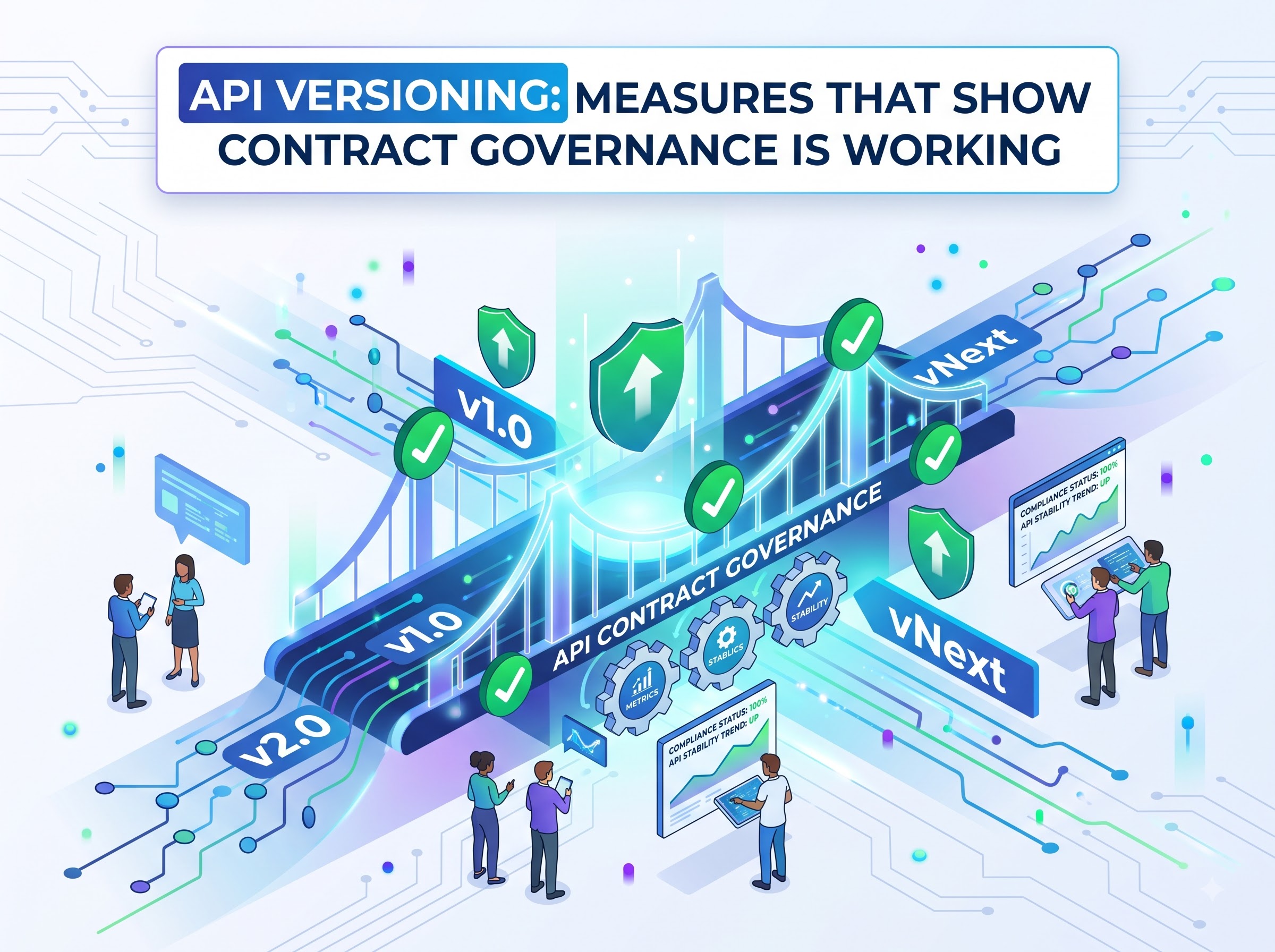
Connect technical measures to enterprise workflow governance outcomes. A faster release is not successful if it increases manual approvals, produces incorrect templates or weakens source-to-card evidence. Mature contract governance reduces emergency changes, duplicate work and long-lived compatibility debt while keeping CCA authority clear throughout evolution.
Implementation Roadmap
- Inventory request response event and error contracts across CCA BCM BOC portals source systems gateways and providers.
- Assign product technical governance security privacy operations and consumer ownership for every production contract.
- Define versioning compatibility classification documentation and emergency-change standards.
- Create a contract registry with schemas semantics lifecycle dates consumers environments and data classifications.
- Automate schema validation provider tests consumer tests negative cases and CCA authority checks in delivery pipelines.
- Record contract policy template and authorization versions through the complete order and event chain.
- Establish deprecation notices migration milestones parallel-support rules cutover approvals and rollback criteria.
- Instrument adoption errors decision distributions BCM rejects event health exceptions and reconciliation by version.
- Migrate one high-value consumer and verify end-to-end outcomes before expanding the pattern.
- Retire obsolete routes credentials transforms documentation and telemetry only after verified zero use and reconciliation.
Frequently Asked Questions
What is API contract governance?
It is the ownership, versioning, testing, release, deprecation and evidence framework that keeps API structure and meaning controlled across producers and consumers.
Does adding an optional field require a new version?
Not always. The change still needs semantic, privacy and governance review because an optional field can alter a CCA decision or downstream behavior.
Should consumers automatically use the latest version?
No. Governed ordering requires explicit migration, testing and approval so changed semantics are not introduced silently.
Can an API gateway solve versioning?
A gateway can route and enforce technical policies, but it cannot replace contract ownership, CCA decisioning, consumer testing or operational reconciliation.
How long should an old version remain available?
Use a risk-based support window tied to consumer inventory, migration evidence, business criticality and approved retirement criteria rather than an arbitrary date alone.
What makes a change breaking?
Any structural, behavioral, security, privacy or business-semantic change that can alter a supported consumer or governed outcome should be treated as potentially breaking.
How does CCA preserve authority across versions?
CCA records the input contract and applies versioned enterprise policy, templates, approvals and constraints to create a distinct locked authorization.
What role does BOC play during migration?
BOC monitors version adoption, owns operational exceptions and reconciles decisions, orders and provider outcomes before retirement.
The Strategic Outcome
API versioning and contract governance let enterprise integrations evolve without making business-card governance dependent on fragile assumptions. Every contract has a clear owner, meaning, compatibility promise, and lifecycle. Consumers migrate with evidence. CCA decisions remain reproducible, BCM execution remains locked to approved authority and BOC accounts for operational outcomes across the transition.
This reinforces the core purpose of the CCA website: centralized administration and control of enterprise business card programs. APIs extend governed ordering into other systems, but versions do not redefine eligibility, identity, brand, approval or spend rules outside CCA. Integration becomes adaptable while authority remains stable.
Choose one production business card API and trace its active versions, consumers, schemas, owners and deprecation status. Then follow one transaction from the incoming contract through the CCA decision, BCM order and provider events to BOC reconciliation. Any version without an owner, semantic definition, migration plan or end-to-end evidence should become a contract-governance priority.