

API Consumer Onboarding and Access Governance For Enterprise Business Card Ordering
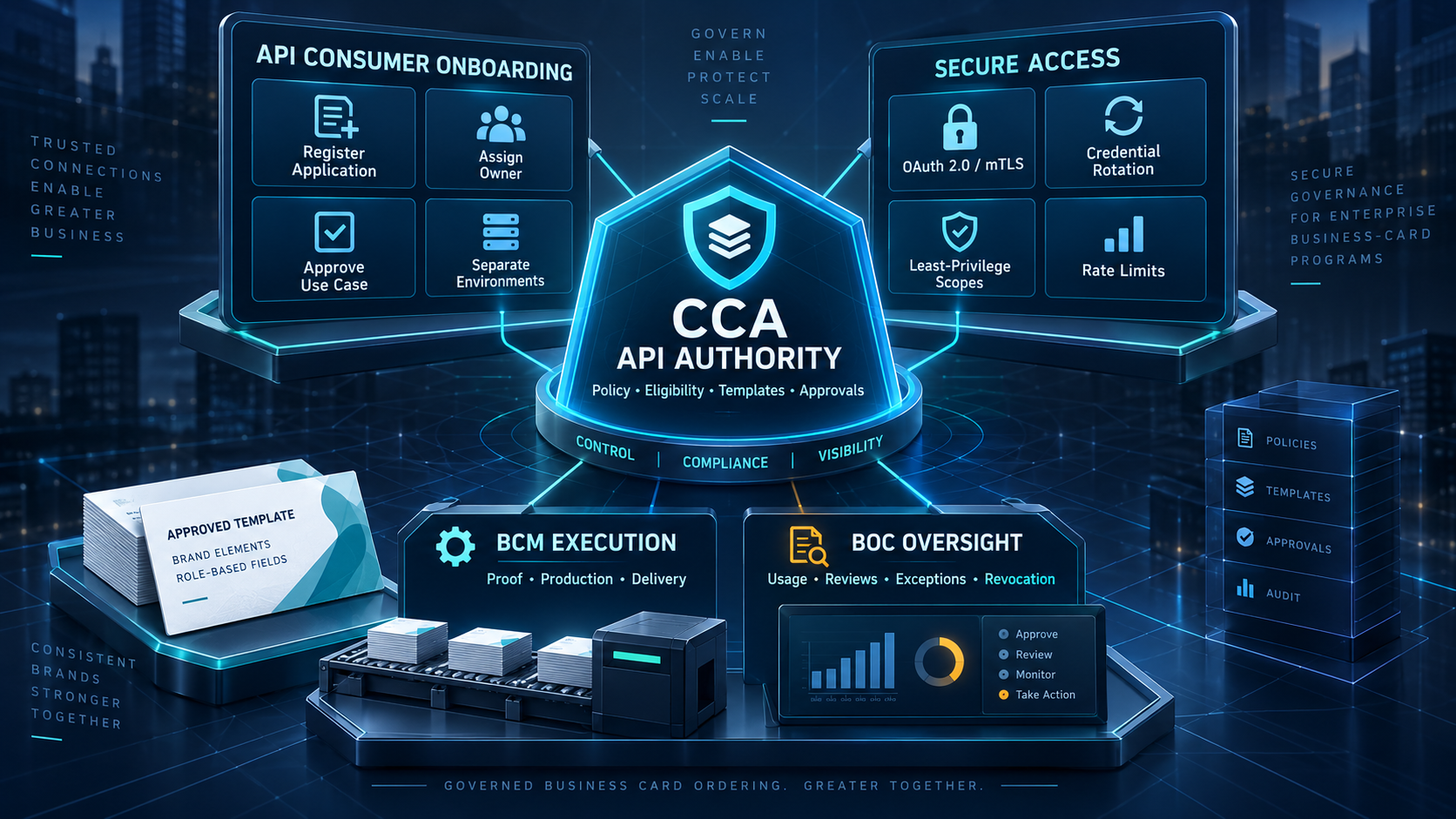
API Access Is Not Business Authority
Enterprise applications need different ways to interact with business card ordering. An employee portal may request eligibility and submit a governed order. An HCM integration may send workforce changes. An enterprise procurement governance platform may supply cost objects. A reporting service may retrieve operational status. A provider adapter may exchange production events. Giving these systems access to the same unrestricted interface creates unnecessary risk.
API access governance identifies each consumer, limits the capabilities it may invoke, protects its credentials and maintains accountable ownership. It does not decide which employee is eligible, which identity fields are approved or which card may be produced. Color Card Administrator (CCA) remains the authority for eligibility, identity, templates, approvals, quantities, destinations, provider routing and exceptions. Business Card Manager (BCM) executes the locked authorization, and Business Ops Center (BOC) monitors exceptions and reconciliation.
Separate Authentication, Authorization, and CCA Decisioning
| Control layer | Question answered | Example evidence | What it must not imply |
|---|---|---|---|
| Authentication | Which application or service is calling? | Client identity certificate token issuer and environment | That the caller may order any card |
| API authorization | Which technical capabilities may it invoke? | Approved scopes audience, method and resource constraints | That a technically valid request is eligible |
| CCA decisioning | What governed business action is permitted now? | Decision ID policy template approvals limits route and expiry | That access rules can be changed downstream |
| BCM execution | Was the valid authorization executed exactly? | Authorization hash order ID proof production and fulfillment | That BCM may alter approved values |
| BOC oversight | Were exceptions owned and outcomes reconciled? | Case owner actions state history and closure evidence | That operational closure replaces CCA authority |
Register Every Consumer as an Owned Enterprise Asset
Every consumer should have a stable identity, business purpose, technical owner, business owner, data classification, supported environments, required capabilities, expected traffic, dependencies and retirement plan. Generic API integration accounts obscure accountability and make it difficult to distinguish legitimate behavior from misuse. A service identity should represent one bounded application or workload.
The registration record should also name the card programs, regions, legal entities, and user populations that the integration intends to serve.. These attributes inform review and monitoring, but they do not replace per-request CCA evaluation. Ownership must remain current through reorganizations, vendor changes, and platform migrations. An ownerless consumer should not remain indefinitely active.
Design Scopes Around Capabilities
| Scope family | Permitted capability | Typical consumer | CCA guardrail |
|---|---|---|---|
| Reference read | Retrieve approved programs schemas templates metadata or non-sensitive status | Portal or integration configuration service | Returned content remains filtered by tenant program and policy context |
| Decision request | Ask CCA to evaluate eligibility identity and applicable controls | Employee portal HCM workflow or embedded application | Scope permits evaluation not automatic approval |
| Approval action | Submit or record a permitted approval decision | Approved workflow or manager experience | Approver identity route decision version and separation rules apply |
| Order submission | Send a current locked authorization to BCM | CCA-controlled orchestration service | Cannot construct or edit authorization fields |
| Event ingestion | Submit authenticated provider or lifecycle events | Provider adapter or enterprise event service | Events cannot rewrite the CCA decision |
| Oversight read | Retrieve exception status metrics or reconciliation evidence | BOC reporting audit or operations service | Access is minimized and role-appropriate |
Avoid Broad Administrative Scopes
A scope such as manage all cards combines unrelated powers and makes review ineffective. Capability scopes should be narrow enough to explain what a consumer can do while remaining operationally manageable. The system should separate high-impact actions such as template publication, policy change, provider routing, and exception approval from routine request and status operations.
Scopes alone may not be sufficient. Resource constraints can limit the consumer to an enterprise tenant, region, program, provider adapter or event type. Method restrictions can make reference endpoints read-only. Contextual checks can require an approved user session for employee-initiated actions. CCA still evaluates the business request after these access controls pass.
Use Different Identities for Different Environments
Development, test, staging and production should use separate service identities, credentials, audiences, endpoints and data. A credential copied from production into a test tool can expose employee information and create untracked orders. Production access should be granted only after testing, approval and operational identity governance readiness are complete.
Non-production should use synthetic or properly protected test data and provider simulators where possible. It should not silently call production CCA, BCM or supplier endpoints. Environment markers belong in tokens, logs, metrics and transaction records so evidence cannot be confused across stages. Promotion should create or activate the approved production identity rather than repurpose a development credential.
Choose Credential Methods by Workload
| Consumer type | Preferred control pattern | Lifecycle expectation | Risk to avoid |
|---|---|---|---|
| Server workload | Short-lived service token with confidential client or workload identity | Automated issuance rotation revocation and audience restriction | Long-lived shared secret in code or configuration |
| User-facing portal | User authentication plus backend service identity and delegated context | Session limits consent or enterprise authorization and service ownership | Sending reusable API credentials to the browser |
| Partner adapter | Mutual authentication or strongly managed confidential client | Contracted owner certificate rotation network and incident controls | One partner identity reused across unrelated providers |
| Batch integration | Dedicated workload identity with narrow schedule and capability | Job ownership bounded token life run monitoring and expiry | Permanent access for an abandoned scheduled process |
| Administrative automation | Privileged identity separated from ordinary transactions | Explicit approval just-in-time use logging and frequent review | Embedding governance administration inside routine ordering |
Protect Secrets and Prefer Short Lived Credentials
Credentials should be issued through approved enterprise identity infrastructure, stored in managed secret or workload-identity systems and excluded from source code, tickets, logs and examples. Short-lived tokens reduce the useful lifetime of exposure. Audience, issuer, signature, expiry and scope should be validated on every request. Token possession should never be treated as sufficient evidence of employee eligibility.
Rotation should be tested as an ordinary operational event. Where overlapping credentials are required, the window should be defined and monitored. Emergency revocation must be possible without waiting for an application release. Failed authentication, unexpected geography, unusual scope use and repeated denied calls should be observable and correlated to the consumer owner.
The Controlled Consumer Onboarding Lifecycle
- Document the business purpose user journey data needed operations performed expected volume and integration dependencies.
- Assign accountable business technical security and operations owners with support and escalation contacts.
- Classify the consumer source system data sensitivity legal entities regions card programs and provider relationships.
- Select the minimum capabilities resource constraints environments credential method and token lifetime.
- Register distinct non-production identities and provide approved schemas examples endpoints and error guidance.
- Test authentication authorization CCA decisions negative cases retries idempotency event handling and privacy controls.
- Complete security privacy architecture CCA governance BCM operations and BOC readiness reviews.
- Issue production identity and activate access through a time-bound approved change with monitoring and rollback.
- Observe real usage compare it with declared purpose and resolve unexpected scopes volumes failures or programs.
- Revalidate ownership purpose access and usage regularly and revoke the consumer when the need ends.
Test Denial Paths Before Production
A consumer is not ready because its happy path works. Tests should confirm rejection of invalid issuer, wrong audience, expired token, missing scope, prohibited method, unauthorized tenant, unsupported API version, malformed contract, stale decision, expired authorization and invalid event signature. A denied technical request must not create partial state or an executable order.
Business tests should prove that a valid token cannot bypass CCA eligibility, choose a prohibited template, exceed quantity, skip approval, change locked fields or route to an unapproved provider. BCM should reject unauthorized or altered packages. BOC should receive the right exception context without exposing credentials or unnecessary personal data.
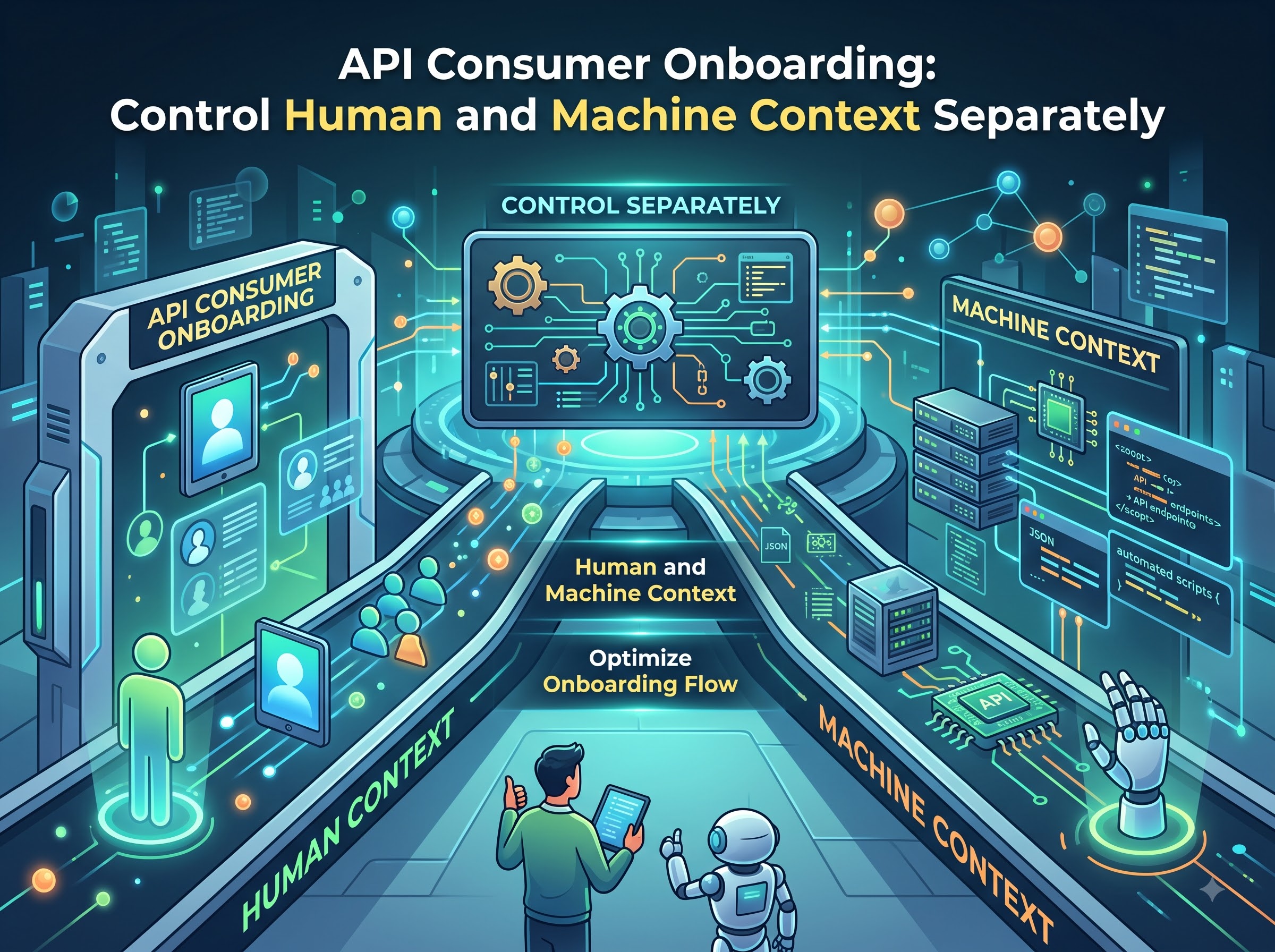
Control Human and Machine Context Separately
Many ordering journeys include both a human user and a backend service. The service identity establishes which application is trusted to call the API. The user context establishes who initiated or approved the action. These identities should remain distinct in audit records. A backend service should not impersonate arbitrary employees merely because it holds a powerful credential.
Delegated actions should include the authenticated subject, permitted relationship to the request and relevant session evidence. CCA evaluates the employee and program context. Service-to-service processes such as lifecycle events may not have a current user, but they still need an accountable workload identity, a defined purpose and bounded capabilities.
Monitor Use Against Declared Purpose
Post 106 established observability across the governed order. Consumer governance adds a question: is this application behaving as approved? Monitor calls by client, scope, capability, environment, program, region, decision outcome, error category and volume. Sudden use of an unused scope, new regions, unusual hours or repeated attempts to access prohibited programs may indicate configuration drift or compromise.
Monitoring should distinguish policy denials from authentication and authorization failures. A CCA denial can be the correct business outcome; an unexpected rise may reveal a source or consumer defect. Alerts should name the consumer and owner, affected capabilities and safe correlation references. Credentials and full card payloads must not appear in telemetry.
Review Access with Evidence
| Review question | Evidence to examine | Required outcome |
|---|---|---|
| Does the purpose still exist? | Owner confirmation service inventory recent traffic and roadmap | Retain revise suspend or retire |
| Are scopes still minimal? | Actual endpoint and scope use denied calls and feature changes | Remove unused or overly broad access |
| Is ownership current? | Business technical security and operations contacts | Assign accountable owners or suspend |
| Are credentials healthy? | Age method storage rotation failures and last successful use | Rotate migrate revoke or approve exception |
| Does behavior match declared boundaries? | Programs regions volumes environments and decision distributions | Investigate drift and correct constraints |
| Is reconciliation complete? | CCA decisions BCM orders provider outcomes and BOC exceptions | Close evidence gaps before expanding access |
Offboard Consumers Completely
Retirement is more than deleting a credential. The enterprise operational accountability should stop scheduled jobs and event subscriptions, revoke tokens and certificates, remove gateway routes and allowlists, disable secrets, archive approved configuration, resolve queued work, transfer or close exceptions and retain required audit evidence. Provider callbacks should be redirected or disabled intentionally.
BOC should reconcile in-flight decisions, BCM orders and provider events before final closure. Observability should confirm that traffic has ceased. If another consumer replaces the old one, it needs its own identity and onboarding record; reusing the retired identity obscures the migration boundary and carries unnecessary permissions forward.
Respond to Credential Exposure Without Bypassing Governance
When a credential may be exposed, revoke or disable it, identify affected scopes and time range, block suspicious traffic, preserve evidence and issue replacement access only through an approved recovery path. Investigators should trace calls to CCA decisions, BCM orders and provider events to determine whether any physical orders or data access require remediation.
A rapid replacement credential should not receive broader scopes for convenience. If ordering continuity is necessary, use a preapproved narrow service identity or hold requests until access is restored. BOC should own unresolved transactions and reconciliation. The incident closes only when access, orders, exceptions and evidence are accounted for.
Security Privacy and Audit Requirements
| Control area | Access governance requirement | Evidence |
|---|---|---|
| Registration | Unique consumer purpose owners environments and supported populations | Registration ID approvals inventory and review date |
| Authentication | Strong workload identity validated issuer audience signature and expiry | Method configuration rotation and authentication logs |
| Authorization | Least-privilege scopes resource limits and separated administration | Scope approval gateway policy use and denial evidence |
| CCA authority | Current decision required for governed ordering actions | Decision ID policy template approvals constraints and expiry |
| Privacy | Minimized data synthetic tests protected telemetry and bounded retention | Field purpose test-data source access export and deletion |
| Lifecycle | Controlled issue rotation review suspension incident response and retirement | Owner actions timestamps changes revocation and reconciliation |
Measures for Consumer Governance
Useful measures include registered consumers with current owners, production consumers by credential type, unused scopes, authentication failures, authorization denials, expired or overdue credentials, rotation success, inactive clients, access-review completion, unexpected program or region use, production traffic from non-production identities, incident revocation time and retired consumers still generating traffic.
Connect these measures to business outcomes: CCA decisions by consumer, authorization expiry, BCM rejects, duplicate orders prevented, provider-event gaps, exceptions by client and reconciliation coverage. A technically quiet credential can still be excessive, while a high-volume portal can be well governed. The question is whether access remains necessary, bounded and subordinate to CCA authority.
Implementation Roadmap
- Inventory every current API key client certificate service account token issuer gateway route consumer owner and capability.
- Define a consumer registration model with purpose ownership environments data classes populations programs and retirement conditions.
- Create capability-based scopes and resource constraints that remain separate from CCA business decisioning.
- Standardize workload user-delegated partner batch and privileged credential patterns with short-lived access where possible.
- Separate development test staging and production identities endpoints data and provider connections.
- Build a controlled onboarding workflow with contract testing security privacy CCA BCM and BOC approvals.
- Instrument client scope environment decision and order activity without logging credentials or unnecessary personal data.
- Establish rotation revocation exposure response and continuity procedures that preserve CCA authority.
- Run periodic evidence-based access reviews and remove unused scopes ownerless consumers and inactive credentials.
- Offboard consumers completely and reconcile in-flight decisions orders provider events queues and exceptions.
Frequently Asked Questions
What is API consumer onboarding?
It is the controlled process for registering, testing, approving, credentialing, monitoring and eventually retiring an application that uses enterprise APIs.
Does an API scope authorize a business card order?
No. It permits a technical capability. CCA still determines whether the specific identity, template, approval, quantity and route are allowed.
Should applications share credentials?
No. Each bounded workload should have a distinct identity so access, ownership, monitoring and revocation remain accountable.
Are long-lived API keys acceptable?
Short-lived tokens or workload identities are preferable. Any exception needs protected storage, rotation, monitoring, ownership and revocation controls.
Why separate environment identities?
It prevents test tools or data from reaching production and makes access, telemetry, incidents and evidence unambiguous.
What should be tested before production?
Authentication, scopes, negative access cases, CCA decisions, locked authorization, retries, events, privacy controls, monitoring and reconciliation.
How often should access be reviewed?
Use a risk-based recurring cadence and trigger reviews after ownership, purpose, architecture, region, provider or incident changes.
What role does BOC play?
BOC owns access-related operational exceptions, unresolved orders, incident recovery evidence and end-to-end reconciliation.
The Strategic Outcome
Controlled consumer onboarding lets enterprises embed business card ordering in many systems without creating a collection of privileged shortcuts. Each application has a known identity, narrow capabilities, protected credentials, accountable owners and an observable lifecycle. CCA continues to evaluate every governed business action, BCM executes only a valid locked authorization and BOC accounts for exceptions and outcomes.
This protects the core purpose of the CCA website as the central administrative authority for enterprise business card programs. APIs extend that authority into employee, HR, procurement, identity and partner experiences. Access governance ensures that connectivity increases reach without redistributing control.
Select the highest-volume production API consumer and compare its registered purpose with its actual scopes, endpoints, programs, regions, and traffic. Then trace one order to the CCA decision, BCM execution and provider outcome. Any unused privilege, missing owner or unlinked transaction should become an access-governance priority.