

API Service Level Governance For Enterprise Business Card Ordering
Ensuring Reliability in Business Card Ordering Systems through Effective Governance and Monitoring
The discussion begins by highlighting that simply having an API for business card ordering isn’t sufficient to guarantee a reliable process. Despite the API’s availability, issues arise when decision-making delays or ambiguous system states render ordering unusable.
Reliable Ordering Requires More Than API Uptime
An API can be technically available while enterprise business card ordering is operationally unusable. The caller may authenticate but wait too long for a policy decision, receive an approval state it cannot interpret, lose visibility after submission, or remain unable to determine whether production began. Availability alone does not prove that a governed business outcome was delivered.
Color Card Administrator (CCA) is the authority layer for eligibility, approved identity, templates, quantities, approvals, destinations, and ordering rights. Business Card Manager (BCM) is the business card ordering management system or software that receives valid CCA authorization, creates and manages the order, coordinates proof and fulfillment status, and preserves execution evidence. Business Ops Center (BOC) provides operational oversight, exception ownership and reconciliation. Service-level governance must measure this complete operating chain without confusing the responsibilities of these systems.
Define the Service Before Defining the Number
A service level should begin with the business capability being promised. Examples include evaluating eligibility, returning approved card fields, creating an approval request, accepting an authorized order into BCM, exposing order status or reconciling an uncertain outcome. Each capability needs a start event, completion event, exclusions, measurement source and owner.
| Service capability | Start event | Successful completion | Primary owner |
|---|---|---|---|
| CCA decision | Valid governed request received | Decision returned with status and correlation | CCA platform and policy owner |
| Approval visibility | Approval requirement created | Current state and permitted next action available | CCA workflow owner |
| BCM order acceptance | Valid locked authorization delivered | BCM order ID and accepted status returned | BCM ordering management software |
| Proof and production status | Order accepted by BCM | Normalized status available to authorized consumer | BCM and fulfillment integration |
| Exception recovery | Impact classified as unresolved | BOC case reconciled with evidence and closure | BOC operations |
| End-to-end outcome | Valid intent accepted for processing | Final order or governed non-order outcome known | Shared service governance |
Use SLIs, SLOs, and SLAs Deliberately
A service-level indicator is the measurement, such as the percentage of valid CCA decision requests completed within a defined time. This service-level objective is the internal target for that indicator. A service-level agreement is a contractual commitment with defined scope and consequences. The terms should not be used interchangeably.
Engineering teams need objectives that provide early warning before a contractual commitment is at risk. Enterprise identity standardization buyers need transparent definitions so they can distinguish availability, latency, completeness and recoverability. Legal commitments should be based on approved contracts; an editorial or technical document should not invent them.
Measure the Governed Transaction
| Layer | Useful indicator | Why it matters | Failure interpretation |
|---|---|---|---|
| Access | Successful authenticated requests by approved consumer | Confirms controlled entry to the service | Identity or scope failure, not policy denial |
| CCA decision | Valid evaluations completed within target latency | Measures authority responsiveness | Delay must not be treated as approval |
| Approval | State transitions visible within target interval | Prevents duplicate submissions and manual workarounds | Pending is a governed state, not outage |
| BCM acceptance | Authorized orders accepted once and assigned an order ID | Measures the ordering management software handoff | Unknown acceptance creates duplicate risk |
| Status | Accepted orders with current normalized execution state | Supports employee, support and procurement visibility | Stale status needs ownership and evidence |
| Recovery | Unknown outcomes reconciled within target time | Measures operational control under failure | Open ambiguity blocks unsafe resubmission |
Set Measurement Boundaries That Match Responsibility
The CCA decision clock should not silently include time spent waiting for an enterprise identity provider, a customer approval or a paused campaign unless the service definition says so. The BCM acceptance clock should begin only when BCM, the business card ordering management system, receives a valid locked authorization. Provider production time should be measured separately from BCM software availability.
Exclusions must be specific, observable and reviewable. A broad dependency exclusion can make a service report look healthy while users remain blocked. When a dependency is excluded from one commitment, its effect should still appear in operational identity governance reporting so the enterprise can see the complete experience.
Separate Availability from Correctness
An endpoint that returns a fast but incorrect answer is not delivering reliable governance. CCA service quality includes correct tenant isolation, current policy version, authoritative data use and valid approval state. BCM service quality includes accepting each authorization once, preserving the authorized payload and maintaining accurate order state.
Track correctness failures separately from availability. Examples include a decision made with stale source data, an authorization accepted after expiry, a duplicate BCM order, an invalid template reaching proof or a status event mapped to the wrong order. These events may be rare, but their business impact is greater than ordinary latency.
Create Service Classes Without Creating Policy Bypass
Enterprises may need distinct service classes for standard employee requests, approved acquisitions, executive onboarding, regulatory changes or global rebrands. A service class can change capacity allocation, target response time, support route and operational priority. It cannot make an ineligible person eligible or remove a required approval.
CCA should validate entitlement to the service class as part of the governed request. BCM, as the business card ordering management software, can then schedule the authorized order within the assigned execution class. BOC monitors queue age, breached objectives and exceptions. Consumers should not gain priority merely by sending more retries or labeling every request urgent.
Align Service Levels with Capacity Governance
Post 112 established tenant quotas, burst control, priority classes, bounded queues and provider backpressure. Service objectives should be designed against those controls. A latency target that assumes unlimited demand will fail during the very campaigns that matter most. Capacity forecasts should include normal peaks, approved programs, recovery traffic and downstream constraints.
| Demand condition | Service-level response | Consumer guidance | Governance protection |
|---|---|---|---|
| Normal demand | Meet standard objective and report normal status | Submit within documented limits | CCA decision and BCM execution remain separated |
| Approved campaign | Apply planned allocation and campaign objective | Release controlled waves with item identities | Capacity increase does not expand eligibility |
| Unexpected surge | Protect status and recovery traffic first | Back off with jitter and retain intent key | Fastest retry does not gain priority |
| Provider constraint | Slow BCM release or route under approved rules | Use normalized status and avoid resubmission | Provider cannot redefine business authority |
| Regional incident | Declare impact and activate recovery objective | Follow incident communication and status path | BOC tracks evidence and reconciliation |
Define Incident Severity by Business Impact
Incident severity should reflect the governed business card ordering impact, affected tenants, duration, deadlines, duplicate risk, privacy exposure, and recoverability. A complete outage is severe, but so is a condition that accepts orders without returning identifiers or exposes stale approval state. Technical utilization alone should not determine priority.
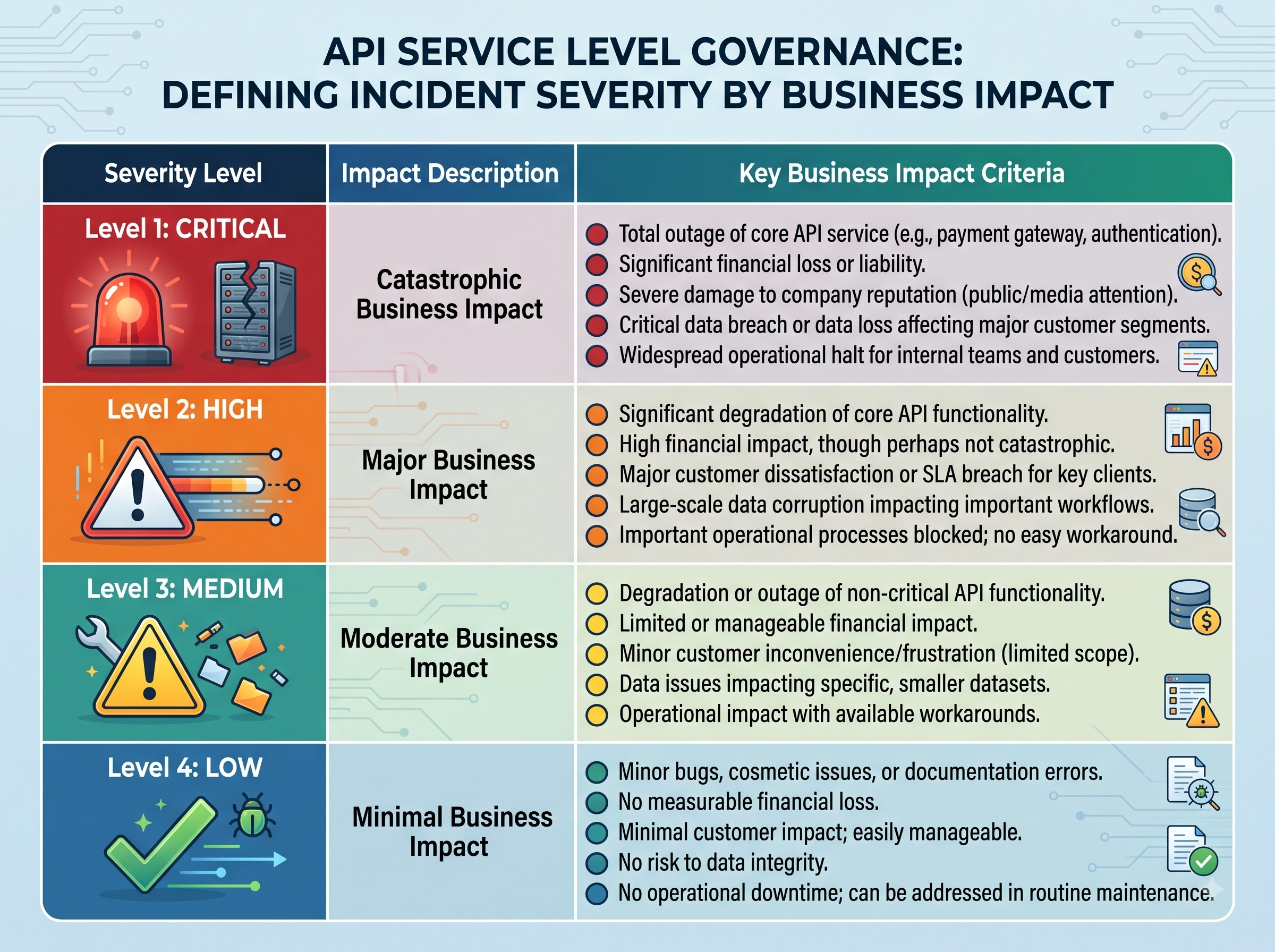
| Severity signal | Example impact | Immediate action | Owner coordination |
|---|---|---|---|
| Authority unavailable | CCA cannot evaluate valid requests for affected tenants | Protect state, stop unsafe fallback and communicate impact | CCA platform, security and program owners |
| Ordering acceptance uncertain | BCM may have accepted authorization but response is lost | Query by correlation and block duplicate submission | BCM software operations and BOC |
| Incorrect governed result | Decision, template or identity may be wrong | Contain affected scope and preserve evidence | CCA policy, data, security and BOC |
| Status degradation | Orders progress but consumers cannot see current state | Protect status capacity and publish known limitations | BCM integration and BOC |
| Provider delay | Authorized work is accepted but production is constrained | Apply backpressure and update commitments | BCM operations, provider and BOC |
Publish Maintenance and Change Expectations
Planned maintenance needs advance notice, scope, expected user impact, start and end times, rollback criteria and status communication. Maintenance should not leave approvals, authorizations or BCM orders in ambiguous states. If an authorization may expire during the window, the plan should define whether CCA reevaluates it before execution.
Contract changes and version retirement require separate notice from routine maintenance. Consumers need time to test a new API version, update mappings and confirm error behavior. Post 109 covers compatibility governance; service reporting should reveal adoption risk before a retired version becomes an incident.
Design Recovery Objectives Around State Integrity
Recovery time should not be measured only until servers respond. The system has not fully recovered the service while order acceptance remains unknown, queued authorizations are stale, or the system has not reconciled provider events. Recovery objectives should include restoration of safe decisioning, BOC business card ordering management, status visibility and exception processing.
Recovery point objectives also need business meaning. The platform should know which CCA decisions, approval transitions, BCM order records and provider events are durable. Replaying state must preserve idempotency and sequence. No recovery process should manufacture a new authorization or a second physical order.
Report Service Levels with Evidence
| Reporting element | Required context | Evidence source |
|---|---|---|
| Availability | Capability, tenant scope, valid request definition and interval | Gateway and application telemetry |
| Latency | Start and completion events, percentile and excluded wait states | Distributed traces and decision records |
| Correctness | Policy version, authorization constraints and validation result | CCA audit evidence and control tests |
| BCM execution | Order acceptance, idempotency outcome and current state | BCM ordering management records |
| Provider progress | Normalized production, shipment and delivery events | Fulfillment integration events |
| Incidents | Impact window, affected capabilities, recovery and follow-up | BOC case and incident timeline |
| Service credits | Only where defined by the governing contract | Approved contractual calculation |
Protect Privacy in Service Telemetry
Metrics should use tenant, consumer, program, operation, correlation and outcome identifiers without placing personal card data in labels or dashboards. Employee names, email addresses, phone numbers and complete card payloads create unnecessary exposure and high-cardinality telemetry. Detailed diagnostics should remain access controlled, and retention governed.
Service reports should disclose enough to support accountability without revealing another enterprise tenant, internal security rules, or provider credentials. Administrative changes to objectives, exclusions and incident classifications need role-based access and audit history.
Implementation Roadmap
- Inventory the business capabilities delivered by CCA, BCM ordering management, fulfillment integrations, and BOC.
- Define start events, success events, exclusions, measurement sources and owners for each capability.
- Separate indicators, internal objectives, and contractual agreements, and obtain the appropriate approvals.
- Measure availability, latency, correctness, status freshness, unknown outcomes, and recovery rather than uptime alone.
- Create service classes that change operational priority without changing CCA eligibility or approval policy.
- Align objectives with quotas, burst controls, bounded queues, authorization expiry and provider capacity.
- Define incident severity from business impact, duplicate risk, privacy exposure and deadline sensitivity.
- Publish maintenance, version-change and communication expectations for connected consumers.
- Test recovery of CCA decisions, approval states, BCM orders and provider events with idempotent replay.
- Review evidence with platform, security, procurement, BCM, BOC and enterprise program owners.
Frequently Asked Questions
Is API uptime enough to measure business card ordering reliability?
No. The enterprise also needs timely and correct CCA decisions, visible approval states, reliable BCM order acceptance, current status, and evidence-based recovery.
What is BCM in this operating model?
Business Card Manager (BCM) is the business card ordering management system or software. It manages authorized orders and their execution lifecycle after CCA grants valid authority.
Is BCM the print vendor?
No. BCM is the ordering management software. It can coordinate with fulfillment providers, but the enterprise should not describe it as the external print vendor.
When should the BCM acceptance clock begin?
When BCM receives a valid locked authorization from CCA, not while a request is waiting for eligibility or approval.
Can a premium service class bypass CCA policy?
No. It can change capacity, response targets, or support priority, but eligibility, approved fields, and approvals remain governed by CCA.
Should provider delays count as BCM software downtime?
Not automatically. Provider production performance and BCM software availability should be measured separately while the end-to-end impact remains visible.
What makes an incident fully recovered?
Safe CCA decisioning, BCM order management, status visibility, and exception reconciliation must be restored; server response alone is insufficient.
Can service telemetry contain personal card data?
It should not. Use governed identifiers and outcome metadata, with sensitive diagnostics protected separately.
The Strategic Outcome
Service-level governance converts reliability from a vague availability claim into an accountable enterprise operating model. CCA proves that governed decisions remain responsive and correct. Business Card Manager (BCM), the business card ordering management software, proves that valid authorizations become traceable orders without duplication. BOC proves that delayed or uncertain outcomes receive ownership, evidence and closure.
This reinforces the core purpose of the CCA website as the centralized governance and administrative authority for enterprise business card programs. API integrations extend that authority into enterprise applications, while explicit service boundaries ensure that CCA decisioning, BCM order management, provider fulfillment and BOC oversight remain measurable without being confused.
Choose one high-volume business card journey and define its start event, governed completion, target, exclusions, and evidence at every boundary. Confirm that the document names BCM correctly as the business card ordering management system, separates provider fulfillment from software availability, and prevents any degraded-state workaround from bypassing CCA.