

Centralized Control vs Decentralized Chaos in Business Card Management
Introduction
Enterprise organizations do not fail at business card management due to complexity alone.
They fail due to a lack of centralized control.
At scale, decentralized systems introduce fragmentation across workflows, vendors, approvals, and brand execution. What begins as flexibility quickly becomes operational chaos.
Centralized control is not about restriction.
It is about enforcing structure across identity execution.
Decentralized Business Card Management: Where It Breaks

In decentralized environments, business card ordering happens across multiple channels:
– Employees request cards independently
– Departments manage their own vendors
– Templates are shared informally
– Approvals are inconsistent or bypassed
This creates:
– Brand inconsistency
– Vendor sprawl
– Lack of procurement control
– No audit visibility
– Operational inefficiencies
Decentralization scales problems, not systems.
What Centralized Control Actually Means
Centralized control does not eliminate flexibility.
It introduces structured governance.
At an enterprise level, centralized business card management includes:
- Unified Ordering System
All requests originate from a controlled platform.
- Role-Based Access
Users interact with predefined templates based on role.
- Standardized Workflows
Approvals follow consistent, automated paths.
- Vendor Governance
Only approved vendors are used across the organization.
- Audit and Reporting
Every action is tracked and visible.
Centralization aligns execution with governance.
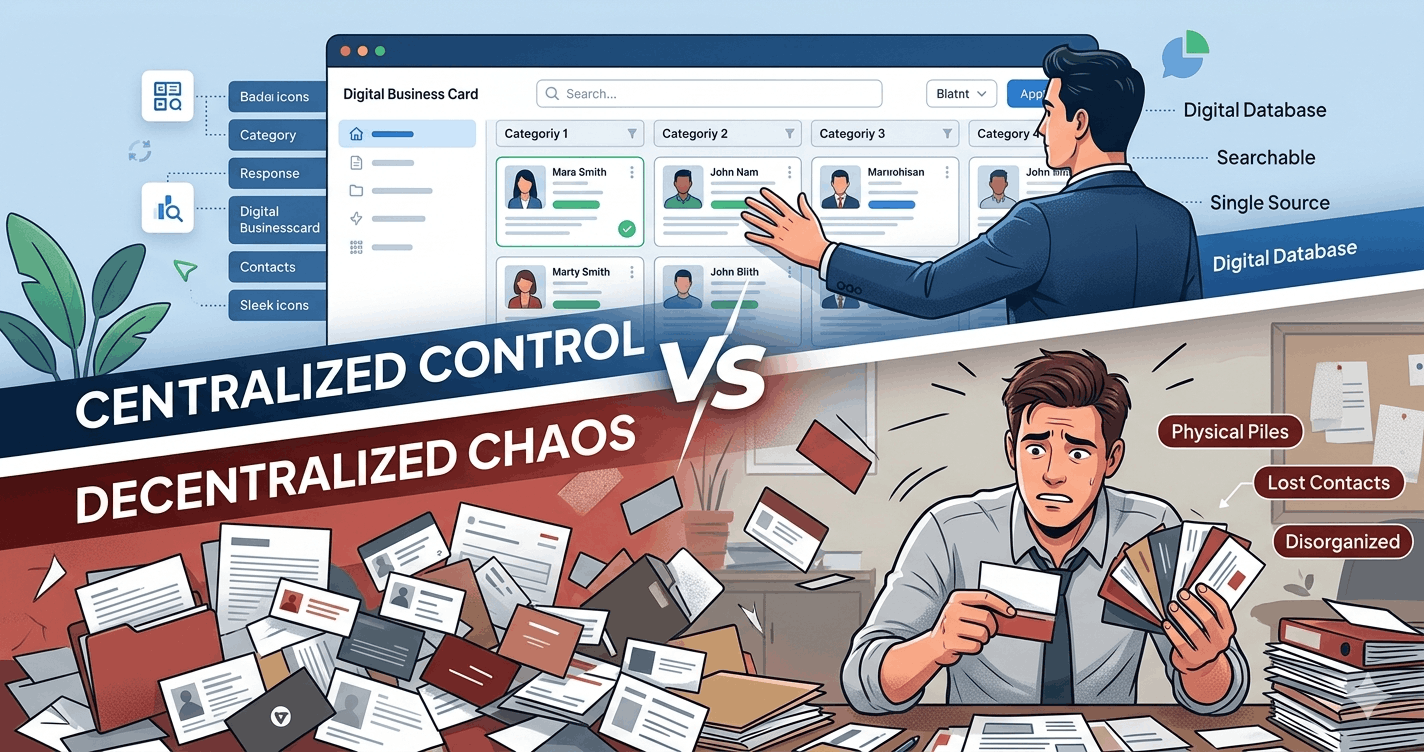
Operational Impact: Chaos vs Control
Decentralized Model:
– Fragmented workflows
– Inconsistent branding
– No procurement oversight
– High operational friction
Centralized Model:
– Unified workflows
– Consistent identity execution
– Controlled vendor ecosystem
– Full visibility and reporting
The difference is structural, not incremental.
Centralization as Infrastructure
Business card management is not an isolated function.
It connects to:
– HR systems (employee data)
– Procurement systems (vendor control)
– Compliance systems (audit and reporting)
Centralization transforms business card management into part of the enterprise infrastructure.
The Role of Governance Platforms
Governance platforms enable centralized control by:
– Integrating with enterprise systems
– Automating workflows
– Enforcing policy rules
– Managing templates centrally
– Providing real-time visibility
This shifts business card execution from manual coordination to system-driven governance.
Strategic Takeaway
Decentralization introduces variability.
Centralization enforces consistency.
Enterprise organizations that adopt centralized control systems gain:
– Operational efficiency
– Compliance assurance
– Brand consistency
– Scalable identity execution
Centralized business card management is not an optimization.
It is a requirement for enterprise governance.