

Role-Based Business Card Eligibility: From HCM Data To CCA Governance
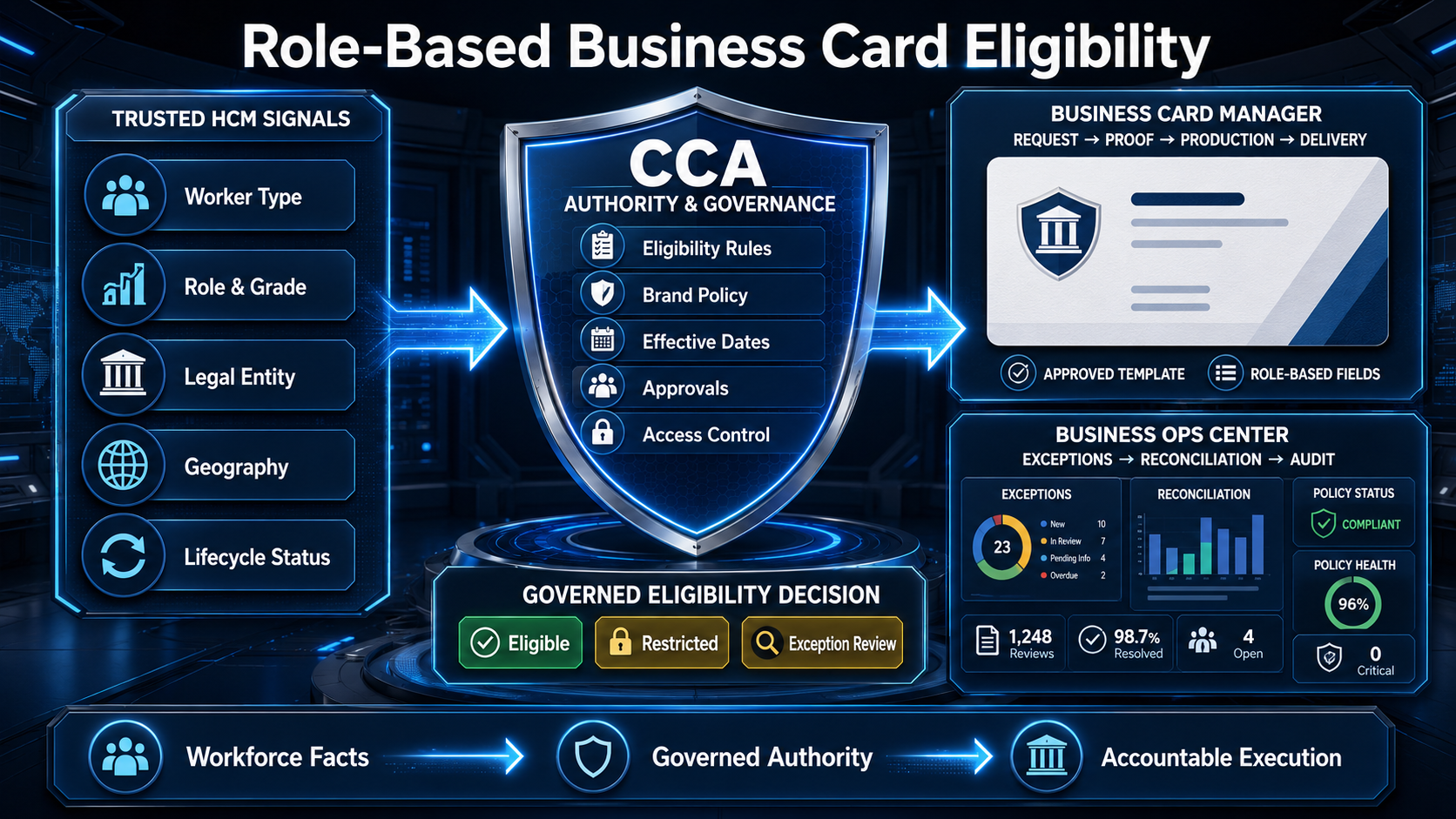
Role-Based Business Card Eligibility Is an Enterprise Governance Decision
An enterprise business card is a compact expression of corporate authority. It communicates a person’s relationship to the organization, the role the organization recognizes, the brand the person is permitted to represent, and the channels through which external stakeholders may engage. Because that expression carries institutional meaning, eligibility cannot be reduced to a simple question such as whether an employee record exists in an Oracle HCM Cloud business card integration platform.
Human capital management systems are designed to hold and manage workforce facts. They may contain employment status, worker type, department, title, location, cost center, manager, legal entity, effective dates, and organizational relationships. Those facts are indispensable, but they are not the policy decision itself. A workforce record can establish that a person joined the enterprise; it does not automatically establish that the person should receive a printed card, which card program applies, which identity fields may appear, who must approve the request, or whether the organization should temporarily suspend production.
Color Card Administrator (CCA) fills this governance gap. It acts as the authority engine between workforce data and business identity execution. CCA evaluates trusted employment events against enterprise policy and produces a governed decision: eligible or ineligible, permitted identity profile, required approvals, approved brand context, fulfillment route, and applicable controls. Business Card Manager (BCM) then operates as the conversion engine that turns the approved decision into a controlled request, proof, production order, and delivery event. Business Ops Center (BOC) provides the operational oversight needed to manage exceptions, reconciliation, service performance, and auditability across the process.
Why “Active Employee” Is Not a Sufficient Eligibility Rule
A basic integration may treat active employment status as permission to order. That rule is easy to automate, but it is rarely adequate for a complex enterprise. Two workers with the same active status may have entirely different business identity requirements. A customer-facing executive may need a premium, multilingual card associated with a regional brand. A plant-based employee may require a standardized identity execution and operational card with a facility address. A contractor may be excluded from printed cards but permitted to use a controlled digital identity. A worker on a short-term assignment may require a temporary market-specific variant. An employee on leave may remain active in the HCM system while card production should be paused.
The weakness of the active-employee rule is that it confuses a source-system fact with an enterprise authorization. When that distinction is ignored, organizations create predictable risks: unnecessary spend, outdated titles, incorrect legal entities, inconsistent logos, unauthorized contact details, uncontrolled premium options, and fulfillment activity that cannot be defended during an audit. The problem is not incomplete automation. It is automation without a policy interpretation layer.
CCA Converts Workforce Attributes into Governed Authority
CCA provides a policy-controlled decision layer that interprets HCM attributes in context. Instead of copying fields directly into a card template, it asks what those fields mean under the organization’s business identity rules. The same department code can produce different outcomes by country, worker type, legal entity, brand, seniority level, or employment stage. Same title change can require automatic approval in one operating unit and brand review in another. The same delivery destination can be permitted for an office-based employee but restricted for a regulated site.
This approach changes the role of integration. The objective is no longer merely to synchronize employee data. The objective is to establish a trusted chain of authority from workforce event to identity decision to controlled execution. CCA becomes the place where enterprise policy is made executable, visible, repeatable, and auditable.
The Policy Dimensions Behind Role-Based Eligibility
A mature eligibility model typically evaluates several dimensions together rather than relying on one field. Worker relationship distinguishes employees, contractors, temporary workers, franchise participants, partners, and other populations. Organizational context identifies the legal entity, division, cost center, reporting line, and operating brand. Role context evaluates function, grade, customer exposure, leadership level, and approved title conventions. Geographic context applies country, language, office, tax, regulatory, and delivery rules. Lifecycle context considers whether the event is a hire, promotion, transfer, leave, assignment, return, or separation. Program context determines whether the person is eligible for printed cards, digital cards, premium stock, translated variants, accessibility formats, or restricted templates.
CCA can combine these dimensions into role-based policy profiles. A policy profile should not expose the complexity to the employee. It should translate complexity into a clear and controlled ordering experience: the correct program is available, only authorized choices are shown, preapproved identity data is applied, required reviewers are inserted, and prohibited options never enter the workflow.
A Governed Decision Model for Enterprise Business Cards
| HCM signal | CCA policy interpretation | Governed decision | Execution outcome |
|---|---|---|---|
| New hire; effective date confirmed | Worker type, role, entity, location, brand and start-date policy evaluated | Eligibility date, template family, approval route and delivery timing established | BCM opens an authorized request at the appropriate point before or after day one |
| Promotion or title change | New role mapped to title standards, authority level and premium options | Approved title expression and any additional review requirements determined | BCM generates a controlled proof; obsolete variants are retired |
| Cross-border transfer | Destination entity, language, address, brand and regulatory rules applied | New market-specific identity profile authorized; old profile sunset date defined | BCM routes the replacement; BOC monitors exceptions and completion |
| Leave or temporary assignment | Duration, access status and program policy interpreted | Order permission paused, limited or time-bound | Unauthorized production is prevented while legitimate exceptions remain governable |
| Termination or contract end | Effective separation timing and retention rules applied | New orders revoked; open requests stopped or reviewed | BCM halts execution and BOC records reconciliation evidence |
Eligibility Must Be Effective-Dated, Not Merely Current
Enterprise workforce events often become known before they become effective. A future-dated hire may need first-day readiness without permitting premature use of the company identity. A promotion may be approved today but announced next month. A transfer may require the destination card to arrive before travel while the prior identity remains valid until the assignment begins. A termination may require immediate revocation or a controlled effective-date sequence depending on local process.
CCA should therefore evaluate both the event and its effective window. Policy can determine when a request may be initiated, when a proof may be reviewed, when production may begin, and when the identity becomes valid. Effective dating prevents two opposite failures: late fulfillment that disrupts an employee’s legitimate business activity and early fulfillment that exposes an identity before the organization authorizes it.
Data Minimization Strengthens Governance
Role-based eligibility should not become a reason to distribute the entire employee record. CCA requires only the attributes necessary to make and document the identity decision. A governance-first integration defines which fields are authoritative, why each field is required, how long it is retained, who can access it, and which downstream systems may receive it. Sensitive HR data that has no role in business card policy should remain outside the ordering process.
This separation is especially important when the enterprise works with multiple printers, regional service providers, or fulfillment partners. BCM should receive the approved enterprise identity operations framework data and production instructions required for execution—not an unrestricted workforce profile. BOC should receive operational measures and exception context—not unnecessary personal information. The architecture supports privacy by making each platform responsible for a clearly bounded purpose.
CCA, BCM and BOC: One Control Chain, Three Distinct Responsibilities
CCA: Authority and policy interpretation
It governs whether a workforce event creates, changes, limits, or revokes business card eligibility. It maps authoritative HCM data to the correct brand, template, field rules, approval path, access permissions, and program entitlements. The result is a defensible identity decision rather than a raw data transfer.
BCM: Controlled execution and fulfillment
BCM converts the governed decision into an actionable workflow. It supports request creation, proof generation, validation, approval capture, production routing, shipment, delivery, and status visibility. BCM should execute what CCA authorizes; it should not independently invent enterprise identity policy.
BOC: Operational oversight and accountable intervention
BOC provides the operational control surface for exceptions, stalled requests, provider performance, reconciliation, audit evidence, and service-level reporting. It helps operating teams distinguish a legitimate exception requiring intervention from an unauthorized deviation that should be blocked.
Exception Governance Is Part of Eligibility Governance
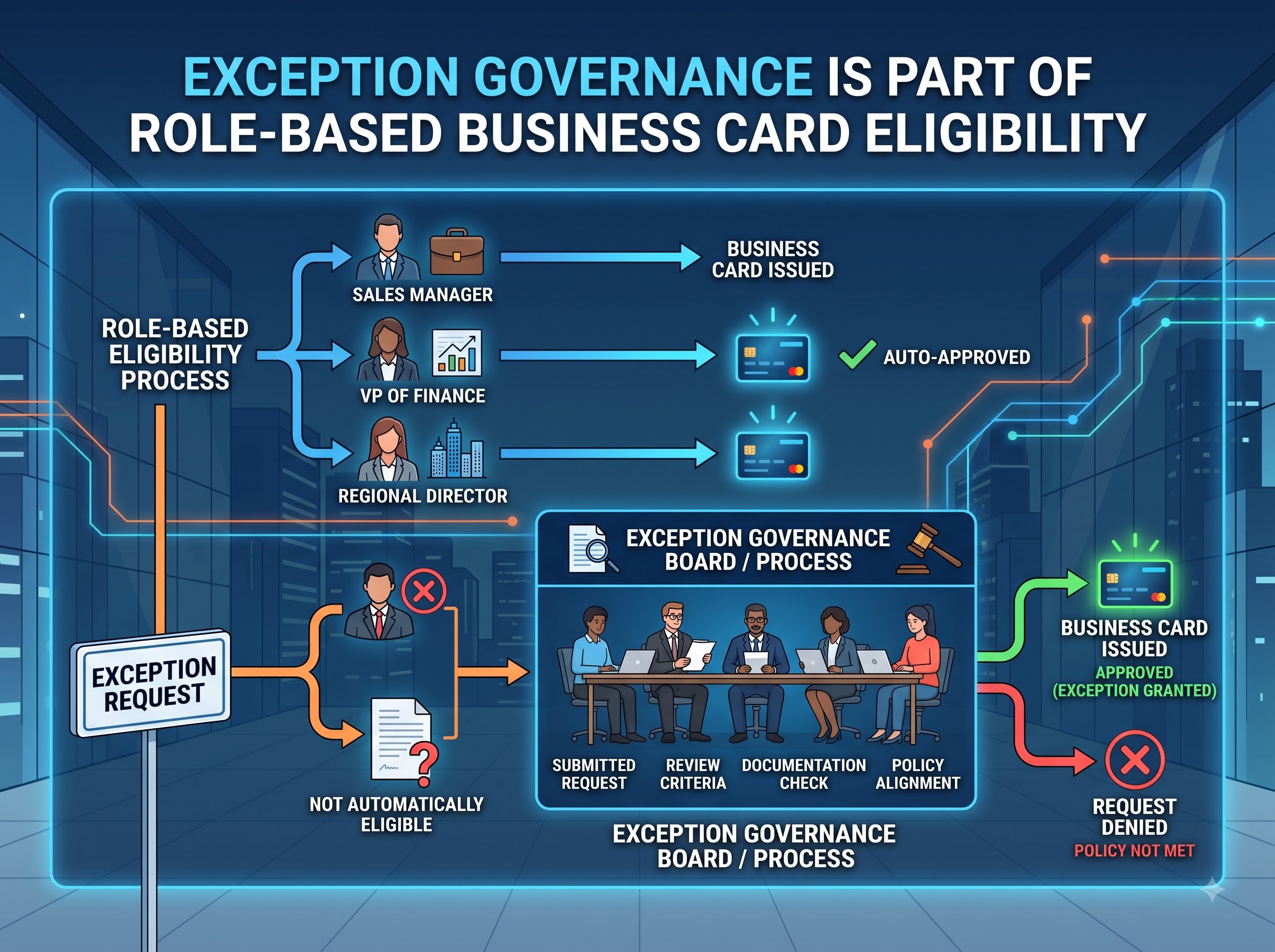
No enterprise policy model eliminates exceptions. A newly acquired company may not yet have complete organizational codes. A senior leader may require a card before an HCM update is finalized. A remote employee may need an alternate delivery path. A regulated location may require an additional disclaimer. The objective is not to pretend these cases do not exist; it is to prevent them from bypassing governance.
CCA can route exceptions through explicit authority. The request should identify the missing or conflicting condition, the policy that triggered the exception, the authorized reviewer, the permitted override scope, and the expiration or remediation requirement. BCM then executes only after the exception is approved. BOC tracks the exception population, aging, recurring causes, and closure evidence. This converts exception handling from informal email activity into an accountable operational process.
What Enterprise Buyers Should Require
- Authoritative-source mapping: Every card field and eligibility attribute should have a declared source of truth, transformation rule, and fallback behavior.
- Policy transparency: Administrators should be able to explain why a worker was eligible, restricted, routed for review, or denied.
- Effective-dated control: Future hires, promotions, transfers, assignments, leaves, and separations should be governed according to their valid dates.
- Role and context sensitivity: Rules should combine worker type, entity, brand, location, function, grade, lifecycle state, and program entitlement.
- Least-privilege access: Employees, managers, administrators, reviewers, and providers should see only the functions and data required for their roles.
- Exception accountability: Overrides should be authorized, scoped, time-bound, documented, and measurable.
- Downstream enforcement: Approved identity data and fulfillment instructions should pass to BCM without reopening governed choices.
- Operational evidence: BOC should make exceptions, reconciliation, service performance, and audit trails visible across the program.
Business Outcomes of Role-Based Eligibility
The immediate benefit is control, but the operational and financial effects extend further. Employees encounter fewer irrelevant choices and submit fewer incomplete requests. Managers spend less time correcting titles, brand assignments, and cost-center issues. Brand teams review true exceptions rather than routine orders. Procurement gains a clearer relationship between policy entitlement and spend. HR avoids repeated manual confirmation of workforce facts. Service providers receive cleaner, production-ready instructions. Audit and compliance teams gain evidence that identity decisions followed defined authority.
The larger outcome is enterprise consistency at scale. Whether the workforce spans one country or many, grows organically or through acquisition, and uses one printer or a network of providers, the organization can maintain a common governance model while allowing policy-controlled local variation. CCA supplies the control plane, BCM supplies the execution discipline, and BOC supplies enterprise operational accountability.
Implementation Roadmap: From Data Mapping to Governed Execution
- Define the authority model: Identify which functions own eligibility, title standards, brand policy, data stewardship, exception approval, fulfillment, and operational oversight.
- Inventory workforce signals: Map the HCM attributes and lifecycle events that materially affect business card eligibility. Exclude fields that do not support a declared purpose.
- Design policy profiles: Translate worker, role, organization, geography, and lifecycle conditions into explicit program entitlements and restrictions.
- Establish effective-date behavior: Define when requests, approvals, production, replacement and revocation become valid for each event type.
- Configure the CCA decision layer: Implement eligibility rules, template assignment, field governance, approval routing, access control and exception paths.
- Connect governed execution: Pass approved decisions to BCM so that request, proof, production and delivery follow the authorized context.
- Operationalize oversight: Use BOC to monitor exceptions, incomplete events, provider performance, reconciliation and policy drift.
- Measure and refine: Track automated decision rates, exception causes, approval aging, rework, obsolete-card risk, spend and service outcomes.
How to Measure Whether Eligibility Governance Is Working
A governance program should measure decision quality, not only transaction volume. Useful indicators include the percentage of lifecycle events that produce an automatic policy decision; the share of orders requiring manual data correction; the number and age of eligibility exceptions; the frequency of title, brand, entity, address, or language changes after proof generation; the proportion of future-dated events fulfilled within the permitted window; the number of open requests stopped after a separation event; and the percentage of provider transactions successfully reconciled in BOC.
Trends matter more than isolated numbers. A growing exception rate may indicate missing HCM attributes, poorly designed rules, inconsistent organizational data, or policy that no longer reflects the operating model. Repeated overrides for one business unit may indicate that local requirements need a governed policy variant rather than continued manual intervention. BOC makes these patterns visible, while CCA provides the policy mechanism to correct them.
Frequently Asked Questions
Can an HCM system determine business card eligibility on its own?
An HCM platform can provide authoritative workforce facts and may support basic rules, but enterprise business card eligibility usually requires a dedicated interpretation of brand, identity, approval, access, production, and exception policies. CCA provides that governance layer.
Why not send HCM data directly to a printer or ordering portal?
Direct transmission can automate fulfillment while bypassing policy interpretation. It may expose unnecessary HR data, create invalid card variants, and make exceptions difficult to govern. CCA establishes authorization before BCM or a provider executes.
What is the difference between CCA and BCM?
CCA is the authority engine: it determines eligibility, identity rules, approvals and access. BCM is the conversion engine: it carries the approved request through proof, production and delivery.
Where does BOC fit?
BOC provides operational oversight. It surfaces exceptions, reconciliation issues, service performance and audit evidence across the governed program.
Can role-based eligibility support multiple brands and countries?
Yes. Policy profiles can combine legal entity, brand, geography, language, role, worker type and lifecycle status so that enterprise standards and permitted local variations are enforced together.
Does governance prevent legitimate urgent orders?
No. A mature model includes authorized exception paths. It allows urgent or unusual cases to proceed with explicit approval, defined scope, time limits, and operational evidence instead of informal bypasses.
Conclusion: Make Eligibility an Explicit Enterprise Authority
HCM integration is essential to employee identity automation, but integration alone does not create governance. Workforce data tells the enterprise what has changed. CCA determines what that change authorizes. BCM executes the authorized business card workflow. BOC ensures that exceptions, reconciliation, and service performance remain visible and accountable.
By treating role-based business card eligibility as an explicit enterprise decision, organizations can move beyond manual ordering and simplistic active-employee rules. They can establish a policy-controlled chain from trusted workforce event to governed identity decision to accountable execution. That chain reduces risk, improves employee readiness, protects brand integrity, limits unnecessary data movement, and makes business identity operations defensible at enterprise scale.
Evaluate where business card eligibility is decided today. If workforce facts move directly from HCM into ordering or production without a governed authority layer, CCA can establish the policy control needed to connect HCM data, BCM execution, and BOC oversight as one accountable enterprise system.