

From Hire To Retire: Employee Lifecycle Identity Automation For Enterprise Business Cards
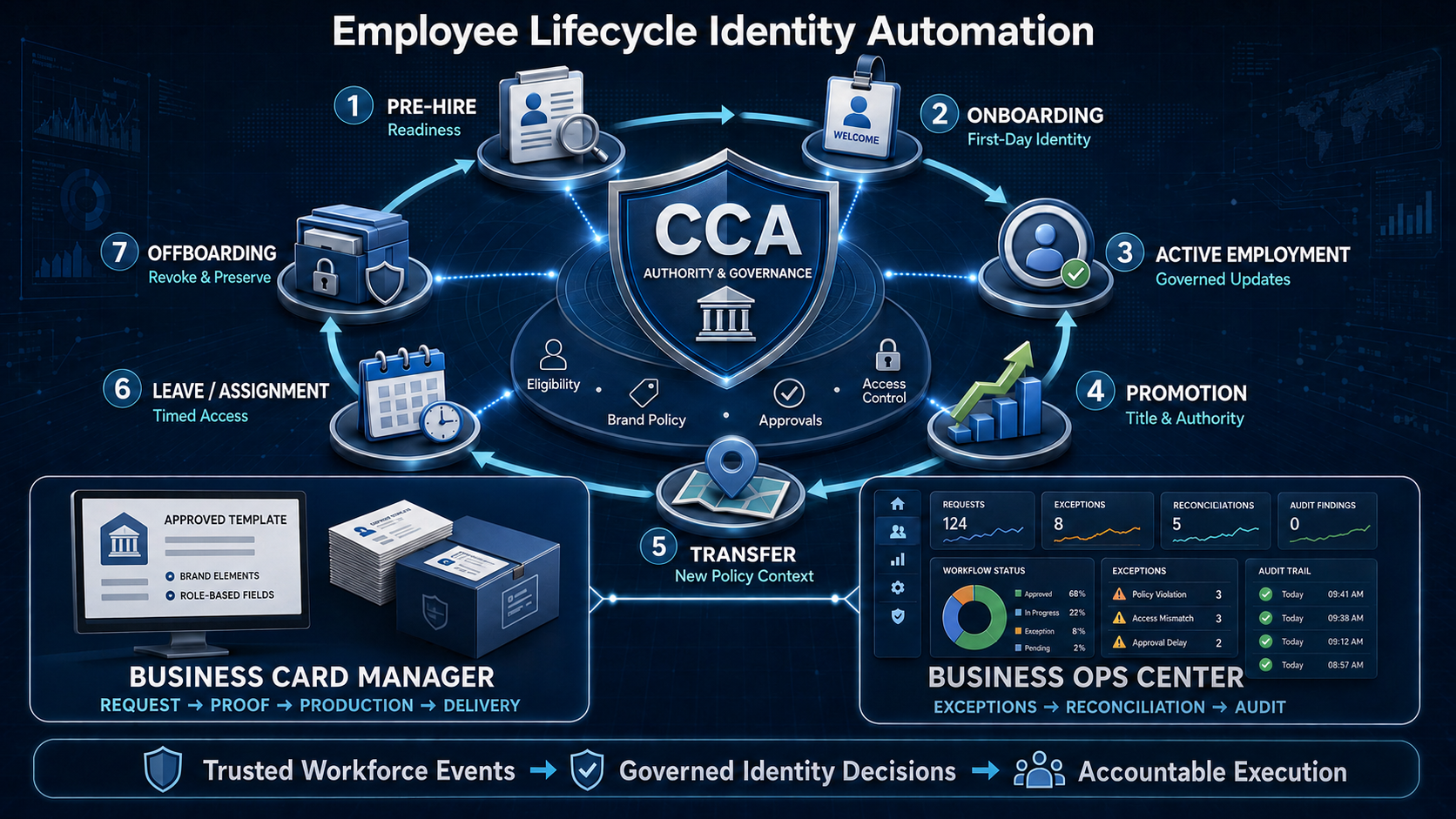
How CCA, Business Card Manager, and Business Ops Center convert workforce changes into governed, accurate, and audit-ready identity execution
Business Identity Changes Throughout the Employee Lifecycle
An employee’s business identity is not created once and left unchanged. It evolves with the employment relationship. A pending worker becomes a new hire. A new hire joins a department, office, legal entity, and reporting structure. A promotion changes title and authority. A transfer changes location, business unit, brand, cost center, or manager. A temporary assignment may require a different public identity for a limited period. A termination or cancelled work relationship should stop new ordering activity immediately while preserving the evidence of prior approvals and orders.
Business cards sit at the visible edge of these changes. They present an individual’s name, role, organization, credentials, location, and contact channels to customers, partners, regulators, and the market. When card ordering is disconnected from employee lifecycle data, the enterprise relies on people to recognize every relevant change, interpret policy correctly, re-enter information, locate the right template, identify an approver, and coordinate production. The process may appear simple at low volume, but at enterprise scale it becomes a recurring identity-control problem.
Employee lifecycle business card automation closes this gap by connecting workforce events to a governed workflow. The HCM or HRIS provides authoritative employee facts and effective dates. CCA determines whether the event creates an identity obligation, which rules apply, and who has authority. Business Card Manager converts that governed decision into a request, proof, approval, production, and delivery process. Business Ops Center maintains operational visibility when data is incomplete, approvals stall, orders fail, or systems disagree.
Why Lifecycle Automation Requires an Authority Layer
A direct connection between an HCM platform and a printer can move data quickly, but speed alone does not establish authority. The HCM may know an employee’s formal job title, but the brand team may maintain rules for public-facing titles. It may know the worker’s legal entity, while procurement controls which entity funds the order. This may know the manager, while the enterprise approval policy routes certain titles, quantities, locations, or executive templates to additional reviewers. It may know that a transfer is future-dated, while the card must not enter production until the destination address and effective date are confirmed.
CCA serves as the authority and orchestration layer between workforce truth and identity execution. It evaluates employee data in context: eligibility, role, entity, location, brand, template, quantity, funding, approval, shipping, replacement, and exception rules. The output is not simply a populated form. It is a policy decision that BCM can execute, and BOC can observe.
| GOVERNANCE PRINCIPLE
An HCM event may authorize evaluation, but it should not automatically authorize production. Data synchronization, eligibility, approval, ordering, production, and fulfillment are distinct controlled states. |
The Hire-to-Retire Identity Workflow
| Lifecycle stage | HCM signal | CCA decision | BCM execution | BOC oversight |
|---|---|---|---|---|
| Pre-hire | Pending worker, start date, entity, location | Determine timing, eligibility, template readiness and approver | Prepare an invitation or controlled draft; do not print early | Track missing data and start-date readiness |
| Onboarding | Active hire, manager, title, contact and cost center | Apply role, brand, funding and approval policy | Collect employee confirmation, approve proof, produce and deliver | Monitor onboarding SLA and delivery status |
| Active employment | Phone, email, credential, manager or department update | Decide whether the change affects printed identity or routing | Update account data or open a governed replacement request | Reconcile changes and prevent unnecessary reprints |
| Promotion | New title, level, responsibility and effective date | Validate public title, template, quantity and approval path | Create a replacement workflow with prior history retained | Track approval aging, cost and completion |
| Transfer | New entity, office, country, brand or cost center | Switch policy context and prevent use of the former template | Issue destination-specific request, proof and delivery instructions | Resolve mapping conflicts and coordinate effective date |
| Leave or temporary assignment | Status and duration change | Hold, restrict or enable temporary identity according to policy | Pause or issue time-bounded ordering rights | Maintain owner, expiry and exception visibility |
| Offboarding | Termination or cancelled relationship | Revoke ordering authority and apply cancellation rules | Stop new requests; cancel eligible work; preserve history | Confirm closure and audit completion |
Stage One: Pre-Hire Readiness Without Premature Production
Pre-hire data creates an opportunity to prepare business identity before the employee’s first day, but it also creates risk. Start dates move. Offers are renegotiated. Candidates decline. Locations or managers change before onboarding. A pending-worker record should therefore begin a readiness workflow, not an irreversible order.
CCA can evaluate whether the role is card-eligible, determine the correct entity and template family, identify missing attributes, and calculate the earliest permitted production date. BCM can prepare a draft or invitation that remains held until the employee record reaches the required state. BOC can show which hires are ready, blocked, incomplete, or approaching a delivery deadline. This gives HR and operations earlier visibility without turning uncertain pre-hire data into waste.
Stage Two: Governed Onboarding and First-Day Identity
Onboarding is where employee experience and enterprise control meet. The organization wants the employee to receive accurate cards quickly, but the employee should not be asked to interpret template policy, legal-entity rules, cost-center funding, or approval routing. Those decisions should already be embedded in the workflow.
Once the authoritative hire event is received, CCA selects the policy context. The employee or manager may confirm only the fields they are permitted to review, such as preferred display name, work phone, or shipping location. BCM creates the proof using the approved template and routes it through the required approval path. Production begins only after the controlled states are satisfied. BOC monitors readiness, approval time, proof exceptions, production, shipment, and delivery against the onboarding target.
- Use effective dates so invitations can be prepared before the start date without producing cards too early.
- Separate official Oracle HCM Cloud values from approved display values, particularly names, titles, credentials, and regional address formats.
- Make the employee confirmation step narrow and purposeful; do not turn onboarding into a second HR data-entry process.
- Capture every policy evaluation, proof version, approval action, production status, and delivery event in one traceable history.
Stage Three: Managing Identity Changes During Employment
Most workforce updates should not create new business cards. A manager change may affect future approval routing but not the printed card. A department update may change the cost center but leave external identity unchanged. A phone or email correction may require a replacement. A new professional credential may require both evidence and brand review. Lifecycle automation must therefore distinguish between changes that update administration, changes that alter policy context, and changes that justify physical replacement.
This is an area where governance creates measurable savings. If every HCM change automatically produces a reorder, automation increases waste. If changes are ignored, employees continue using obsolete identity materials. CCA evaluates the event against the replacement policy. BCM creates a reorder only when the rule, employee, manager, or authorized administrator establishes a valid need. BOC provides a queue for ambiguous changes, missing mappings, duplicate events, or mismatched effective dates.
Promotions, Transfers, and Multi-Entity Complexity
Promotions and transfers are among the highest-value lifecycle use cases because they combine data change with authority change. A promotion may affect title, credentials, quantity entitlement, approver, and executive template eligibility. A transfer may change legal entity, country, language, brand, address, phone format, shipping destination, tax treatment, cost center, production route, and retention requirements. The old ordering context must not remain available after the new context takes effect.
CCA applies the destination policy rather than merely copying new fields into an old template. It can invalidate obsolete template access, select the correct brand system, route approvals to the destination organization, and determine whether old inventory must be retired. BCM maintains continuity between the previous order and the replacement workflow. BOC exposes the operational handoff so that HR, brand governance, procurement, and local operations can see whether the transfer is ready, held, or complete.
| ENTERPRISE DISTINCTION
A transfer is not a field update. It is a controlled transition from one identity policy context to another. |
Stage Four: Offboarding Is Also an Identity Governance Event
Offboarding is often discussed in relation to system access, devices, payroll, and facilities, yet physical business identity also requires control. An inactive worker should not retain authority to place new orders. Draft requests may need cancellation. Approved work may need an explicit decision based on production status. Unused inventory, recurring replenishment, delegated ordering permissions, and administrator access may require review.
The termination or cancelled-work-relationship event should trigger immediate policy evaluation. CCA revokes or restricts ordering authority according to enterprise rules. BCM prevents new activity while preserving order and approval history. BOC confirms that relevant requests were closed, exceptions were assigned, and the audit trail remains available. This approach protects the enterprise without deleting evidence that procurement, HR, legal, or audit teams may need later.
Event-Driven, Scheduled, and Hybrid Integration Patterns
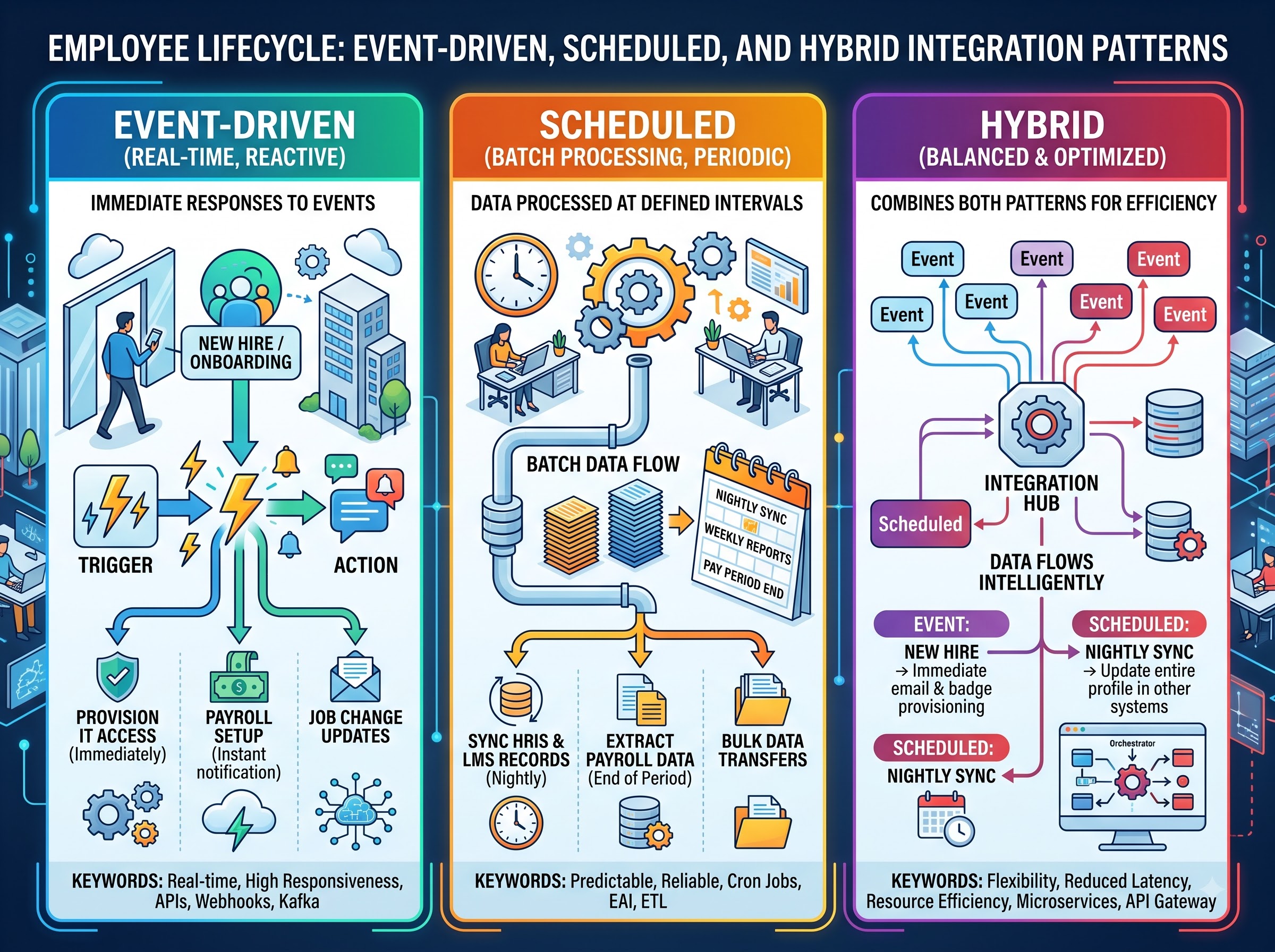
The correct integration timing depends on the HCM platform, licensed capabilities, customer architecture, and business risk. Event-driven patterns can provide near-real-time notification when supported. Scheduled APIs or extracts may be appropriate for controlled batches, large data volumes, reconciliation, or environments where real-time access is unnecessary. A hybrid design often works best: events initiate timely evaluation, while scheduled reconciliation confirms that no lifecycle changes were missed.
Official platform capabilities illustrate why integration design must be product-aware. Oracle Fusion Cloud HCM documents employee Atom feeds for new hires, assignment changes, employee updates, terminations, and work-relationship changes. UKG documents webhooks that pass subscribed event information to an endpoint in near real time. SAP SuccessFactors supports effective-dated OData queries, which are important when future and historical employee states must be interpreted correctly. Workday exposes worker-related APIs and services that can support downstream workforce integrations. CCA should normalize these different source mechanisms into a common governance process rather than forcing every HCM platform into the same technical pattern.
- Design idempotency so retries or repeated events do not create duplicate invitations or orders.
- Use correlation identifiers to trace a workforce event across HCM, integration middleware, CCA, BCM, production, and BOC.
- Acknowledge inbound events quickly when downstream work includes approvals or production delays; process the governed workflow asynchronously.
- Run periodic reconciliation to identify missed, stale, or conflicting employee states.
- Keep future-dated, corrected, rescinded, and retroactive events as explicit test scenarios.
The Canonical Lifecycle Identity Record
A scalable architecture benefits from a canonical record that represents only the employee attributes needed for business identity execution. Typical fields include a stable person or worker identifier, employment status, worker type, preferred display name, approved public title, organizational unit, employing entity, manager, work location, work email, work phone, cost center, effective date, and source-system timestamp. Regional or role-specific extensions may include credentials, language, license number, professional designation, or alternate contact channels.
The canonical record should also contain governance metadata: policy version, template assignment, eligibility result, funding source, approver, last synchronization time, source provenance, exception status, and lifecycle state. This prevents administrators from seeing only the final printed values without understanding why those values were permitted. It also makes the integration auditable when HR data, brand policy, and order history change at different times.
How CCA, BCM, and BOC Divide Responsibility
CCA — authority engine: Interprets lifecycle events; enforces eligibility, identity, template, brand, location, quantity, funding, approval, and access policy; records the reason for each governed outcome.
Business Card Manager — execution engine: Transforms the authorized outcome into employee confirmation, request, proof, connecting business card approval workflow, production, shipment, delivery, reorder, or cancellation activity.
Business Ops Center — operational control layer: Shows exceptions, incomplete records, aging approvals, failed integrations, reconciliation differences, production problems, service levels, ownership, and resolution history.
This separation keeps the architecture understandable. CCA decides what is allowed. BCM carries out the approved business process. BOC ensures that incomplete or failed execution does not disappear between systems. Each platform contributes distinct search relevance while reinforcing a single enterprise narrative: governed business identity execution connected to the employee lifecycle.
Controls That Prevent Lifecycle Automation From Creating New Risk
- Minimum-necessary data: allowlist only the workforce attributes required for identity execution and exclude sensitive personal data by design.
- Least-privilege integration: use scoped service accounts, protected credentials, encrypted transport, and environment separation.
- Effective-date governance: prevent future, retroactive, rescinded, or corrected changes from producing the wrong action.
- Human review for exceptions: route ambiguous titles, credentials, brand conflicts, executive cards, unusual quantities, and unmatched locations to authorized owners.
- Template version control: record which approved template and policy version produced every proof and order.
- Lifecycle access control: activate, modify, suspend, and revoke ordering rights as employment status changes.
- Audit preservation: retain event, policy, approval, order, production, shipping, cancellation, and administrative override history according to policy.
Metrics for a Mature Employee Lifecycle Business Card Program
A lifecycle management program should be measured by accuracy and governance, not only by automation volume. Useful metrics include the percentage of eligible hires ready before day one, time from hire event to invitation, time from employee confirmation to approval, first-proof accuracy, lifecycle events requiring manual intervention, replacement rate by event type, duplicate order prevention, orders attempted by inactive workers, transfer completion before the effective date, exception aging, spend by entity and cost center, delivery performance, and mean time to reconcile HCM-to-BCM differences.
Metrics should be reviewed across teams. HR may focus on onboarding readiness. Brand may focus on proof accuracy and policy exceptions. Procurement may focus on spend, quantities, and reprint causes. IT may focus on event success, retries, reconciliation, and data quality. Operations may focus on queues and service levels. BOC brings these operational perspectives together, while CCA provides the policy context necessary to explain the numbers.
Implementation Roadmap
- Map the lifecycle. Identify the workforce events that can change external identity, ordering authority, approval routing, funding, template selection, or fulfillment.
- Define ownership. Assign authoritative owners for employment facts, display identity, brand policy, funding, approvals, shipping, production, and exceptions.
- Create the canonical data contract. Use stable identifiers, minimum-necessary fields, effective dates, provenance, and explicit null and duplicate handling.
- Configure CCA policy before automation. Define eligibility, timing, templates, role access, quantity, replacement, approval, funding, cancellation, and retention rules.
- Connect BCM workflow states. Decide when an event creates readiness, invitation, draft, approval, reorder, cancellation, or no action.
- Configure BOC operational views. Establish queue owners, escalation thresholds, reconciliation rules, service levels, and closure evidence.
- Test the difficult scenarios. Include no-shows, rehires, multiple assignments, future changes, rescinded transfers, retroactive corrections, title exceptions, duplicate events, and partial failures.
- Launch by population. Begin with a defined entity, location, or employee class; measure accuracy and exceptions; then expand with controlled policy reuse.
Frequently Asked Questions
What is employee lifecycle business card automation?
It is the governed use of HCM or HRIS events to prepare, create, update, replace, restrict, or close enterprise business card workflows as employment status and identity change.
Should every HCM change create a new card?
No. CCA should determine whether the event changes printable identity, policy context, approval routing, or ordering authority. Many updates require only administrative synchronization or no action.
Can a pending hire receive cards before the start date?
The workflow can be prepared before day one, but production timing should follow enterprise policy and effective-date controls so delayed, changed, or cancelled hires do not create waste.
How are promotions and transfers handled?
CCA evaluates the new title, entity, location, brand, cost center, template, approval path, and effective date. BCM creates the governed replacement process, while BOC tracks exceptions and completion.
What happens at termination?
Ordering authority is revoked or restricted, eligible drafts or orders are cancelled according to status and policy, and the full historical record is preserved for audit.
How is this different from simple form prefilling?
Prefilling moves data. Lifecycle automation applies authority, timing, eligibility, approval, brand, funding, access, production, and operational controls to the event.
Connect Employee Lifecycle Data to Governed Identity Execution
Employee lifecycle automation should do more than accelerate downstream tasks. It should preserve the authority of HR, brand, procurement, IT, and operations while reducing the work employees and managers must perform. Business cards provide a practical, visible example of why this matters: one small identity asset can carry inaccurate data, obsolete authority, the wrong brand, an unauthorized title, or an incorrect entity into the market.
CCA creates the control boundary between workforce events and external identity. Business Card Manager converts governed decisions into accurate cards and accountable fulfillment. Business Ops Center ensures that exceptions, handoffs, and service performance remain visible. Together, they provide the enterprise with a hire-to-retire identity operating model—not merely another ordering portal.
| Request an enterprise integration briefing to map your HCM events, identity policies, approval requirements, business card workflows, and operational controls across CCA, Business Card Manager, and Business Ops Center. |