

How Business Card Manager API Integrations Connect HCM Platforms to Governed Business Card Operations
HCM Data Should Drive Business Card Execution—Without Bypassing Governance
Human capital management platforms already hold many of the facts that determine whether an employee needs a business card and what that card should communicate: legal or preferred name, job title, department, manager, company, location, work email, business phone, employment status, cost center, and effective dates. Yet in many organizations, those same details are manually re-entered into disconnected forms, email threads, spreadsheets, or supplier portals. The result is predictable: avoidable errors, duplicated work, inconsistent approvals, stale identity data, and limited visibility into who authorized an order.
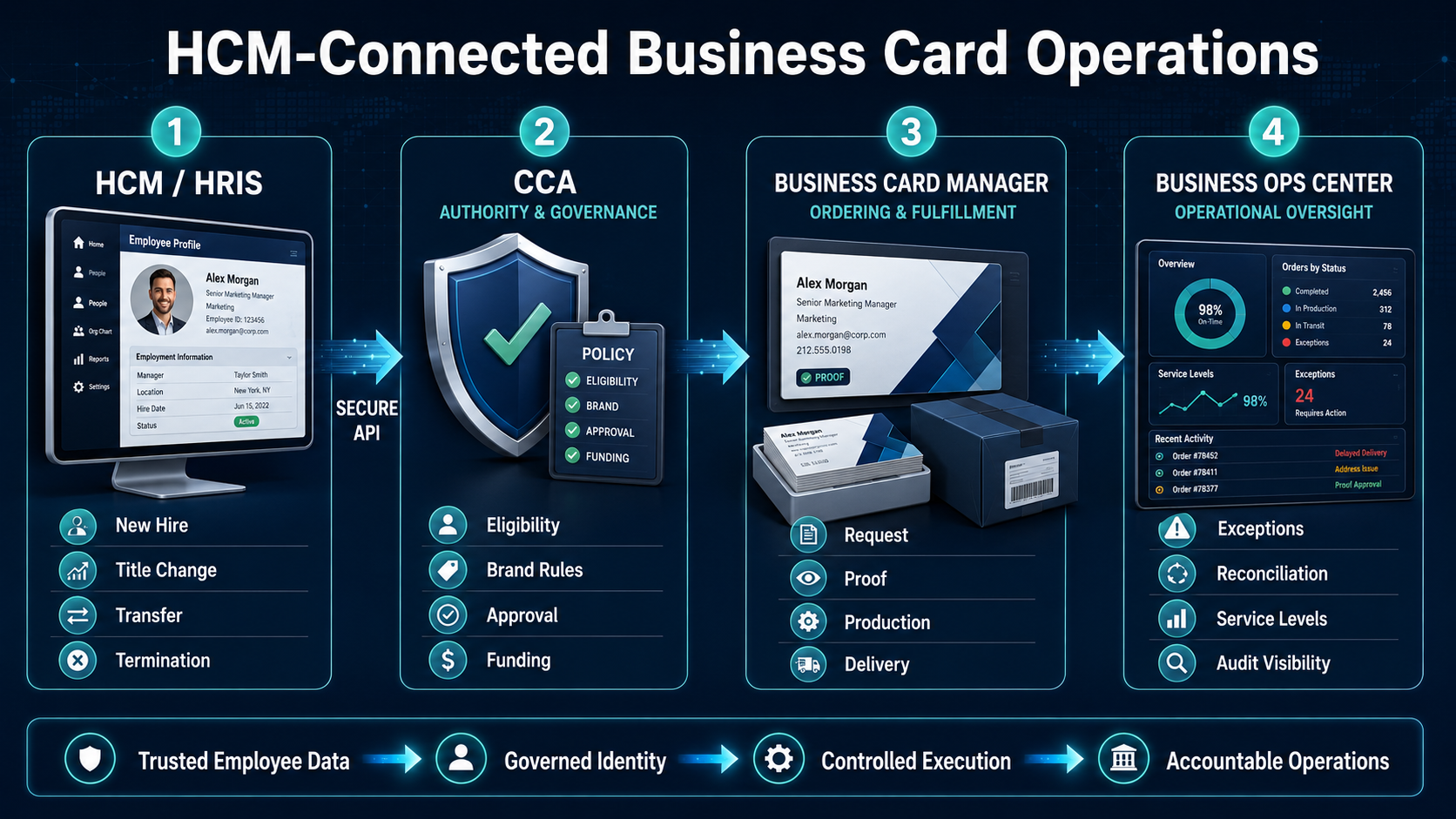
Business Card Manager API integrations create a controlled bridge between HCM data and physical business identity execution. The objective is not simply to move fields from one database to another. The objective is to turn trusted workforce data into a governed operational decision. A new hire, promotion, transfer, location change, brand assignment, or termination can become a structured event that is evaluated against enterprise rules before any business card is requested, approved, produced, or shipped.
This distinction matters for large organizations. An API can automate speed, but automation without authority can reproduce errors faster. CCA provides the policy and orchestration layer that determines what is allowed. Business Card Manager executes the controlled ordering and fulfillment workflow. Business Ops Center provides the operational view needed to reconcile exceptions, monitor service performance, and coordinate work across teams and systems. Together, the three platforms create a stronger model: workforce data enters once, policy is applied consistently, execution remains traceable, and operations retain oversight.
Why HCM Companies Are Natural Integration Partners for Business Card Manager
HCM companies sit at the beginning of the employee lifecycle. Their systems record the events that create, change, and retire a person’s relationship with the enterprise. Business card management sits downstream, where those events become externally visible identity. Connecting these systems closes a gap between internal workforce administration and external brand execution.
The integration opportunity applies across enterprise HCM and HRIS environments, including Workday, SAP SuccessFactors Employee Central, Oracle Fusion Cloud HCM, ADP, UKG Pro, Microsoft Dynamics 365 Human Resources, and other platforms that expose worker, job, organizational, or lifecycle data through APIs, feeds, webhooks, middleware, or scheduled extracts. The exact connector pattern varies by platform and customer architecture, but the governing principle remains the same: the HCM should remain the system of record for workforce facts, while CCA and BCM translate authorized facts into policy-compliant business card outcomes.
| PARTNER VALUE
For HCM providers and implementation partners, a BCM integration extends employee lifecycle automation into a tangible enterprise workflow. For customers, it eliminates another isolated vendor process and brings business card ordering under the same data, security, and governance architecture used for other workforce services. |
The CCA–BCM–BOC Architecture for HCM-Connected Business Cards
| Layer | Primary role | What it controls | Enterprise outcome |
|---|---|---|---|
| HCM / HRIS | Workforce system of record | Worker, job, organization, manager, location, status and effective dates | Trusted upstream employee data |
| CCA | Authority and orchestration layer | Policy, eligibility, approval, brand, funding, integration and audit rules | Governed identity decisions |
| Business Card Manager | Execution and fulfillment layer | Request creation, proofing, approval steps, production, shipping and order history | Accurate, controlled business card delivery |
| Business Ops Center | Operational oversight layer | Exceptions, queues, reconciliation, service levels, handoffs and cross-system visibility | Accountable enterprise operations |
This layered architecture prevents the HCM integration from becoming a fragile point-to-point script. The HCM sends only the data and events required for the business purpose. CCA evaluates those inputs against enterprise identity governance policy. BCM carries out the permitted workflow. BOC makes failed synchronizations, delayed approvals, production exceptions, duplicate records, and incomplete data visible to the people responsible for resolution.
From Employee Events to Governed Business Card Actions
The strongest integration design begins with lifecycle events rather than static data transfer. Each event has an effective date, a source record, an ownership model, and a specific business consequence. This enables the organization to automate what is routine while preserving human review where risk or ambiguity is higher.
| HCM event | CCA policy decision | BCM action | BOC oversight |
|---|---|---|---|
| New hire or pending worker | Confirm eligibility, template, brand, office, funding source and approver | Create an invitation, draft request, or approved onboarding task | Track readiness, missing fields, approval aging and delivery date |
| Promotion or title change | Determine whether the change requires replacement cards and whether approval can be streamlined | Open a controlled reorder with updated title | Monitor replacement volume, cost and completion |
| Transfer, relocation or legal-entity change | Apply the destination entity’s address, brand, template, cost center and approval path | Generate a new governed order; prevent use of the former template | Reconcile effective date, old inventory and shipping destination |
| Manager or department change | Recalculate approval routing and budget ownership | Route future requests to the correct approver | Flag orphaned queues or policy conflicts |
| Leave, contingent-worker conversion or return | Apply eligibility and timing rules | Hold, resume, or change the request state | Maintain exception history and owner visibility |
| Termination | Stop new orders and remove ordering access according to policy | Cancel unapproved work where permitted and preserve order history | Confirm closure, inventory treatment and audit completion |
The Data Contract: Minimum Necessary, Business-Ready, and Governable
A successful integration does not copy the entire employee profile. It defines a purpose-specific data contract. Typical fields may include an immutable worker identifier, preferred display name, approved title, organizational unit, employing entity, manager identifier, work location, cost center, work email, work phone, employment type, worker status, and effective date. Optional fields may support language, professional credentials, regional formatting, shipping logic, or approved social and digital contact elements.
Every mapped field should have a clear owner. HR may own employment status and official organizational placement. Brand or communications teams may own naming conventions, credentials, logo rules, and template language. Procurement may own funding and vendor rules. Local operations may own delivery instructions. CCA brings these authorities together so that an HCM value is not treated as printable merely because it exists.
- Use a stable worker or person identifier as the integration key; do not rely on email address alone because email can change.
- Separate source data from display data. A formal HCM title may require an approved public-facing title rule before printing.
- Use effective dating so future hires and transfers do not trigger production too early.
- Maintain field-level provenance so administrators can see which system supplied each value and when it was last synchronized.
- Define null, duplicate, conflict, and stale-data handling before go-live rather than leaving exceptions to manual discovery.
Integration Patterns for Major HCM Platforms
CCA and Business Card Manager can be positioned around reusable integration patterns rather than a single vendor-specific method. This makes the architecture relevant to enterprises with different HCM products, integration platforms, security standards, and deployment maturity.
Workday: Worker and organization data can be accessed through Workday APIs and web services, including human resources and staffing domains. A governed BCM pattern can consume approved worker events or scheduled changes, map them to CCA policy, and initiate the correct business card workflow.
SAP SuccessFactors: Employee Central exposes employee and organizational information through OData APIs. An integration can map effective-dated employee records, job information, legal entity, department, location, and manager relationships into governed identity actions.
Oracle Fusion Cloud HCM: Oracle provides worker REST endpoints and advises event-oriented mechanisms such as Atom feeds for detecting key changes. A robust design can use the appropriate Oracle method for new hires, terminations, and employment changes while BCM remains downstream of CCA policy.
ADP: ADP developer resources provide worker-management integration patterns across supported products. The BCM connection can use authorized worker data to prepopulate and govern employee business card requests without treating payroll data as a broad replication source.
UKG Pro: UKG provides developer resources for enterprise people, payroll, talent, and workforce data, including event-driven capabilities in its platform. The integration can align employee updates with controlled ordering, approval, and exception workflows.
Microsoft Dynamics 365 Human Resources and other HRIS platforms: Worker, position, job, and organizational data can be synchronized through platform-native entities, middleware, secure APIs, files, or event services. The key is to preserve system-of-record ownership and route all printable outcomes through CCA enterprise identity governance.
Why “Real-Time” Is a Governance Decision, Not a Marketing Claim
Not every employee change should trigger an immediate order. Some events require near-real-time action, such as blocking ordering access after termination. Others are better processed after an effective date, a manager confirmation, or a scheduled reconciliation. A title change entered during an HR transaction may be corrected before it becomes effective. A transfer may require a new cost center and office address that arrive at different times. A new hire may need to complete onboarding before a card becomes eligible for production.
CCA therefore allows the integration strategy to distinguish between data synchronization, policy evaluation, order creation, approval, and fulfillment. These are separate states. Keeping them separate reduces premature orders, duplicate cards, and confusing exception handling. It also gives BOC meaningful operational checkpoints: received, validated, eligible, awaiting approval, approved, in production, shipped, delivered, held, rejected, or cancelled.
Security, Privacy, and Audit Controls Must Be Designed Into the API
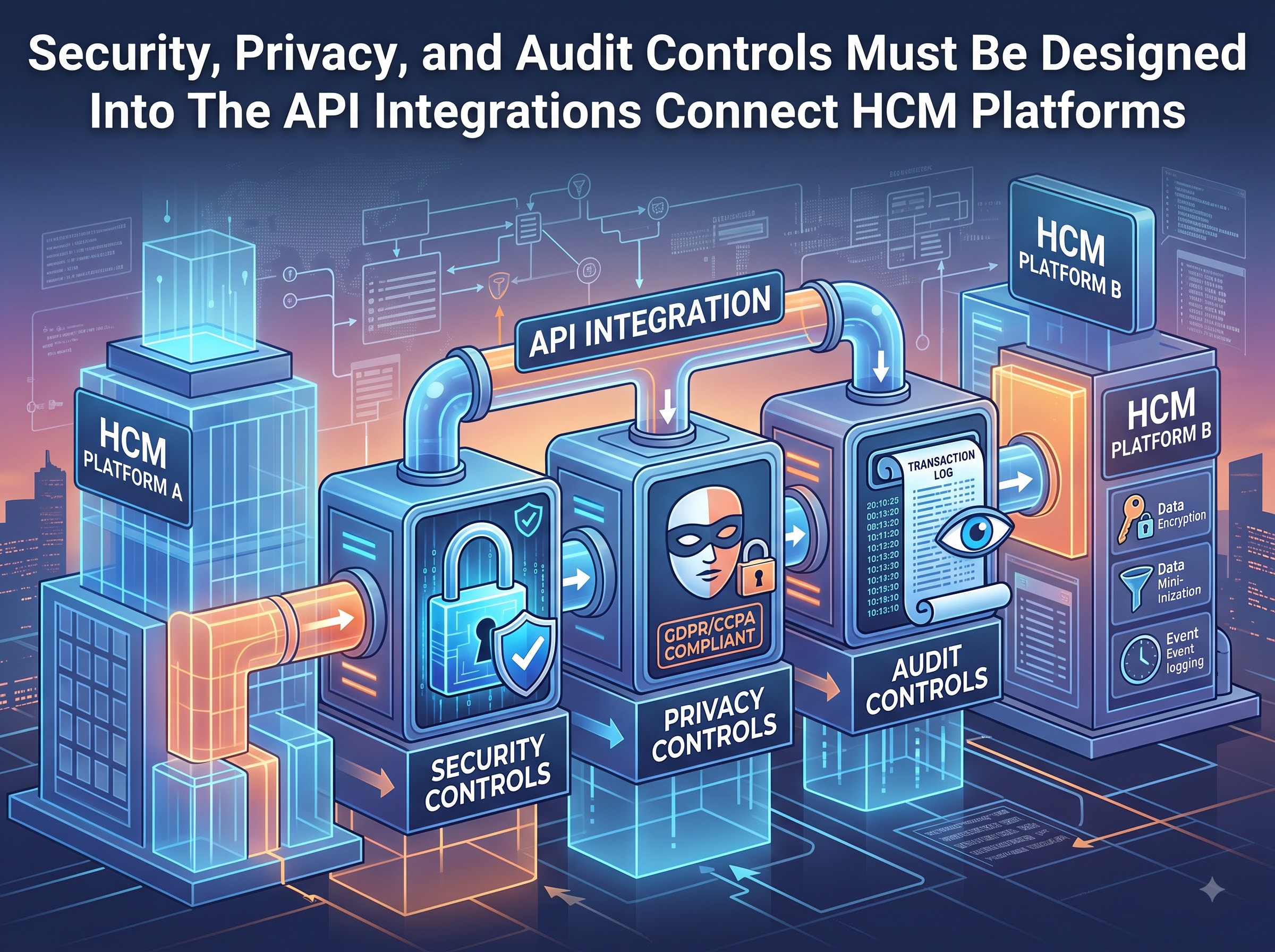
HCM integrations touch sensitive workforce information, even when the downstream use case appears simple. The integration should follow least-privilege access, retrieve only necessary fields, protect credentials, encrypt data in transit, validate payloads, and record administrative and system actions. Environment separation, credential rotation, scoped service accounts, retry controls, and monitoring should be implementation requirements rather than post-launch enhancements.
Equally important, business card data is not automatically harmless because much of it becomes public. The source record may contain personal phone numbers, home addresses, legal names, demographic information, or internal identifiers that must never flow to a card workflow. A governed allowlist is safer than copying a broad worker object and attempting to suppress fields later. CCA should accept only the attributes required for identity execution and retain the audit evidence necessary to explain how a final card was created and approved.
- Authenticate server-to-server integrations with appropriately scoped credentials and approved enterprise security patterns.
- Minimize stored HCM data and define retention periods for staging records, logs, failed payloads, and audit history.
- Mask sensitive values in logs and support correlation identifiers that enable troubleshooting without exposing full employee records.
- Make consent, preferred-name, credential, regional privacy, and accessibility requirements configurable where policy requires them.
- Preserve an immutable history of approvals, policy decisions, template versions, production status, and administrative overrides.
The Operational Role of Business Ops Center
API success cannot be measured only by the percentage of requests returning an HTTP success code. The business outcome is a correct card delivered at the right time under the right authority. Business Ops Center strengthens the architecture by connecting technical status to operational responsibility. It gives teams a place to see which record failed validation, which approval is aging, which order was held because a location mapping is missing, which shipment missed a service level, and which system owns the next action.
This is where CCA, BCM, and BOC reinforce one another in search positioning and in product value. CCA establishes the category of governed enterprise business identity execution. BCM demonstrates the practical workflow that converts policy into an order. BOC shows that integration continues beyond data exchange into accountable operations. Enterprises searching for HCM automation are not merely buying a connector; they are evaluating whether the full operating model can be controlled.
Enterprise Benefits Across HR, IT, Procurement, Brand, and Employees
HR and people operations: Less duplicate entry, a cleaner onboarding and transfer experience, and a reliable link between workforce records and downstream identity services.
IT and integration teams: A defined API contract, clear system ownership, auditable event processing, and fewer one-off manual support requests.
Procurement and finance: Policy-based eligibility, cost-center alignment, spend visibility, vendor control, and a traceable relationship between workforce changes and card expenditure.
Brand and communications: Approved templates, controlled titles and credentials, consistent location and entity treatment, and reduced risk of obsolete or unauthorized identity materials.
Employees and managers: Faster, simpler ordering with prevalidated information, transparent approval status, and fewer corrections after proofing or production.
Enterprise leadership: A scalable identity execution model that works across brands, legal entities, offices, and regions without giving up local operating flexibility.
A Practical Implementation Roadmap
- Define business outcomes and ownership. Agree on which lifecycle events matter, who owns each source field, which teams approve policy, and how success will be measured.
- Inventory the HCM interface. Confirm supported APIs, feeds, webhooks, middleware, authentication, rate limits, effective-dated behavior, sandbox availability, and change-detection options for the customer’s HCM product.
- Design the canonical employee identity contract. Map only the minimum required fields, establish stable identifiers, normalize locations and organizational units, and define source-to-display transformations.
- Configure CCA governance. Set eligibility, template, brand, entity, cost-center, approval, shipping, quantity, replacement, and exception rules before connecting automated events.
- Connect BCM execution. Decide whether each event creates an invitation, a draft, an approval task, or an order; configure proofing, production, shipping, status updates, and employee communications.
- Establish BOC operational controls. Assign owners for failed records and delayed approvals, define service-level thresholds, and create reconciliation views across HCM, CCA, BCM, production, and delivery.
- Test lifecycle scenarios, not only API calls. Validate future-dated hires, rehiring, transfers, multiple assignments, duplicate records, title exceptions, manager changes, terminations, retry behavior, and rollback procedures.
- Launch in controlled phases. Begin with a defined population or location, compare automated results with source records, review exceptions, and expand only after policy and operational metrics are stable.
Metrics That Prove the Integration Is Working
Search visibility may bring an enterprise buyer to the article, but operational evidence turns interest into confidence. The integration program should report both technical and business measures. Useful indicators include the percentage of eligible events processed automatically, field validation failure rate, duplicate prevention rate, time from HCM event to employee invitation, approval cycle time, first-proof accuracy, reprint rate caused by employee data errors, orders placed against inactive workers, spend by entity or cost center, delivery service performance, and mean time to resolve exceptions.
These measures also create a feedback loop. If a high percentage of orders are held because location codes do not map to approved templates, the problem is not simply a printing delay; it is a master-data or governance gap. If title overrides are frequent, HR and brand teams may need a shared public-title policy. BOC turns these patterns into actionable operational intelligence, while CCA preserves the authority model and BCM executes the corrected process.
Frequently Asked Questions
What is an HCM business card integration?
It is a controlled connection that uses authorized workforce data and lifecycle events from an HCM or HRIS platform to initiate, update, approve, or stop enterprise business card workflows.
Does the HCM automatically place a print order?
Not necessarily—and usually it should not do so without policy evaluation. The HCM supplies trusted data or events; CCA evaluates eligibility and rules; BCM creates the appropriate governed workflow, which may include employee review or manager approval before production.
Can Business Card Manager integrate with Workday, SAP SuccessFactors, Oracle HCM, ADP, or UKG?
These platforms provide various API, service, feed, or event capabilities that can support integration patterns. The final design depends on the customer’s licensed HCM features, security requirements, middleware, data model, and required workflow.
What happens when employee data is incomplete or conflicting?
The record should enter a controlled exception state rather than silently creating an inaccurate order. BOC can expose the issue, assign ownership, track resolution, and preserve the reconciliation history.
How does CCA protect brand standards?
CCA applies the correct template, identity rules, approved titles, entity, location, permissions, funding logic, and approval path before BCM moves the request into production and fulfillment.
Can the integration support multiple brands and locations?
Yes. Enterprise policy can map HCM attributes such as legal entity, business unit, country, location, or worker type to specific templates, approval routes, shipping rules, and funding models.
Why involve Business Ops Center?
Because a reliable integration requires operational ownership after data is exchanged. BOC gives teams visibility into exceptions, queues, handoffs, reconciliation, and service levels across the complete workflow.
Build HCM Integration Into the Enterprise Identity Operating Model
Business cards are small physical assets with a large governance footprint. They carry a person’s name, authority, organization, contact channels, and brand into the market. When the ordering process sits outside the workforce system, the enterprise accepts unnecessary duplication and risk. When the HCM connection is treated as a simple data import, the organization gains speed but may still lack control.
The stronger approach is an integrated operating model. HCM companies and implementation partners provide the workforce data and events. CCA converts those inputs into authorized identity decisions. Business Card Manager converts the decisions into accurate ordering, approval, production, and delivery. Business Ops Center makes execution visible and accountable. The result is not merely automated business card ordering. It is governed business identity execution connected to the employee lifecycle.
| CALL TO ACTION
Explore how CCA and Business Card Manager can connect employee lifecycle data, enterprise policy, approvals, fulfillment, and operational oversight. Request an enterprise integration briefing to map your HCM platform, governance requirements, and deployment path. |