

Enterprise Trust Fabric: Establishing Continuous Digital Trust Through Identity-Centric Governance
Introduction
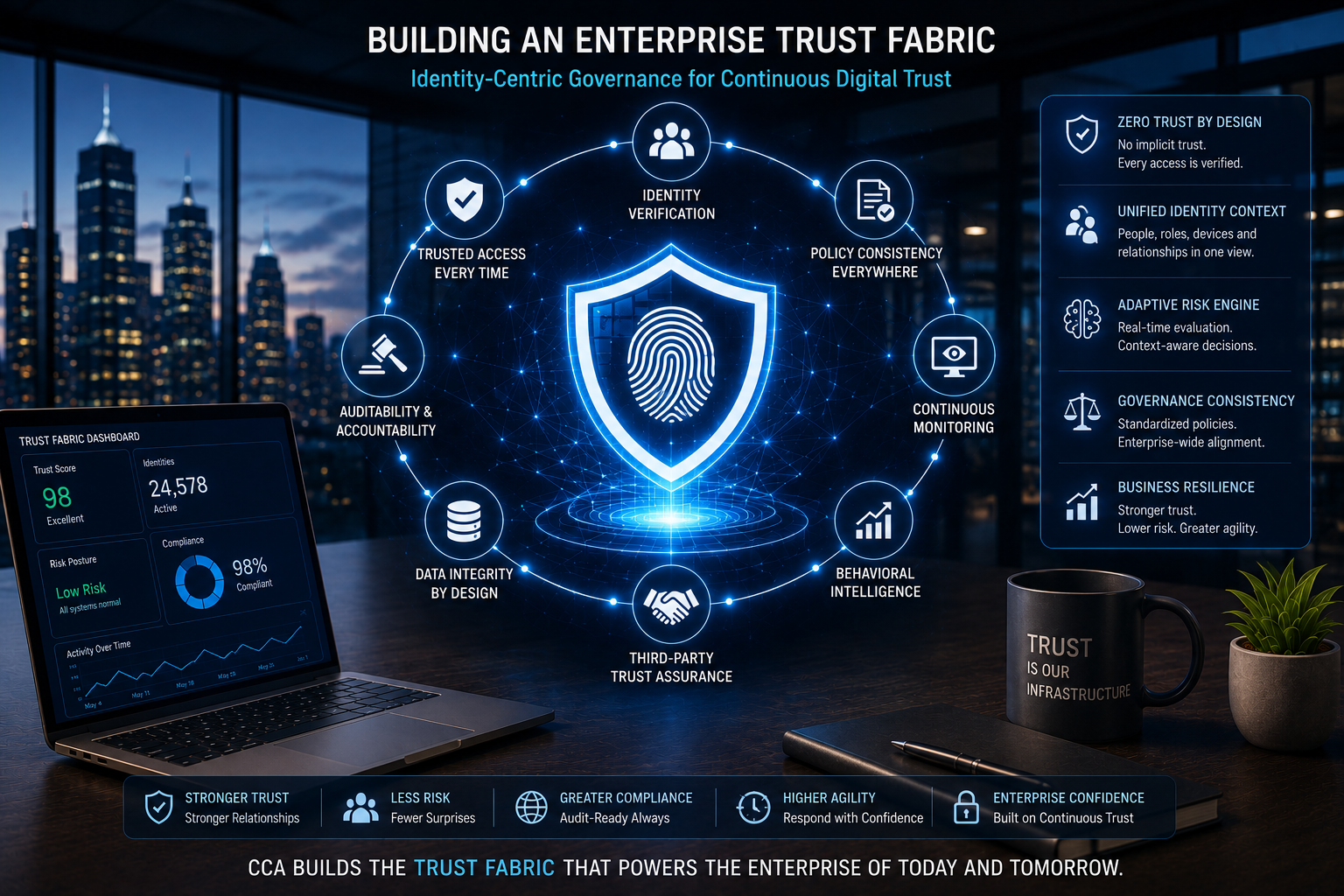
Digital transformation has fundamentally changed how enterprises establish trust. Employees collaborate across continents, vendors access enterprise platforms, customers expect instant service, and automated systems execute decisions at machine speed. In this environment, trust can no longer depend solely on security controls or periodic compliance reviews. It must become a continuously managed operational capability.
An Enterprise Trust Fabric provides this capability by connecting identity, governance, policies, workflows, operational intelligence, and compliance into a unified control architecture. Rather than allowing each application to define its own governance model, the trust fabric establishes consistent enterprise policies that govern every operational interaction. Color Card Administrator (CCA) delivers this governance-first architecture, enabling organizations to build trusted enterprise operations that remain resilient as technology and business models evolve.
Why Digital Trust Has Become a Business Requirement
Enterprise trust influences every operational decision. Whether approving a business identity request, onboarding a supplier, granting delegated authority, or executing lifecycle automation, organizations must ensure every action follows enterprise policy. Fragmented governance creates inconsistent decisions, audit complexity, and operational risk. A centralized trust fabric eliminates these challenges by ensuring governance is applied consistently across all enterprise systems.
Identity Intelligence as the Foundation of Trust
Identity extends far beyond authentication. It represents business ownership, reporting relationships, regional responsibilities, vendor accountability, employment lifecycle, and delegated authority. CCA transforms trusted identity into operational intelligence by using identity context to determine approvals, workflow routing, policy enforcement, branding governance, and vendor orchestration. Every operational decision is supported by authoritative enterprise data rather than isolated application logic.
CCA as the Enterprise Trust Fabric
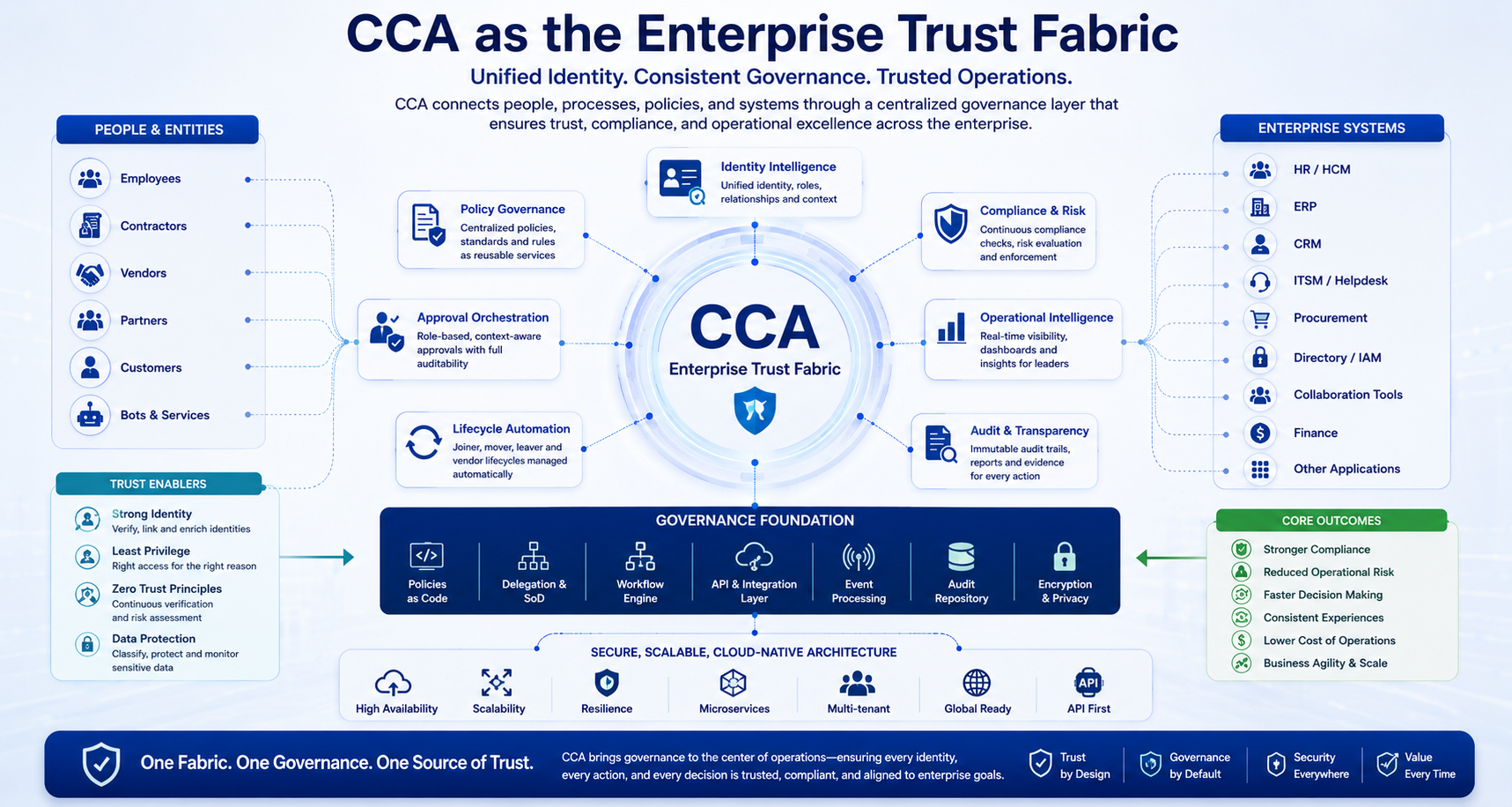
CCA functions as infrastructure rather than another operational application. It integrates with HR, ERP, CRM, procurement, directory services, collaboration platforms, and external fulfillment providers through APIs while introducing centralized governance across every connected environment.
Policy-driven workflow orchestration, lifecycle management, delegated administration, vendor governance, branding governance, audit logging, executive reporting, and operational intelligence become reusable enterprise services. This architecture preserves existing technology investments while creating a single governance model for the entire organization.
Operational and Strategic Benefits
Organizations implementing an Enterprise Trust Fabric improve compliance, reduce operational risk, accelerate onboarding, simplify audits, strengthen vendor governance, standardize approvals, and enhance executive visibility. Governance becomes proactive instead of reactive because operational events are continuously evaluated against enterprise policies. Decision-makers gain greater confidence knowing governance remains consistent regardless of geography, department, or technology platform.
Implementation Roadmap
Successful implementation begins with authoritative identity sources, standardized governance policies, workflow discovery, API integration, lifecycle automation, governance dashboards, and measurable KPIs. Enterprises should implement the trust fabric incrementally, beginning with high-value operational processes before expanding governance across additional business domains.
Preparing for AI-Native Enterprises
AI-powered operations will increasingly rely on trusted governance. Autonomous agents, predictive analytics, and intelligent workflows require explainable policies, transparent audit trails, and reliable identity context. Organizations that establish an enterprise trust fabric today will be better positioned to adopt future technologies without sacrificing governance, compliance, or accountability.
Conclusion
Enterprise trust is no longer created through isolated security controls. It emerges from continuous governance applied consistently across people, processes, vendors, applications, and operational decisions. Color Card Administrator (CCA) enables organizations to establish an enterprise trust fabric that transforms identity intelligence into scalable, policy-driven operational excellence.