

Why Business Identity Governance Is Becoming a Strategic Enterprise Capability
lIntroduction
Every generation of enterprise technology introduces a new operational discipline that changes how organizations manage scale. Enterprise Resource Planning systems standardized finance and supply chains. Customer Relationship Management platforms centralized customer engagement. Human Capital Management systems organized workforce administration. Identity and Access Management platforms secured access to enterprise applications. Each technology category solved a defined enterprise problem and then became part of the operating foundation of the modern organization.
Yet one enterprise capability has remained fragmented even after decades of digital transformation: business identity. Business identity extends beyond employee records, login credentials, business cards, or directory data. It is the complete operational identity of the enterprise as it appears across people, departments, locations, vendors, workflows, approvals, brand representation, and external-facing business interactions.
Business identity determines who may represent the organization, who may approve operational decisions, which vendors may perform enterprise services, which organizational hierarchy governs execution, how brand standards are enforced, and how business identity is maintained across a distributed enterprise. When this identity is fragmented, governance becomes fragmented as well.
Historically, business identity responsibilities were distributed across Human Resources, IT, Marketing, Procurement, Operations, Finance, regional administration, and external vendors. Each function performed its own work, but no single governance layer connected these activities into one operational identity model. As enterprises expanded globally, this fragmentation became harder to control.
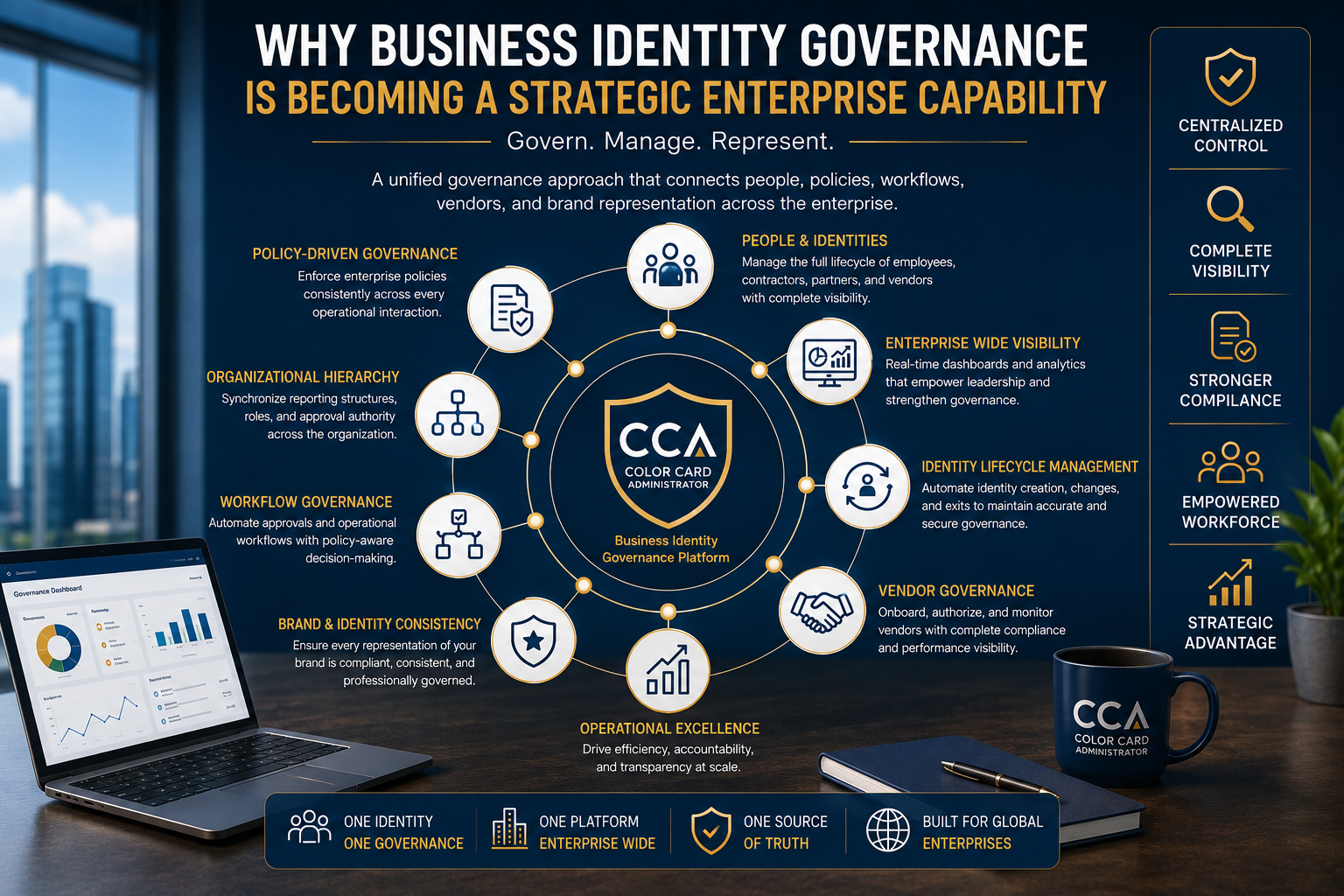
Modern enterprises are now recognizing that business identity requires centralized governance. Business Identity Governance is no longer an administrative support process. It is becoming a strategic enterprise capability that connects people, policies, workflows, vendors, organizational structures, and enterprise representation into one governance framework.
Why Business Identity Has Become More Complex Than Ever
Two decades ago, enterprise identity was often easier to understand. Organizations primarily governed employees, departments, office locations, telephone directories, and internal systems. Operational identity was comparatively stable because work was performed inside clearer organizational boundaries.
Today, enterprise identity includes full-time employees, contractors, temporary staff, consultants, outsourcing providers, regional offices, franchise operations, global business units, print vendors, marketing agencies, procurement teams, shared service centers, executive assistants, and external partners. Each participant may represent the enterprise, initiate requests, approve workflows, interact with vendors, or influence customer-facing identity.
This business identity complexity increases further when organizations operate across multiple regions, currencies, languages, regulatory environments, and vendor networks. A title change in one country may require a different approval workflow than the same change in another country. A business card request in one region may require a local print vendor, while another region may require centralized fulfillment. A department transfer may affect cost center ownership, brand representation, procurement eligibility, and approval authority at the same time.
Business identity therefore grows exponentially as the enterprise grows. Managing this identity through emails, spreadsheets, disconnected portals, and local administrative practices is no longer sustainable. The enterprise needs governance infrastructure that can continuously align identity with operational reality.
Identity Has Become the Foundation of Operational Decisions
Identity once answered a simple question: who is this employee? Modern governance requires identity to answer a much broader set of operational questions. Who owns this responsibility? Who may authorize this request? What do policies apply to? Is the vendor permitted? Should a branding standard be used? Region governs execution? Which department owns the cost? Which manager must approve?
Every operational decision depends on identity context. Without accurate identity context, organizations rely on manual interpretation. Different managers may choose different approval paths. Regional offices may maintain different templates. Vendors may receive inconsistent instructions. Administrative teams may use outdated employee information. These inconsistencies are not isolated mistakes; they are symptoms of weak identity governance.
Business Identity Governance turns identity into operational context. It ensures that identity attributes such as role, region, department, reporting structure, cost center, vendor eligibility, and brand permissions are not merely stored as information. They actively guide enterprise execution.
When identity becomes the foundation of operational decisions, governance becomes more predictable. Employees no longer need to interpret complex policies manually. Systems apply the correct governance rules based on the identity context of each request.
Business Identity Is Becoming Enterprise Infrastructure
Every mature enterprise eventually reaches a point where isolated operational systems cannot keep pace with organizational growth. Departments become more specialized. Business units become more autonomous. Regional operations expand internationally. Vendors become strategic partners. Processes become increasingly interconnected. The challenge is no longer the absence of technology; the challenge is the absence of a shared governance layer.
Business Identity Infrastructure addresses this gap. It acts as the connective layer between enterprise systems such as ERP, CRM, HCM, IAM, procurement platforms, workflow engines, vendor systems, and brand management processes. It does not replace these systems. Instead, it coordinates how they participate in governance.
For example, an HCM system may know an employee’s role, but it may not know which business card template should apply. A procurement system may know vendor contracts, but it may not know which region can use which print provider. A workflow platform may route approvals, but it may not know whether the approver reflects the current organizational hierarchy. Business Identity Governance connects these operational details into one governed model.
Infrastructure is valuable because it supports everything built upon it. In the same way that networks support communication and databases support information management, business identity infrastructure supports operational governance. It allows enterprise policies to be applied consistently across every connected process.
Governance Must Follow the Entire Business Identity Lifecycle
Business identity is dynamic. It evolves as organizations grow, restructure, hire, promote, transfer, merge, acquire, outsource, and expand. A governance model that only works at the point of creation is incomplete. Business identity must be governed across its complete lifecycle.
At identity creation, the enterprise must establish business unit assignment, department ownership, region, manager, approval authority, brand permissions, business card eligibility, vendor relationships, cost center, and compliance obligations. If these attributes are not governed from the beginning, downstream processes inherit inconsistency.
At identity evolution, the enterprise must respond to promotions, transfers, relocations, new responsibilities, organizational changes, and leadership changes. Each change may affect approval authority, vendor access, business card details, departmental ownership, and brand representation. Without synchronization, old permissions remain active and new responsibilities are not applied consistently.
At identity retirement, the enterprise must remove operational permissions as rigorously as digital access. Many organizations deactivate system access quickly when an employee leaves, but business identity often remains active in vendor portals, approval lists, print workflows, spreadsheets, and administrative records. This creates unnecessary operational and compliance risk.
Business Identity Governance treats creation, modification, suspension, and retirement as governance events. Each event triggers policy-driven updates across operational processes.
Identity-Driven Workflow Governance
Workflow automation is now common across large enterprises. Organizations automate approvals, procurement requests, employee onboarding, marketing requests, business card ordering, finance processes, and administrative operations. However, automation without identity governance can accelerate inconsistency.
A workflow is only as governed as the identity context that drives it. Two employees may submit the same type of request, but their governance requirements may differ based on region, department, role, seniority, cost center, vendor eligibility, and brand standard. A generic workflow cannot handle these differences unless it is identity-aware.
Identity-driven workflow governance evaluates who initiated the request, which organizational rules apply, which department owns the process, which regional policies apply, which vendors are authorized, which approvals are required, and which audit records must be created. Only after governance validates these conditions should workflow execution begin.
This approach changes the role of workflow automation. Automation is no longer only about speed. It becomes a mechanism for executing governance accurately and consistently. The workflow does not bypass policy; it becomes the vehicle through which policy is applied.
Vendor Identity Is Enterprise Identity
One of the fastest-growing governance challenges involves external operational identities. Modern enterprises rely on print vendors, marketing agencies, outsourcing providers, recruitment partners, logistics organizations, managed service providers, technology consultants, and regional distributors. Each external entity may represent or influence the enterprise in some capacity.
Yet vendors are often governed differently from employees. Employees are managed through identity systems and lifecycle policies. Vendors are frequently managed through contracts, emails, and procurement records. Contracts establish responsibility, but operational governance ensures that responsibilities are executed consistently.
Vendor identity should be treated as part of enterprise identity. The enterprise should govern which vendors may provide specific services, which regions may use them, who may approve vendor work, which brand standards apply, what compliance requirements exist, and when authorization should expire.
This is especially important for business identity operations such as business card production, print fulfillment, brand asset execution, and regional representation. A vendor producing enterprise identity assets becomes part of the governance ecosystem. If vendor identity is not governed, enterprise identity is not fully governed.
Organizational Hierarchy Drives Operational Governance
Organizational hierarchy is often treated as a reporting structure, but in an enterprise governance context it is much more than that. Hierarchy determines approval authority, budget ownership, vendor governance, procurement permission, department administration, brand accountability, regional ownership, and escalation responsibility.
When hierarchy changes, governance must change at the same time. A promotion may create new approval rights. A transfer may change cost center ownership. A reorganization may alter who owns vendor relationships. A new regional office may introduce local brand requirements. If governance is not synchronized with hierarchy, operational systems begin to reflect outdated organizational reality.
Business Identity Governance ensures that hierarchy remains an active governance asset. Approval workflows, business card rules, vendor permissions, and brand controls reference the current organization rather than static lists maintained manually by administrators.
This reduces administrative effort and improves audit readiness because decisions can be traced to the organizational structure that existed at the time of execution.
Distributed Enterprises Require Centralized Governance

Global organizations require distributed execution. Regional teams must respond to local market needs. Country offices need localization. Business units require operational independence. Shared service centers need efficiency. Local vendors may be necessary for practical execution. However, distributed execution should never become distributed governance.
Distributed governance creates inconsistent policies, inconsistent vendor relationships, inconsistent branding, and inconsistent approval structures. Over time, the enterprise loses visibility and control. Business Identity Governance solves this by separating governance from execution.
Governance remains centralized through enterprise policies, brand standards, approval models, compliance rules, vendor controls, and identity lifecycle management. Execution remains distributed through regional workflows, local vendors, business unit operations, and approved exceptions. This model provides flexibility without sacrificing control.
Business Identity Supports Enterprise Decision-Making
Every operational decision begins with context. Who initiated the request? Which department owns responsibility? Do business units govern execution? Where do policies apply? Are vendors authorized? Do regional governance models apply? Business identity provides this context.
Without centralized business identity governance, decision-making becomes dependent on human interpretation. Different teams may follow different processes. Mu regions may enforce different standards. Different vendors may receive different instructions. Leadership may lack visibility into why decisions were made.
Business Identity Governance creates decision consistency by ensuring that operational decisions reference the same identity framework. This improves confidence for employees, managers, auditors, vendors, and executive leadership. It also improves the quality of operational data because decisions are governed at the point of execution.
The Role of Color Card Administrator (CCA) as Business Identity Infrastructure
As enterprises expand across regions, business units, and partner ecosystems, governance can no longer depend on disconnected operational tools. Organizations require a centralized platform that connects business identity with enterprise execution. Color Card Administrator (CCA) provides this governance layer.
CCA is not positioned as a simple business card ordering application. It is an enterprise-first Business Identity Governance Platform that transforms operational identity into governed enterprise infrastructure. It centralizes business card lifecycle governance, approval workflow automation, vendor governance, organizational hierarchy synchronization, brand governance, regional administration, department management, identity lifecycle governance, policy enforcement, and operational audit visibility.
When an employee requests a business card, CCA can evaluate the requester’s identity, department, role, region, approval authority, authorized vendor, brand template, cost center, and compliance requirements. The request becomes a governed identity event rather than a manual administrative task.
This approach allows enterprises to define governance once and execute it consistently across distributed operations. CCA connects centralized control with distributed execution, which is essential for large organizations that must maintain policy consistency while enabling local teams to operate efficiently.
Governance Becomes Continuous Rather Than Periodic
Many organizations still evaluate governance periodically through monthly reviews, quarterly audits, annual policy updates, and occasional vendor assessments. These activities remain important, but they are retrospective. They evaluate governance after operational decisions have already occurred.
Business Identity Governance enables continuous governance. Every operational interaction becomes a governance checkpoint. A promotion updates approval authority. A transfer updates templates and cost centers. A vendor change updates eligibility and regional fulfillment. A department reorganization updates workflow routing. Governance becomes active at the moment of change.
Continuous governance reduces the distance between organizational reality and operational execution. The enterprise does not wait for the next audit to discover an inconsistency. Governance is maintained as work happens.
Governance Should Be Invisible but Always Present
The most effective governance platforms are often the least disruptive. Employees should not need to determine which vendor is authorized, which template applies, which approval path is correct, or which policy governs a request. Those decisions should be applied automatically.
Invisible governance creates a better employee experience because employees can focus on work rather than policy interpretation. At the same time, the enterprise gains stronger control because governance is consistently enforced behind the scenes.
This does not make governance less important. It makes governance more reliable. The objective is not to make governance more visible; the objective is to make governance impossible to bypass unintentionally.
Enterprise Governance Requires a Single Operational Language
Large enterprises often struggle because departments describe governance differently. Human Resources discusses roles and reporting structures. IT discusses identities and access. Procurement discusses suppliers. Marketing discusses brand standards. Operations discusses execution. Finance discusses controls. These perspectives are different, but they often refer to the same operational relationships.
Business Identity Governance provides a single operational language across departments. It connects roles, departments, vendors, workflows, approvals, and representation through one governed model. This improves cross-functional collaboration and reduces ambiguity.
When every function references the same business identity framework, enterprise governance becomes easier to understand, measure, and improve.
Governance Should Support Innovation Rather Than Restrict It
Some leaders sometimes mistake governance for a barrier to flexibility. In mature enterprises, governance enables flexibility because it creates safe operating boundaries. Teams can move faster when they know which policies apply and when systems apply those policies automatically.
Regional offices can execute within approved boundaries. New business units can integrate more quickly. Vendors can be onboarded more consistently. Acquisitions can be standardized faster. Innovation accelerates because governance provides predictable structure rather than manual friction.
Business Identity Governance therefore supports transformation. It does not slow the enterprise; it reduces uncertainty so the enterprise can move with confidence.
Business Identity Governance During Enterprise Transformation
Enterprise transformation affects business identity at every level. Digital transformation changes how people perform work. Global expansion introduces new regions and vendors. Mergers and acquisitions introduce new organizational structures. Outsourcing changes operational ownership. Remote work changes location assumptions. New regulations change compliance expectations.
Without centralized governance, every transformation initiative creates identity inconsistency. Business Identity Governance provides continuity by ensuring that identity, policies, vendors, workflows, and hierarchy remain synchronized throughout change.
This makes business identity governance especially important for enterprises undergoing rapid growth, acquisitions, international expansion, or operational modernization.
Enterprise Governance Maturity: Looking Beyond Technology
Technology alone does not create governance maturity. Maturity emerges when governance becomes embedded in operating culture and enterprise architecture. Organizations typically progress through stages: administrative governance, departmental governance, workflow governance, identity-centric governance, and policy-driven enterprise governance.
At the administrative stage, governance relies on emails, spreadsheets, and individual knowledge. The departmental stage, individual functions improve local controls. In the workflow stage, automation improves routing but may not guarantee policy consistency. At the identity-centric stage, identity becomes the foundation for governance. At the policy-driven stage, governance becomes enterprise infrastructure.
Organizations operating at higher maturity levels experience stronger compliance, better audit readiness, reduced administrative overhead, improved vendor governance, faster organizational change, and more predictable execution across global operations.
The Future of Business Identity Governance
The next generation of Business Identity Governance platforms will become increasingly intelligent. AI-assisted governance will analyze operational patterns and recommend improvements. Predictive governance will identify risks such as approval bottlenecks, vendor exceptions, identity inconsistencies, and brand governance issues before they become operational problems.
Continuous organizational synchronization will reduce manual administration as identity changes automatically propagate across connected workflows and governance processes. Unified operational visibility will give leadership teams a broader view of governance performance across identity consistency, vendor governance, workflow compliance, brand governance, and policy adoption.
This evolution will elevate governance from a compliance requirement to an executive management capability. Leaders will not only ask whether teams are completing the work; they will ask whether the enterprise is governing that work consistently.
Business Identity Governance as a Competitive Advantage
Organizations often view governance as a cost of doing business. That perspective is changing. Strong governance can become a competitive advantage because it enables scale, speed, consistency, and trust.
Enterprises with mature business identity governance can onboard employees faster, reorganize more confidently, standardize vendor relationships, maintain brand consistency, improve audit readiness, reduce operational risk, and support global expansion. These benefits are not merely administrative. They influence enterprise performance.
When governance is weak, growth creates complexity. When governance is strong, growth becomes more manageable. Business Identity Governance gives organizations the operational foundation required to scale without losing control.
Conclusion
Business Identity Governance has evolved from an administrative necessity into a strategic enterprise capability. As organizations become more distributed, operational consistency depends on the ability to connect people, organizational hierarchy, workflows, vendors, policies, and enterprise representation through a unified governance framework.
Business identity provides the context that guides enterprise decisions. It determines who can represent the organization, who can approve requests, which vendors can be used, which brand standards apply, and how governance is maintained across changing organizational structures.
Color Card Administrator (CCA) supports this transformation by providing an enterprise-first Business Identity Governance Platform that centralizes business card management, approval workflows, vendor governance, organizational hierarchy synchronization, brand compliance, and operational identity execution. CCA extends governance beyond traditional identity systems into the practical execution of enterprise operations.
As enterprises continue expanding across global operations, Business Identity Governance will increasingly become one of the defining capabilities of successful digital organizations.