

Enterprise Business Card Procurement: How Centralized Platforms Improve Cost Control and Visibility
Introduction
For many organizations, business card purchasing is often treated as a minor operational expense. Orders are submitted, vendors produce cards, and procurement teams focus their attention on larger spending categories. While this approach may seem reasonable, enterprise organizations frequently discover that decentralized business card procurement creates hidden costs, operational inefficiencies, and governance challenges.
As companies grow, business card programs often expand across multiple offices, regions, departments, and vendors. Without centralized oversight, organizations struggle to maintain visibility into spending, enforce procurement policies, manage vendor relationships, and measure operational performance.
This is why enterprise organizations are increasingly adopting centralized business card management platforms that support procurement governance as part of a broader operational framework.
Business card printing is the transaction.
Business card management is the workflow.
Governance is the control layer.
API integration is the differentiator.
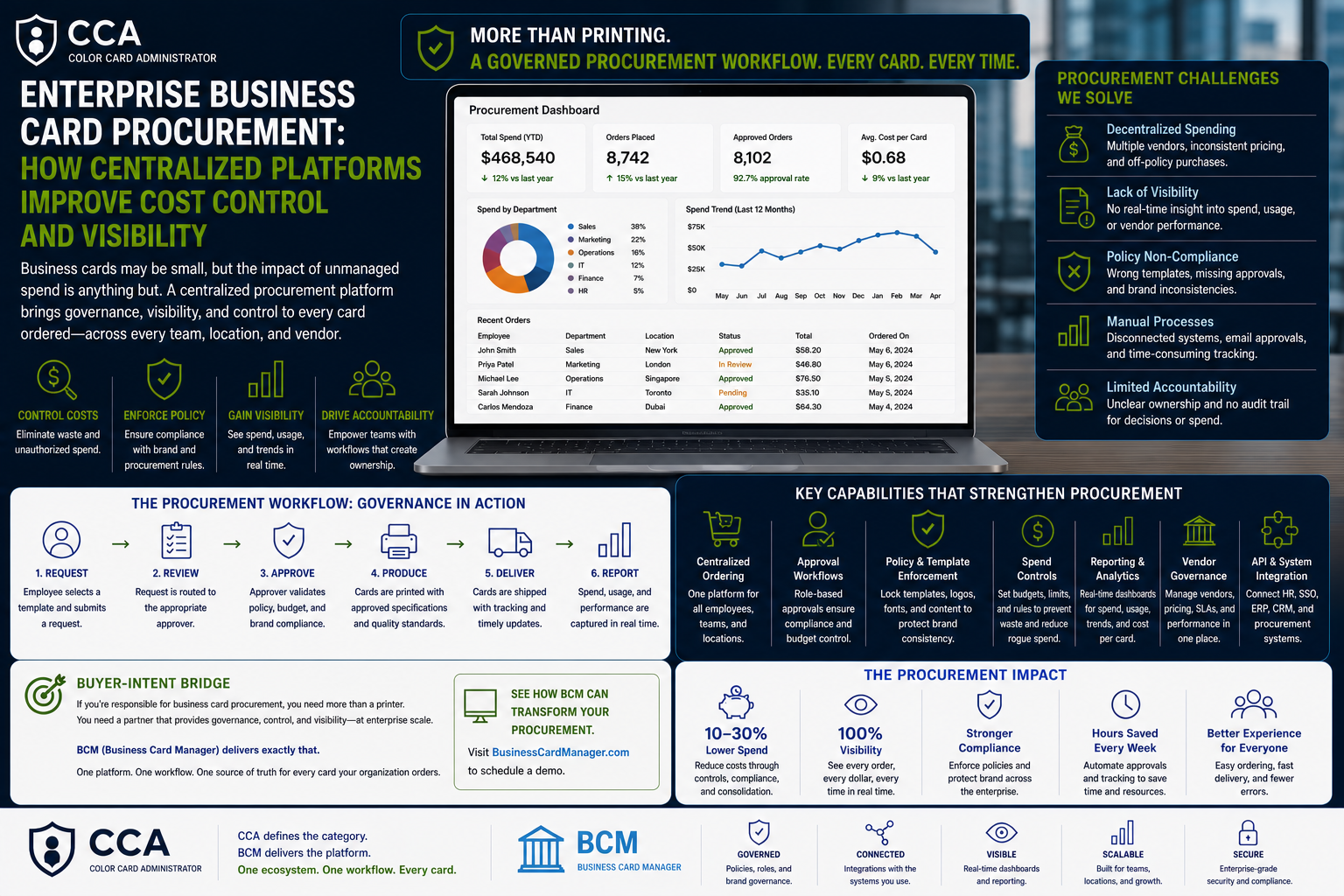
The Procurement Challenges of Decentralized Ordering

Many organizations allow business card orders to be managed locally. Individual offices select vendors, employees submit requests independently, and approvals vary from one department to another.
While this approach provides flexibility, it often introduces significant procurement challenges.
Common Procurement Challenges
- Organizations lose visibility into overall spending.
- Vendor relationships become fragmented.
- Pricing varies across locations.
- Reporting becomes difficult.
- Contract compliance becomes inconsistent.
- Administrative effort increases.
Over time, these challenges create unnecessary costs and reduce procurement effectiveness.
Why Procurement Visibility Matters
Procurement visibility is essential for organizations that want to manage spending effectively.
Without visibility, organizations cannot accurately answer important questions:
- How much is being spent on business cards?
- Which departments generate the highest costs?
- Which vendors provide the best performance?
- How many orders are approved each month?
- Where do inefficiencies occur?
A centralized business card management platform provides a single source of truth for procurement activity.
This enables leaders to make informed decisions while strengthening financial oversight.
Centralized Ordering and Cost Control
One of the most significant benefits of centralized business card procurement is improved cost control.
Centralized ordering consolidates activity into a single platform, allowing organizations to standardize workflows, negotiate vendor agreements, reduce duplicate processes, and improve purchasing consistency.
Organizations gain greater control over budgets while reducing administrative complexity.
Approval Workflows and Procurement Governance
Procurement governance begins before an order is placed.
Organizations often require approval workflows to validate spending, confirm employee information, verify branding requirements, and enforce purchasing policies.
Business card approval workflow software helps organizations automate these controls.
Requests follow predefined approval paths. Spending oversight improves. Compliance becomes easier to maintain.
This reduces risk while strengthening governance.
Vendor Governance and Supplier Management
Vendor management is a critical component of procurement success.
Many organizations work with multiple business card suppliers across different regions. Without centralized visibility, evaluating vendor performance becomes difficult.
Business Card Management Platforms Allow Organizations to Monitor:
- Vendor performance
- Fulfillment quality
- Pricing consistency
- Service-level agreements
- Delivery timelines
- Operational outcomes
This creates greater accountability while improving supplier relationships.
Reporting and Procurement Intelligence
Procurement teams increasingly require data-driven decision-making.
Business card management platforms provide reporting capabilities that transform transactional activity into operational intelligence.
Leaders gain insight into spending trends, order volumes, approval performance, vendor effectiveness, and workflow efficiency.
This supports better budgeting, stronger governance, and improved strategic planning.
Multi-Location Procurement Management
Enterprise organizations frequently operate across multiple locations and business units.
Managing procurement independently across each location often creates inconsistencies and inefficiencies.
A centralized platform allows organizations to standardize procurement workflows while maintaining flexibility for local operations.
This balance between control and flexibility is one of the key advantages of enterprise business card management platforms.
The Role of API Integration
API integration plays an increasingly important role in procurement management.
Enterprise organizations already operate procurement systems, ERP environments, HRIS platforms, reporting tools, and workflow applications.
Business card procurement should not operate independently from these systems.
API-Connected Infrastructure Enables:
- Employee information can synchronize with ordering workflows.
- Reporting systems can receive operational data.
- Approval events can trigger procurement actions.
This creates a connected operational framework that improves efficiency and visibility.
Buyer-Intent Bridge
How This Differs from Traditional Business Card Purchasing
Traditional purchasing focuses on placing orders.
Enterprise business card procurement focuses on governance, visibility, reporting, vendor management, cost control, and operational efficiency.
Why Enterprises Need Centralized Procurement Management
As organizations grow, decentralized purchasing creates visibility gaps and governance challenges. Centralized platforms help organizations maintain control while improving scalability.
When Should Organizations Adopt a Centralized Platform?
Organizations should consider centralized procurement management when spending visibility becomes limited, vendor relationships become fragmented, reporting becomes difficult, or administrative effort increases.
What Should Buyers Prioritize?
Enterprise buyers should prioritize:
- Procurement visibility
- Centralized ordering
- Approval workflows
- Vendor governance
- Reporting capabilities
- API integration
- Scalability
Strategic Takeaway
Enterprise business card procurement is no longer simply about purchasing printed materials.
It is about managing spending, governance, vendor relationships, reporting, approvals, and operational workflows within a centralized framework.
Organizations that adopt centralized business card management platforms gain stronger procurement visibility, better cost control, improved governance, and more scalable operations.
As enterprise business card programs continue evolving, procurement management will become an increasingly important component of API-Integrated Enterprise Business Card Printing and Management.