

API Rate Limits and Capacity Governance For Enterprise Business Card Ordering
Capacity Is Part of Business Card Governance
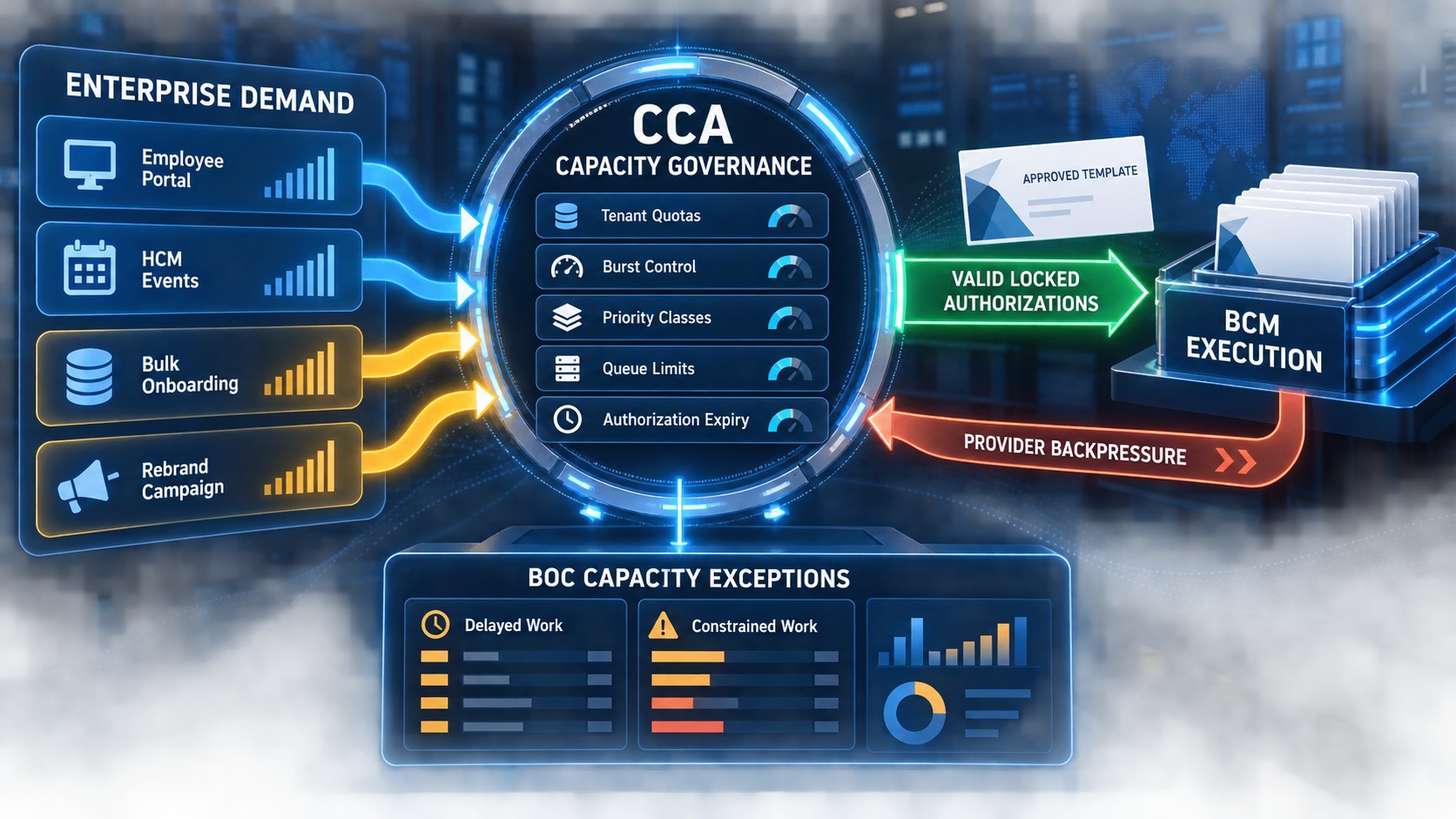
Enterprise demand is uneven. A new acquisition can add thousands of employees, a brand migration can trigger replacement programs, a seasonal hiring cycle can generate synchronized requests and an employee portal defect can create a retry storm. If every request competes equally for limited processing capacity, urgent governed work can be delayed while duplicate or invalid traffic consumes the system.
Color Card Administrator (CCA) should control how connected systems access enterprise business card ordering under load. It remains the authority for eligibility, identity fields, templates, approvals, quantities, destinations, and ordering rights. Business Card Manager (BCM) executes only valid locked authorizations. Business Ops Center (BOC) observes capacity exceptions, provider constraints, and reconciliation. Rate limits protect this operating model; they do not replace it.
Separate Technical Capacity from Business Authority
| Control | Question answered | Owner | Result |
|---|---|---|---|
| Authentication limit | Is the caller creating abnormal identity or token traffic? | Identity and API platform | Slow, reject or investigate access activity |
| Consumer quota | How much API work may this application initiate in a defined window? | CCA integration governance | Permit within allocation or return timing guidance |
| Tenant allocation | How is shared capacity divided among enterprises or programs? | CCA platform governance | Isolate demand and preserve fairness |
| Business rule | Is this card request permitted? | CCA authority engine | Approve, deny or require approval |
| Execution capacity | Can BCM safely accept authorized work now? | BCM execution layer | Accept, queue or apply controlled backpressure |
| Provider capacity | Can production and fulfillment meet the committed service level? | BCM and provider operations | Route, schedule or open an exception |
| Exception oversight | Is delayed work owned and reconciled? | BOC | Track impact, evidence, recovery and closure |
Use More Than One Rate Limit
A single requests-per-minute number is too blunt for enterprise ordering. Read-only status checks, policy evaluations, proof generation, approval transitions, and final order submissions have different costs and risks. Limits should be layered by tenant, consumer, endpoint, operation, program, and downstream dependency. They should also distinguish short bursts from sustained volume.
| Limit layer | Purpose | Typical key | Governance concern |
|---|---|---|---|
| Global safety limit | Protect the entire service from systemic overload | Environment and service | Must preserve room for health, status and recovery traffic |
| Tenant limit | Prevent one enterprise from exhausting shared capacity | Tenant or contract | Must reflect committed service and isolation |
| Consumer limit | Control each portal, workflow or integration client | Client identity | Must expose ownership and prevent noisy neighbors |
| Operation limit | Match request frequency to processing cost and risk | Endpoint and method | Order creation requires stronger protection than reads |
| Program limit | Shape known campaigns such as rebrands or acquisitions | Program ID | Must align with approved rollout plan |
| Provider limit | Respect print, shipping or regional fulfillment constraints | Provider route | Must not create unbounded execution queues |
Distinguish Bursts from Sustained Demand
A brief burst is not necessarily abuse. Employees may sign in at the start of a shift, a portal may release a scheduled batch, or an approved campaign may begin at a planned time. Token-bucket or similar controls can allow a documented burst while limiting the sustained rate. The burst allowance should reflect safe processing headroom, not optimistic peak throughput.
Sustained demand needs a different response. Once the burst budget is consumed, CCA should return stable capacity guidance, including whether the request was accepted, the applicable limit scope, a safe retry time and a correlation reference. Consumers should spread retries with jitter and remain within a bounded budget. Repeated unchanged submissions must not create new business intent.
Design Quotas Around Governed Work
Quota units should represent useful business work rather than raw network calls alone. One status lookup may cost less than a full eligibility evaluation, proof render or order submission. Weighted quotas can reflect processing cost, but the contract must remain predictable enough for consumer teams to design against it.
Quota allocation should also reflect enterprise commitments. A planned global rebrand, acquisition onboarding or regulatory identity update may require a temporary program allocation. That allocation should have an owner, approved scope, start and end time, expected volume, monitoring threshold and rollback plan. Increasing capacity must never expand who is eligible or which card attributes someone/the policy authorizes.
Protect High Value and Recovery Traffic
When capacity is constrained, not every operation has equal urgency. Authentication repair, order-status inquiry, business card approval workflow completion, cancellation before production, and reconciliation may need reserved capacity. Without reservation, a flood of new requests can prevent consumers from learning whether earlier orders succeeded, which increases duplicate risk.
Priority should be based on explicit service classes and business deadlines, not on who retries fastest. A request marked urgent by a consumer should not bypass CCA policy. CCA can validate the priority entitlement, and BCM can schedule authorized execution within the applicable service class. BOC should be able to see delayed queues and breached commitments without manually changing authorization.
Govern Bulk Onboarding and Campaign Demand
| Stage | CCA control | BCM behavior | BOC evidence |
|---|---|---|---|
| Plan | Validate population, program, templates, schedule and expected volume | Reserve forecast execution capacity | Record owner, forecast and readiness checks |
| Prepare | Prevalidate authoritative data and approval dependencies | Confirm production and fulfillment constraints | Track unresolved data and provider risks |
| Release | Issue governed decisions in controlled waves | Accept locked authorizations within agreed rate | Measure queue age, rejection and throughput |
| Recover | Pause or slow new waves when thresholds are crossed | Drain accepted work without duplication | Open capacity cases and reconcile outcomes |
| Close | Expire temporary quota and unused authorization | Complete final execution status | Confirm counts, exceptions and evidence |
Bulk work should use explicit batch and item identities. The batch communicates the approved campaign context; each item retains its own employee, decision, authorization and execution evidence. Partial success must be visible. A failed item should not force a complete replay of successful work, and a restarted batch must not create duplicate physical orders.
Return Machine Actionable Capacity Responses
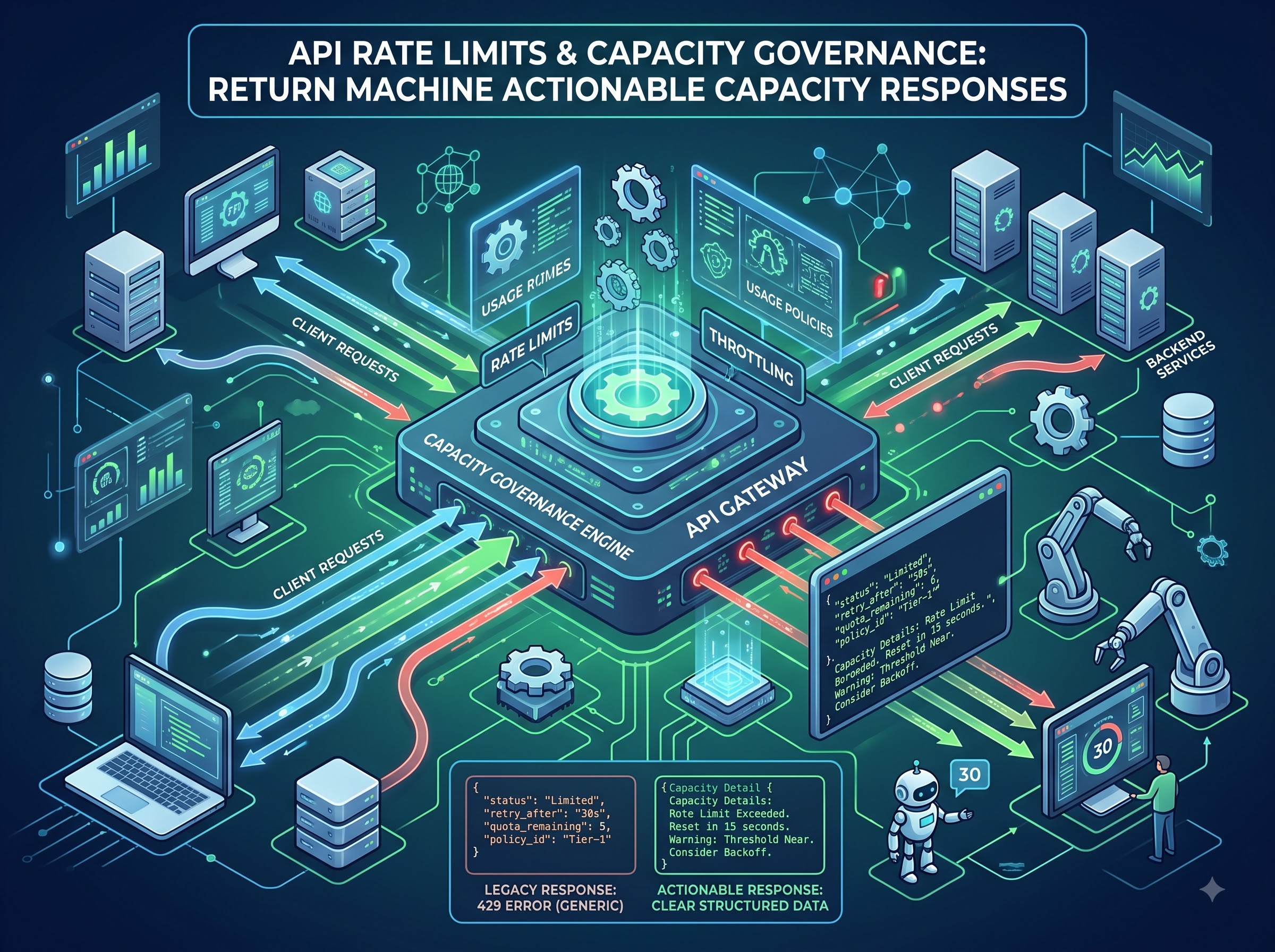
A capacity response should say whether [the system] rejected the request before processing, accepted it for asynchronous work, or left it with an unknown outcome. It should identify a stable code, limit scope, policy name or version where permitted, remaining capacity when useful, retry time, correlation ID and status location. Standard headers can carry timing information, while the response body explains the enterprise business card management meaning.
Post 111 established the error taxonomy. Capacity limits should use that taxonomy rather than return a generic server failure. A safe response enables the consumer to wait, reduce concurrency, query accepted work or escalate a prolonged service impact. It must not encourage a user to submit manually outside CCA.
Coordinate Backpressure Across CCA BCM and Providers
Backpressure must travel upstream before queues become unbounded. Provider production constraints should inform BCM intake; BCM execution capacity should inform CCA authorization release; CCA guidance should shape portal and integration traffic. Each layer should preserve its responsibility instead of exposing a downstream provider directly to enterprise consumers.
| Signal | Source | Upstream action | Authority preserved |
|---|---|---|---|
| Execution queue threshold | BCM | Reduce authorization release or schedule accepted work | CCA still determines permitted business action |
| Provider capacity warning | Fulfillment integration | Adjust routing or approved campaign pacing | Provider cannot redefine eligibility or card content |
| CCA evaluation saturation | CCA platform | Throttle new evaluations and protect status traffic | No authorization is inferred from delay |
| Consumer retry storm | API gateway and telemetry | Apply client limit and notify owner | Repeated traffic cannot change the decision |
| Regional service disruption | BOC and operations | Pause affected execution and reconcile impacted orders | Recovery remains evidence based |
Keep Queues Bounded and Observable
A queue hides demand temporarily; it does not create capacity. Every asynchronous queue needs a maximum depth, maximum age, ownership, dead-letter behavior and admission rule. The system should know whether an item is waiting for CCA evaluation, approval, BCM execution, provider acceptance or BOC operational reconciliation. One undifferentiated backlog makes service commitments impossible to manage.
Queue age is often more meaningful than queue length. Ten complex international orders may consume more time than hundreds of simple status reads. Track age percentiles by tenant, operation, priority class, program and provider. Alert when business deadlines or authorization validity are at risk, not only when infrastructure utilization is high.
Respect Authorization Expiry During Delay
Capacity delay cannot extend authority indefinitely. If a CCA decision or locked authorization expires before BCM accepts it, the item must return for a fresh governed evaluation. This protects against role changes, termination, template retirement, address changes and policy updates that occur while work is queued.
The platform should distinguish queue reservation from authorization. Reserving capacity for a campaign does not preapprove its members. Likewise, accepting an intent for later evaluation does not guarantee that CCA will authorize an order. Consumer interfaces should display these states accurately so users do not interpret waiting as approval.
Prevent Rate Limits from Becoming a Security Oracle
Limit messages should not reveal another tenant’s usage, internal capacity thresholds, provider credentials or sensitive program activity. Attackers can use timing and remaining-quota details to map the platform or infer ADP Workforce Now events. Return only the information the authenticated consumer needs to recover safely.
Use tenant isolation, authenticated limit keys, protected administrative overrides and tamper-resistant telemetry. Do not key quotas with personal data such as employee email addresses. Emergency limit changes need role-based access, reason, duration, approval where required and a complete audit trail.
Measure Capacity as a Business Control
| Measure | What it reveals | Decision supported |
|---|---|---|
| Accepted request rate | Useful demand admitted by operation and tenant | Baseline allocations and forecast growth |
| Throttled request rate | Demand deferred or rejected by limit scope | Identify undersized quotas or faulty consumers |
| Retry amplification | Extra calls produced for each constrained request | Correct backoff and retry-storm behavior |
| Queue age percentile | How long governed work waits at each stage | Protect deadlines and authorization validity |
| Authorization expiry in queue | Valid decisions lost before execution | Tune release pacing and execution capacity |
| Duplicate intents prevented | Repeated demand stopped before extra orders | Quantify governance protection |
| Capacity exception time | Duration from impact to reconciled closure | Improve BOC recovery and ownership |
Implementation Roadmap
- Inventory API consumers, operations, current limits, peak patterns, queues, provider constraints and service commitments.
- Define tenant, consumer, operation, program and provider limit scopes with named owners.
- Separate burst allowance, sustained rate, concurrency, queue depth and business quota controls.
- Reserve capacity for status, cancellation, approval completion and recovery operations.
- Publish machine-actionable timing and accepted-versus-rejected semantics using the Post 111 error model.
- Require idempotency and item-level identity for bulk workflows, partial success and replay.
- Connect provider and BCM backpressure to CCA release pacing without redistributing authority.
- Enforce authorization expiry and fresh evaluation when delayed work becomes stale.
- Test campaign surges, retry storms, consumer failures, regional outages and recovery traffic.
- Review capacity metrics with integration, security, program, BCM and BOC owners and adjust governed allocations.
Frequently Asked Questions
Does a rate limit mean the business card request was denied?
No. A capacity limit says the system cannot accept or process that API work at the current rate. CCA policy evaluation remains a separate business outcome.
Should a consumer immediately retry a throttled request?
No. It should follow the returned timing guidance, use bounded backoff with jitter and preserve the same idempotent intent.
Can a higher quota bypass CCA approval?
No. More capacity changes how much work can be evaluated or executed, not who is eligible or which approval is required.
How should bulk onboarding be handled?
Use an approved program, controlled waves, item-level identities, bounded queues, partial-success reporting and reconciliation.
What happens if authorization expires in a queue?
The item must return to CCA for a fresh decision before BCM execution.
Should status checks be limited like order submissions?
They should be controlled, but often with separate capacity because status visibility prevents unsafe resubmission and supports recovery.
Who owns provider capacity exceptions?
BCM manages execution with the provider, while BOC tracks unresolved impact and evidence. CCA continues to govern any new business action.
Can operations temporarily raise a limit?
Only through a governed, time-bound change with owner, reason, scope, monitoring and audit evidence.
The Strategic Outcome
Governed capacity management keeps enterprise business card ordering dependable during ordinary peaks and extraordinary programs. Connected applications receive predictable limits and recovery guidance. CCA protects fair access and valid decisions, BCM executes within bounded capacity, and BOC makes delayed or uncertain outcomes visible and accountable.
This reinforces the core purpose of the CCA website as the centralized administrative and governance authority for enterprise business card programs. APIs extend that controlled service into employee portals and enterprise applications; rate limits ensure that scale does not turn into policy bypass, duplicate production or unowned operational debt.
Map the busiest hour of business card activity across every connected portal, integration, CCA decision path, BCM queue and provider. Identify which operations need reserved recovery capacity, where authorization can expire and which consumer produces the greatest retry amplification. Convert those findings into documented limit scopes, service classes and owners.