

API Error Taxonomy and Governed Recovery For Enterprise Business Card Ordering
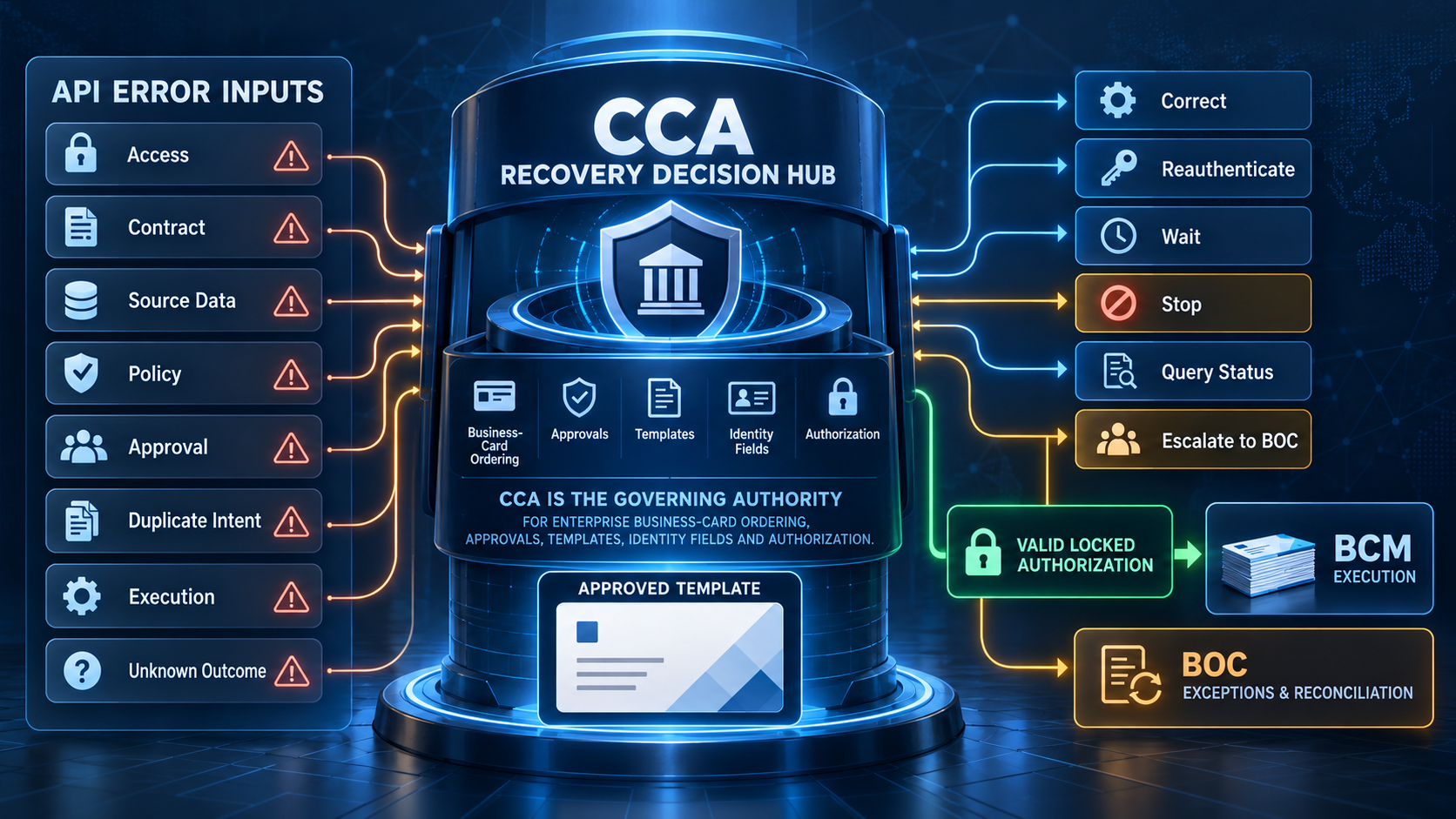
Turning every failure into a safe next action without bypassing CCA. Classify clearly, recover deliberately, preserve authority.
An Error Is A Governance Decision Point
When an enterprise application receives a generic failure, it must guess what to do. A portal may invite the employee to submit again, an integration worker may retry indefinitely, an operator may override a control or a support team may create a manual order. Those reactions can multiply requests, bypass approvals, expose personal data or conceal a policy denial. Clear error semantics are therefore part of business card governance, not merely a developer convenience.
Color Card Administrator (CCA) should identify whether the failure concerns access, contract validity, authoritative data, enterprise policy, approval state, duplicate intent, execution, or an unknown outcome. CCA remains the authority for eligibility, approved identity, templates, approvals, quantity, destination, and provider routing. Business Card Manager (BCM) executes a valid locked authorization. Business Ops Center (BOC) owns operational exceptions and reconciliation. Every error should lead to a bounded recovery action that respects these roles.
Separate Technical Failure from Business Outcome
| Layer | Question answered | Example result | Recovery owner |
|---|---|---|---|
| Authentication | Can the caller identity be trusted? | Token expired certificate invalid or issuer rejected | API consumer and identity platform |
| Technical authorization | May this consumer invoke this capability? | Scope missing tenant prohibited or environment blocked | Consumer owner and access governance |
| Contract validation | Is the request structurally and semantically valid? | Required field missing unknown version or invalid format | Consumer development team |
| CCA decisioning | Is the governed business action permitted? | Eligible denied approval required or authorization expired | CCA policy and program owner |
| BCM execution | Can the locked authorization be executed exactly? | Accepted duplicate prevented package rejected or production failed | BCM operations |
| BOC oversight | Is the final outcome known and reconciled? | Exception open provider status unknown or evidence incomplete | BOC case owner |
Build an Enterprise Error Taxonomy
An error taxonomy groups failures by meaning, risk, and recovery behavior. The code should be stable and machine-actionable; the message should be readable and safe; supporting details should identify the specific invalid field or state without revealing internal configuration. HTTP status is useful, but it cannot express the full enterprise identity standardization meaning on its own.
| Error family | Meaning | Consumer action | Must not do |
|---|---|---|---|
| AUTHENTICATION_FAILED | Caller identity could not be validated | Refresh or repair credentials through the approved identity path | Retry rapidly with the same invalid credential |
| ACCESS_DENIED | Authenticated consumer lacks permitted capability or resource | Stop and request governed access review | Treat denial as a temporary outage |
| CONTRACT_INVALID | Request violates the supported schema or semantic contract | Correct the request before resubmission | Send unchanged retries |
| SOURCE_DATA_UNRESOLVED | Required authoritative identity or organization data is missing or conflicting | Correct the owning source or route an approved exception | Allow free-form downstream substitution |
| POLICY_DENIED | CCA determined the business action is not permitted | Display the policy outcome and stop execution | Retry until a different answer appears |
| APPROVAL_REQUIRED | The request is valid but not yet authorized for execution | Follow the assigned approval route and check status | Create an order outside the approval path |
| IDEMPOTENCY_CONFLICT | The same intent key carries different governed meaning | Use a new key only for a genuinely new intent | Overwrite the original request |
| OUTCOME_UNKNOWN | A side effect may have occurred but confirmation is unavailable | Query status and escalate to BOC if unresolved | Submit a replacement order blindly |
Use a Predictable Error Envelope
Every error response should provide a stable code, category, safe message, correlation reference, contract version, timestamp, and retry guidance. Validation errors can include one or more field paths with reason codes. Governed outcomes can include a CCA decision reference, policy category, approval status or authorization expiry when the caller is permitted to see them. Operational identity governance errors can include an order or case reference without exposing supplier credentials or internal stack traces.
The envelope should distinguish retryable, correctable, approval-dependent, denied and unknown outcomes. A boolean retry flag is rarely enough. A consumer needs to know whether to retry immediately, retry after a specified delay, refresh credentials, correct data, poll status, wait for approval, create a new intent or stop permanently. The API contract should define each option and its limits.
Do Not Turn Policy Denials into Technical Errors
A CCA policy denial is a successful evaluation of an impermissible business request. It should not appear as a server failure, because automated infrastructure may retry server failures. The response should state that the action was evaluated and denied, identify an approved reason category and provide the allowed next step, such as correcting authoritative source data, selecting an eligible program or contacting a program administrator.
The response must not reveal sensitive policy internals that help a caller probe eligibility or bypass controls. User-facing language can explain the outcome without exposing thresholds or private attributes. A denial remains traceable to the CCA decision and policy version. BCM should never receive an executable authorization for that request.
Represent Approval as a State
Approval required is not the same as failure. The request may be structurally valid and eligible but waiting for an authorized person or workflow. The API should return a stable request and approval reference, current status, permitted status endpoint and expiration behavior. The consumer should display pending state rather than repeatedly create new requests.
Approval completion should trigger or enable a new CCA decision transition under the same governed intent. It should not allow the portal to manufacture an approved result. Rejection, expiry, reassignment and cancellation need distinct states and evidence. BCM executes only after CCA issues the valid locked authorization.
Give Validation Errors Field-Level Precision
Contract validation should identify which field is missing, malformed, unsupported, or conditionally prohibited. The response should use stable field paths and reason codes so a portal can highlight a problem and an integration team can correct its mapping. It should not echo complete personal values into logs or messages.
Schema validity is not business authority. A request can pass structural validation and still be denied by CCA because the employee, template, quantity, destination or approval route is not permitted. Keeping validation and decision errors separate prevents connected applications from assuming that syntactically valid data is authorized data.
Route Source Data Problems to the Right Owner
HCM, IAM, directory, location, CRM, and procurement governance may disagree about the identity or organizational context required for a card. The error should name the authoritative field category and source ownership, not invite the employee to type an alternative that bypasses master-data governance. Post 97 established field ownership; error recoshould enforce it.
When correction cannot happen immediately, CCA can create a bounded exception route with an owner, evidence, permitted fields and expiry. The result remains a governed decision. BOC can track unresolved conflicts and reconciliation, while BCM receives only the final authorized values.
Map Retry Behavior to Error Meaning
| Condition | Retry policy | Idempotency behavior | Escalation |
|---|---|---|---|
| Rate or capacity limit | Wait for server guidance and use bounded backoff with jitter | Reuse the same intent key | Escalate only after defined duration or business deadline |
| Temporary dependency unavailable | Retry within a controlled budget and circuit-breaker policy | Reuse the same intent key and request fingerprint | Open operations incident when the budget is exhausted |
| Authentication expired | Refresh through the approved credential flow then retry once safely | Reuse intent key if business meaning is unchanged | Escalate repeated identity failure to access owner |
| Contract invalid | Do not retry until corrected | Reuse key only if correction preserves the same intent and contract permits it | Route mapping defect to consumer owner |
| Policy denied | Do not retry automatically | Historical intent remains denied | Route any permitted appeal or exception through CCA |
| Approval pending | Poll or consume approved status events at a bounded cadence | Keep the same governed intent | Escalate expired or stalled approval to workflow owner |
| Outcome unknown | Query authoritative status before any command retry | Reuse all original correlations | Open BOC ambiguity case before resubmission |
Return Retry Timing as a Control
Retry timing protects both reliability and governance. Immediate synchronized retries can overload the API, obscure the original incident and produce repeated operational alerts. When a temporary condition is retryable, the response should provide a minimum delay or time, while the consumer applies bounded exponential backoff and jitter. The maximum attempts and total retry window should be documented.
Retry guidance must not override authorization expiry. If the delay extends beyond the validity of a CCA decision or locked authorization, the consumer should request a fresh governed evaluation instead of executing stale authority. A retry budget also prevents abandoned integrations from generating indefinite traffic.
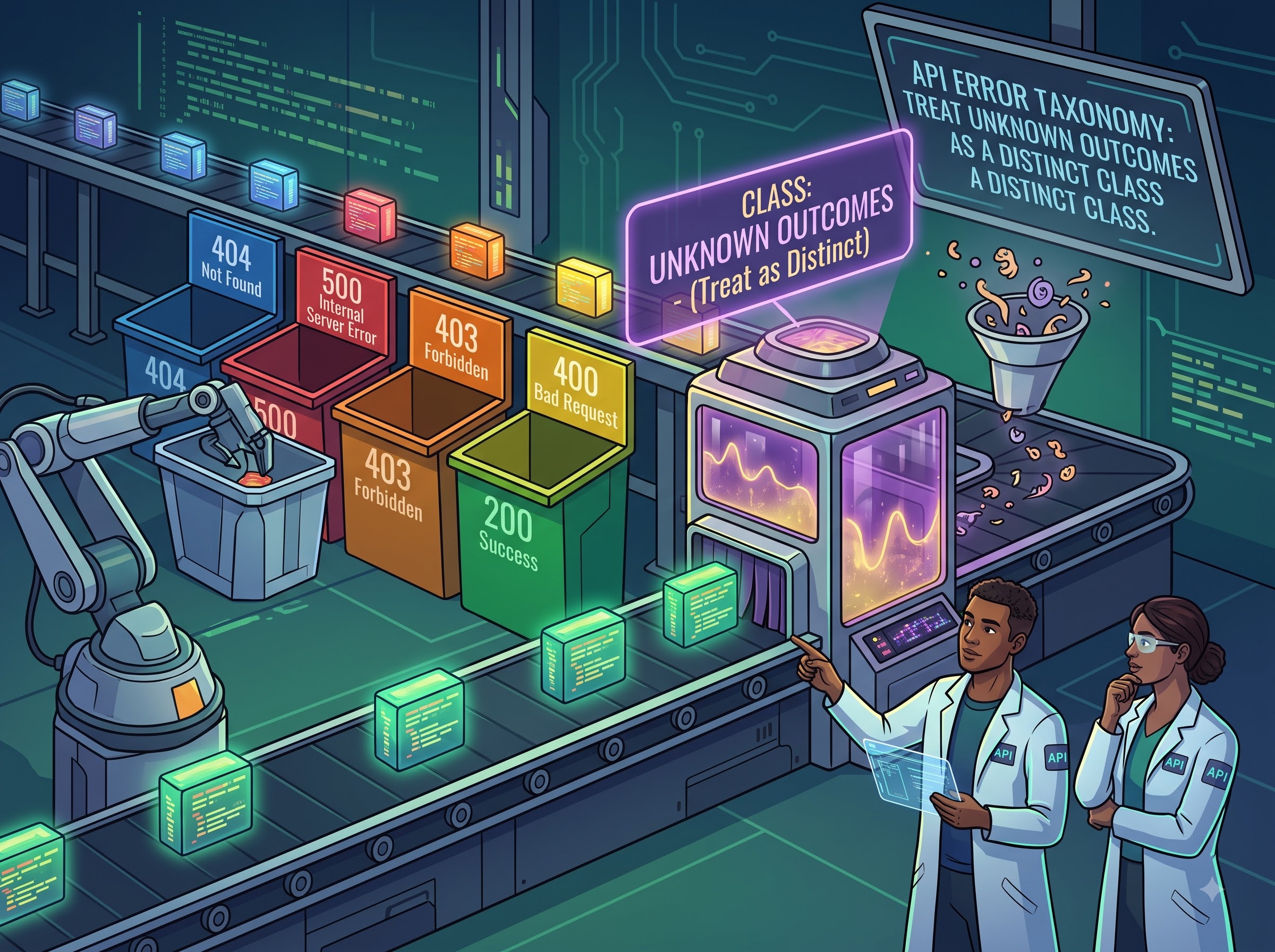
Treat Unknown Outcomes as a Distinct Class
A timeout after a side effect creates uncertainty, not proof of failure. CCA may have issued a decision, BCM may have accepted the authorization or the provider may have begun production. The response or subsequent status query should preserve the idempotency key, decision ID, order ID and provider correlation needed to locate the existing transaction.
If the system cannot establish the result, BOC should own an ambiguity case. The order remains on hold for resubmission until evidence is reconciled. This applies the duplicate-order protections from Post 110 and prevents a generic error handler from creating a second physical job.
Keep Human Messages and Machine Codes Aligned
Machine codes should be stable across wording, localization and channel changes. Human messages should explain what happened, whether any order was created and what the user can do next. Support teams need the same correlation reference shown in the portal. A message such as Something went wrong is unacceptable when the platform knows that approval is pending or policy denied the request.
Do not expose stack traces, database keys, security rules, credentials or full personal payloads. Detailed diagnostics belong in protected telemetry linked by correlation ID. User-facing copy should remain precise enough to prevent resubmission and support the correct recovery path.
Use Error Events for Asynchronous Workflows
Long-running approval, production and fulfillment processes may report failures through events rather than synchronous responses. Error events need stable identifiers, contract versions, affected request or order references, category, state transition, retryability and evidence of source authenticity. Receivers should deduplicate replayed events and reject invalid transitions.
An event can report that production failed or delivery was returned, but it cannot independently authorize a replacement. CCA evaluates the next business action. BCM performs the approved recovery execution, and BOC owns the unresolved exception until reconciliation is complete.
Govern Manual Recovery
Manual operations are necessary for rare conditions, but they should not become an untracked alternative API. BOC recovery actions need role-based access, reason code, evidence, separation of duties where required, and linkage to the original request, CCA decision, BCM order, and provider events. The interface should prevent an operator from issuing a new order while the outcome remains unknown.
Where a replacement is justified, the action should create a new governed intent or a policy-defined continuation, not silently alter the historical transaction. CCA determines the permitted template, quantity, destination, and approval route again when required.
Security Privacy, and Audit Requirements
| Control area | Requirement | Evidence |
|---|---|---|
| Consistency | Stable codes categories response shapes and version rules | Contract registry tests and release history |
| Security | Safe messages protected diagnostics tenant isolation and access checks | Gateway logs denial tests and access reviews |
| Privacy | Minimized field details no personal values in keys or general logs | Data dictionary log review retention and deletion controls |
| CCA authority | Policy denial approval and expiry remain explicit governed outcomes | Decision ID policy version status constraints and timestamps |
| Execution | BCM accepts only a valid locked authorization and preserves failure state | Order record authorization hash attempts and execution events |
| Recovery | BOC cases bind unknown outcomes manual actions and reconciliation | Case owner reason evidence actions and closure record |
Measures That Improve Recovery Quality
Track errors by family, code, consumer, contract version, environment, program, and provider. Measure invalid-request rate, repeated unchanged validation failures, authentication refresh success, access denials, policy denials, pending approval age, retry volume, exhausted retry budgets, idempotency conflicts, unknown outcomes, BCM execution rejects, manual recovery actions, and operational reconciliation time.
Connect error measures to business outcomes: duplicate orders prevented, orders blocked before invalid production, employee resubmissions, support contacts per request, approval completion, provider incident impact and exceptions closed with complete evidence. A falling server-error rate is not enough if consumers still cannot determine the safe next action.
Implementation Roadmap
- Inventory every current error response exception event user message retry and manual recovery path.
- Define enterprise error families that separate authentication access contract source data CCA decision BCM execution and BOC oversight.
- Create a stable versioned error envelope with code category message correlation and recovery guidance.
- Map each code to retry correction approval status inquiry stop escalation and ownership behavior.
- Align policy denials approval states authorization expiry and exception routes with CCA decision evidence.
- Implement field-level validation without exposing unnecessary personal values or internal controls.
- Add bounded backoff idempotency status inquiry event deduplication and unknown-outcome handling.
- Design consistent portal integration support and operations messages from the same machine codes.
- Test denial paths timeouts partial failures stale authorization duplicate delivery and manual recovery.
- Monitor recovery quality and remove generic errors that still cause guessing, resubmission, or governance bypass.
Frequently Asked Questions
Why is an API error taxonomy important?
It gives applications and people a consistent safe next action instead of forcing them to guess whether to retry correct wait stop or escalate.
Is a CCA policy denial a server error?
No. It is a successful governed evaluation whose outcome is that the requested business action is not permitted.
Should every temporary error be retried?
No. Retry only errors explicitly classified as temporary and remain within the documented attempt time and authorization limits.
What should happen while approval is pending?
Keep the original governed intent, expose status safely and wait for the approved workflow instead of submitting another request.
Can an error response include personal data?
Only the minimum permitted detail should be returned. Full card values and sensitive source data should not appear in general messages or logs.
How should a timeout after order submission be handled?
Query by the original correlations and open a BOC ambiguity case if the outcome remains unknown before considering resubmission.
Can BOC operators override CCA policy?
No. BOC manages operational exceptions and evidence; any new order or replacement remains subject to CCA authority.
What makes an error code useful?
It is stable machine-actionable documented versioned and linked to one clear recovery behavior and owner.
The Strategic Outcome
A governed error model converts failure from an uncontrolled branch into a managed enterprise workflow. Connected applications know when to correct, refresh, wait, stop, query or escalate. CCA decisions remain explicit, BCM execution stays bound to valid authorization and BOC resolves uncertainty with evidence.
This reinforces the core purpose of the CCA website as the central administrative authority for enterprise business card programs. APIs extend access to governed ordering, while error handling ensures that integration failures do not redistribute authority, encourage duplicate production or create informal workarounds.
Collect the ten most frequent production errors across portals, integrations, BCM and provider connections. For each one, ask whether the consumer can determine what happened, whether any order exists, who owns recovery and which action is safe. Any answer that depends on guessing should become an error-governance priority.