

API Resilience and Error Recovery For Enterprise Business Card Ordering
Resilience Must Preserve the Purpose of CCA
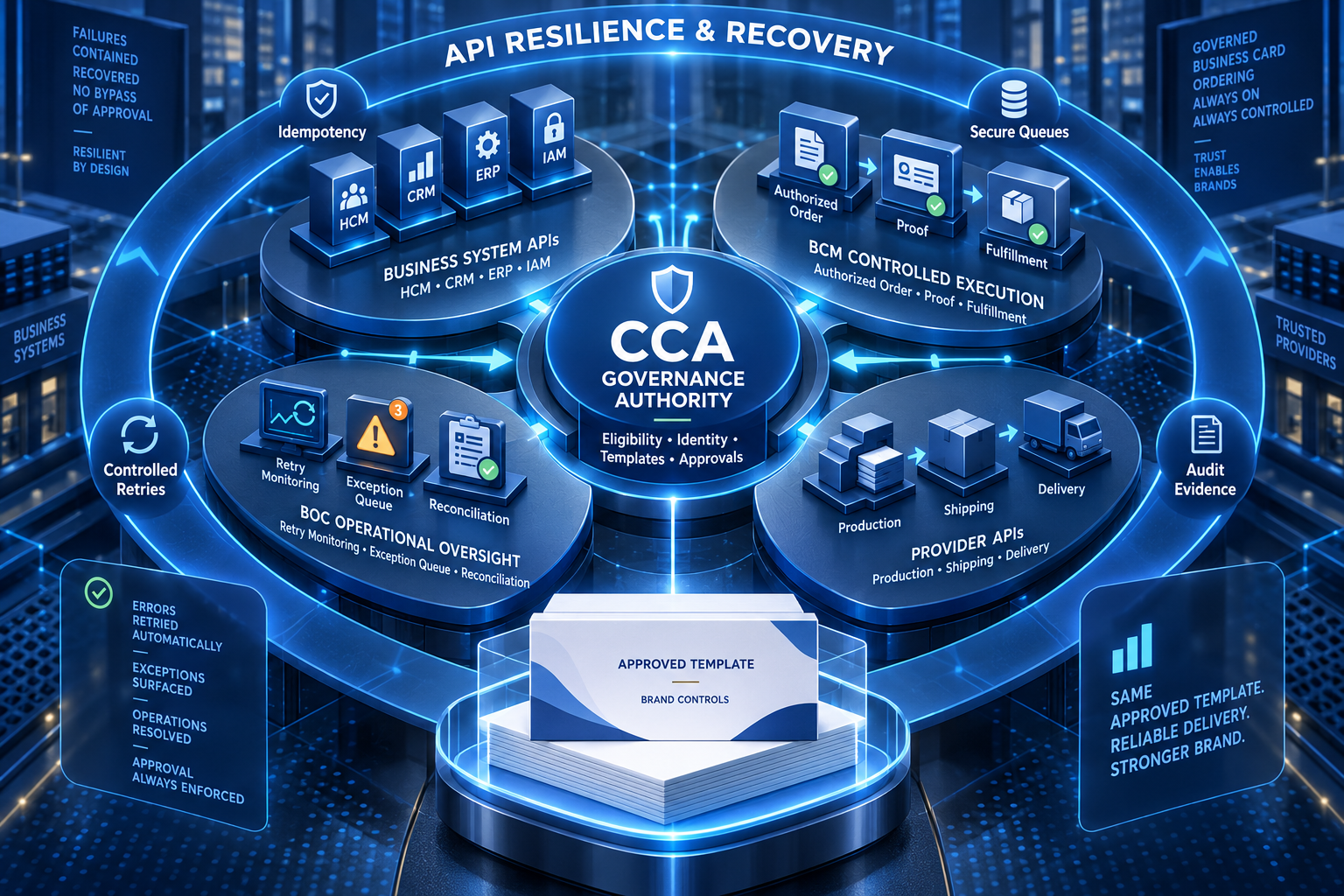
Enterprise business card ordering depends on multiple systems that may fail independently. An HCM feed may be delayed, an identity provider may reject a token, an integration queue may stall, an approval response may arrive late, BCM may time out after accepting an order or a print supplier may stop returning status events. A resilient architecture must recover from these conditions without producing duplicate cards, accepting stale identity data or bypassing enterprise policy.
Color Card Administrator (CCA) remains the authority for eligibility, identity fields, templates, approvals, quantities, destinations, provider routing and exceptions. Resilience controls must preserve that authority during failure and recovery. Business Card Manager (BCM) executes the locked authorization issued by CCA. Business Ops Center (BOC) monitors exceptions, coordinates recovery and reconciles the final outcome. Availability is valuable only when the recovered transaction is still the transaction CCA authorized.
Availability Is Not Permission
A dangerous continuity design treats temporary unavailability as permission to proceed. A portal may reuse yesterday’s eligibility, an integration flow may choose a default template, or an operations team may submit directly to a provider because CCA cannot be reached. These actions can keep work moving while creating an ungoverned physical order. The enterprise then loses assurance over identity, brand, spend and approval.
The safe principle is clear: technical availability does not grant business authority. If CCA cannot make a current decision, the normal response is to hold the request in a controlled state, communicate its status and resume evaluation when authority is restored. Any emergency continuity path must be narrowly defined, time-limited, explicitly approved and reconciled afterward.
Classify Failures Before Choosing Recovery
| Failure class | Typical condition | Safe response | CCA control |
|---|---|---|---|
| Caller failure | Expired token invalid scope malformed request or unsupported version | Reject with actionable error and no state change | Do not evaluate or create an authorization |
| Source failure | Missing stale contradictory or unavailable workforce data | Hold or deny according to policy and route to data ownership | Do not substitute unapproved values |
| Decision failure | CCA unavailable policy dependency failed or evaluation timed out | Queue safely or present a controlled pending state | Do not create an alternate approval path |
| Execution uncertainty | BCM timeout after submission or acknowledgment lost | Query by idempotency key before retrying | Preserve one authorization to one order |
| Provider failure | Order rejected production stalled shipment missing or delivery failed | Create an owned operational exception and follow approved recovery | Do not change identity template or quantity downstream |
| Evidence failure | Event missing duplicated out of order or unmatched | Preserve raw event normalize cautiously and reconcile | Do not infer completion without evidence |
Use Idempotency to Prevent Duplicate Physical Orders
Business card ordering is not an ordinary digital transaction. A retry can create a second physical product, a second shipment, and a second charge. Every request that can cause execution should carry a stable idempotency key associated with the CCA decision and intended operation. BCM must store the first accepted result and return the same outcome when a duplicate request arrives within the governed window.
The key should survive client retries, gateway timeouts, queue redelivery, and service restarts. It should not be regenerated automatically for the same intended transaction. A materially changed identity, template, quantity, destination, or provider route is not a retry; it requires a new CCA evaluation and authorization. API Observability should report duplicates prevented, conflicting reuse, and unresolved submission uncertainty.
Preserve State Through Asynchronous Processing
Queues can isolate systems from temporary outages and smooth spikes in onboarding or reordering. They also introduce delay, duplicate delivery, reordering and poison-message risks. Each message should carry the transaction identifier, CCA decision identifier, authorization version, creation time, expiration, attempt number and integrity evidence. Consumers should acknowledge only after durable processing reaches the intended state.
A dead-letter queue is not a recovery strategy by itself. It is a controlled holding area that requires ownership, classification, replay criteria and closure evidence. Before replaying a failed authorization, the enterprise must confirm that it remains valid and that BCM did not already create an order. Expired or materially changed requests should return to CCA rather than being forced through execution.
The Governed Recovery Sequence
- Capture the original request with caller identity, source references, correlation identifier, and idempotency key.
- Classify the failure as access source decision, execution provider, or evidence related.
- Determine whether the transaction is safe to retry safe to queue requires CCA re-evaluation or must stop for review.
- Preserve the last confirmed state and avoid converting uncertainty into a new executable request.
- Restore the failed dependency or route work through an explicitly approved equivalent technical path that still invokes CCA authority.
- Verify that the CCA decision remains current and that the locked authorization has not expired or changed.
- Query BCM by decision and idempotency identifiers before resubmitting any operation that could create a physical order.
- Resume provider processing and collect authenticated lifecycle events without rewriting approved business values.
- Assign unresolved mismatches or missing evidence to BOC with an owner due date and closure criteria.
- Reconcile the final BCM and provider outcome to the original CCA decision and record the recovery evidence.
Design Retries by Operation
Retries should be selected by operation rather than applied globally. Read-only eligibility or schema retrieval may tolerate bounded retries with jitter. Submitting an authorization requires idempotency and result lookup. Approval actions must confirm that the decision version is still current. Cancellation may be safe only before a provider reaches a defined production state. Webhook ingestion should tolerate duplicate delivery while rejecting invalid signatures and impossible transitions.
Retry budgets need maximum attempts, elapsed time, backoff, expiration and escalation rules. Aggressive retry storms can prolong an outage and obscure the original error. A circuit breaker may protect a dependency, but its open state should produce a controlled business status rather than a fabricated success. Operators need to know whether a request is not started, pending, accepted, executing, completed, failed or uncertain.
Error Contracts Should Guide the Next Safe Action
A generic error message forces consumers to guess. Enterprise business card APIs should use stable error categories that distinguish authentication, authorization, validation, source conflict, stale decision, approval required, rate limit, dependency unavailable, duplicate request, execution uncertainty and provider rejection. Responses should include a correlation identifier and indicate whether the caller may retry, must correct input, should wait or must initiate review.
Error detail must remain privacy-safe. A consumer does not need complete workforce data to understand that an authoritative field is unavailable. Internal traces can link the error to protected evidence. External responses should reveal enough to support the next action without exposing policy internals, personal details or infrastructure information that would increase security risk.
Protect the Locked CCA to BCM Handoff
CCA should issue a versioned authorization containing the approved identity fields, template, quantity, destination, provider route, approvals, policy version, template version, decision identifier, expiration and integrity value. BCM should accept this package as immutable business authority. It may add order and provider identifiers, but it must not repair a missing value by altering the authorized card.
If BCM receives a package it cannot process, the result should be a clear rejection correlated to the authorization. Mapping or contract defects should be corrected in the governed integration and retested. If the package expired during an outage, CCA must evaluate it again. Recovery should never convert an execution error into permission for downstream editing.
Recover Provider Operations Without Losing Control
Provider failures often occur after the enterprise business card governance has committed the order. A timeout may hide an acceptance, a production system may reject the artwork, a shipment may lack tracking or a delivery may fail. The adapter should preserve the provider request, acknowledgment and raw event references. Before resubmitting, BCM must determine whether a provider job already exists and whether the supplier supports a safe query or idempotent operation.
A reroute to another provider is a new business decision when it changes geography, pricing, production rules, template capabilities or delivery commitments. CCA should validate the permitted provider route, and BCM should create the corresponding execution record. BOC should link the original failure, reroute decision, replacement order and final reconciliation so the complete cost and outcome remain visible.

Continuity Modes Need Explicit Limits
| Continuity mode | Permitted behavior | Prohibited behavior | Exit evidence |
|---|---|---|---|
| Read only | Serve approved non-sensitive reference content within a defined freshness window | Reuse stale eligibility or approvals to create an order | Cache age source version and no execution |
| Queued intake | Accept authenticated minimum context and mark the request pending | Promise approval or provider acceptance before CCA evaluates | Queue record receipt and later CCA decision |
| Execution hold | Retain a valid locked authorization until BCM or provider recovers | Modify expired or incompatible authorization values | Authorization status restart time and acknowledgment |
| Emergency exception | Use a preapproved narrow population duration quantity and provider path | Create a general manual bypass around CCA | Approver scope expiry transactions and retrospective review |
| Recovery replay | Replay only after checking current authority and prior execution state | Bulk replay uncertain commands without idempotency lookup | Replay decision duplicate check and reconciled result |
Make BOC the Owner of Operational Uncertainty
Uncertainty is a distinct state, not a synonym for failure. If the consumer timed out after BCM accepted an order, the system does not yet know whether another submission is needed. BOC should surface uncertain transactions, assign ownership, and drive evidence collection across the gateway, CCA, BCM, and provider. The resolution may be confirmation, cancellation, controlled resubmission or a new CCA decision.
BOC should also measure how long transactions remain uncertain, which dependencies create repeated ambiguity, and whether recovery actions close the evidence chain. Exception closure requires more than clearing an alert. It should identify the final order state, responsible action, affected cost, any replacement transaction, and operational reconciliation to the original authorization.
Test Failure and Recovery End to End
Happy-path testing cannot prove resilience. The enterprise should inject token failures, stale source data, CCA timeouts, gateway retries, duplicate queue delivery, BCM acknowledgment loss, provider acceptance without response, delayed webhooks, out-of-order states and partial recovery. Each scenario should confirm both the technical behavior and the governed business outcome.
Tests must verify that no unauthorized card is produced, no approved field changes, no retired template is used, no quantity exceeds the decision and no duplicate physical order is created. They should also confirm that operations can identify the transaction state, the correct team receives the exception and BOC can reconcile the final result. Recovery evidence should be retained with the release record.
Security Privacy and Audit Requirements
| Control area | Resilience requirement | Evidence |
|---|---|---|
| Identity | Distinct service identities credential rotation and authenticated recovery actions | Owner method environment and access review |
| Authorization | Current CCA decision required before execution or material recovery change | Decision ID reason policy version and expiry |
| Integrity | Locked authorization idempotency hashes and protected queue messages | Authorization hash key acknowledgment and state history |
| Privacy | Minimized retry logs masked payloads restricted traces and retention controls | Data class access record export purpose and deletion |
| Change | Reviewed retry queue circuit-breaker continuity and replay configuration | Approval tests effective date deployment and rollback |
| Audit | End-to-end recovery record linked to exception and reconciliation | Failure class owner actions timestamps and closure evidence |
Measures for Resilience and Recovery
Useful measures include request success by capability, CCA decision availability, source-data freshness failures, retry volume, duplicate submissions detected, duplicate physical orders prevented, queue age, dead-letter volume, uncertain transaction age, expired authorizations, BCM acknowledgment latency, provider event completeness, recovery time, exception time to owner and reconciliation coverage.
Metrics should be segmented by consumer, environment, legal entity, region, card program and provider. A low error rate can hide high-impact duplicate or unauthorized orders. The most important measures combine reliability with governance: how often recovery preserved the CCA decision, how quickly uncertainty was resolved and whether every material outcome was reconciled.
Implementation Roadmap
- Inventory every request API queue webhook CCA decision BCM command provider operation exception path and current retry behavior.
- Define canonical transaction decision authorization order and provider identifiers with state ownership across systems.
- Classify operations by retry safety idempotency need expiration business impact and required recovery approval.
- Implement stable idempotency for every operation that can create cancel reroute or reproduce a physical order.
- Create explicit error contracts and controlled pending uncertain rejected failed and completed states.
- Protect queued messages and the locked CCA-to-BCM authorization with versions integrity evidence and expiry rules.
- Establish BOC ownership for dead letters uncertain executions missing events reroutes and reconciliation gaps.
- Test outage retry duplicate stale delayed partial acceptance and recovery scenarios across the complete journey.
- Define continuity modes with narrow scope duration approval monitoring exit criteria and retrospective review.
- Review resilience metrics recovery evidence recurring defects privacy access and residual governance risk regularly.
Frequently Asked Questions
What is business card API resilience?
It is the ability to continue, pause and recover connected business card transactions without losing CCA authorization, execution integrity or audit evidence.
Why is idempotency essential for business card ordering?
Because an automatic retry can create a second physical order, shipment and charge. A stable key lets BCM recognize the same intended operation.
Can orders continue when CCA is unavailable?
Normally requests should be held or queued until CCA can make a current decision. Any emergency mode must be narrowly approved, time-limited and reconciled.
When should a request return to CCA?
When identity, template, quantity, destination, provider route or approval materially changes, or when the previous authorization has expired.
What should happen after a BCM timeout?
The integration should query the existing result by decision and idempotency identifiers before attempting another submission.
Can operations edit a locked authorization to fix an error?
No. Contract or mapping defects should be corrected in the governed integration. Material business changes require CCA re-evaluation.
What does BOC do during recovery?
BOC owns uncertainty and exceptions, coordinates evidence collection, tracks recovery actions, and reconciles the final outcome to CCA authority.
What makes a recovery test successful?
It proves both technical restoration and the governed result: no unauthorized, altered, or duplicate physical order and complete closure evidence.
The Strategic Outcome
A resilient business card integration does not merely stay online. It preserves the meaning of every request and the authority behind every physical order. CCA continues to decide eligibility, identity, design, approval, quantity, and routing even when dependencies fail. BCM executes only a valid locked authorization, and BOC resolves uncertainty and proves the final outcome.
This separation allows enterprises to use retries, queues, circuit breakers, provider rerouting, and recovery automation without creating shadow policy. The CCA website remains the central administrative control layer, while the surrounding architecture gains the reliability required for global ordering at scale.
Choose one production ordering journey and simulate a timeout after BCM submission. If the team cannot determine whether the order exists, prevent a duplicate, verify that the CCA authorization remains current, and reconcile the provider outcome, that path should become a priority resilience improvement.