

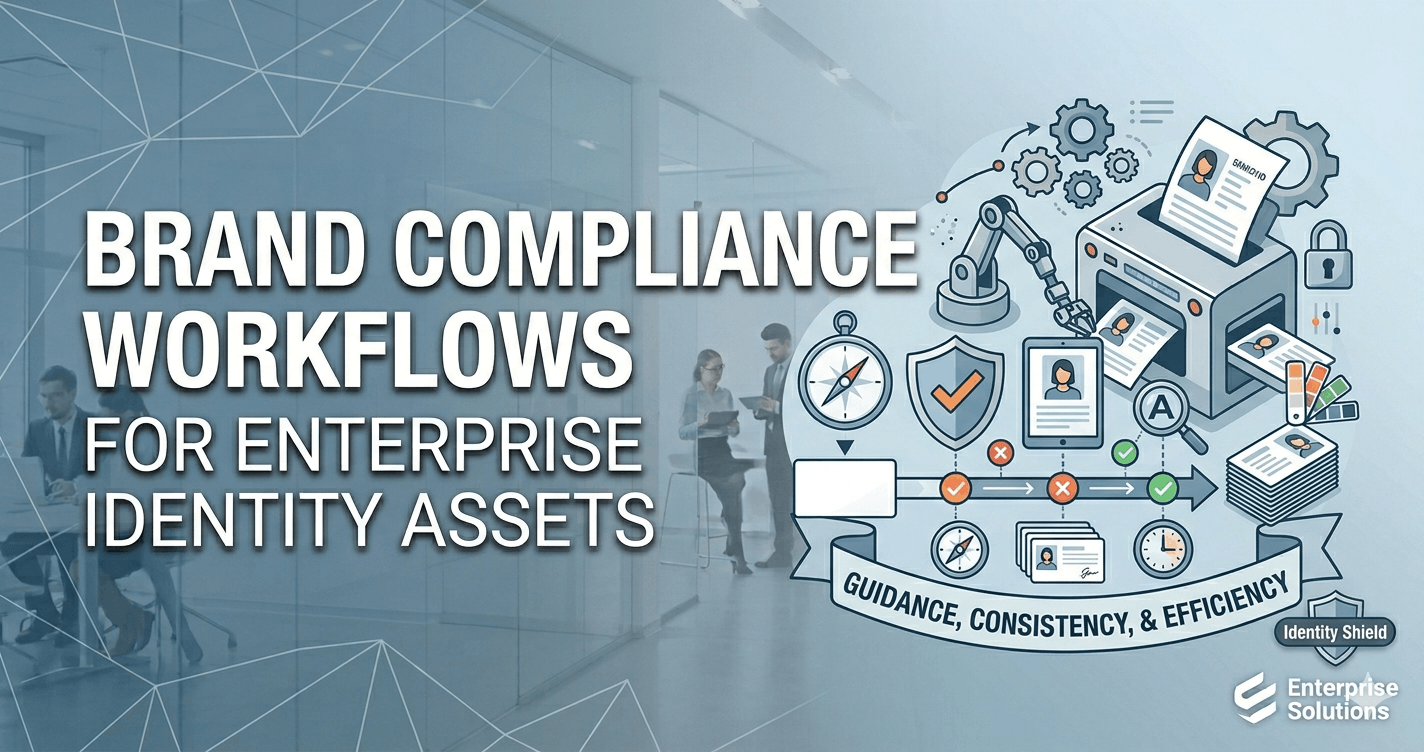
Brand Compliance Workflows for Enterprise Identity Assets
Introduction
Brand compliance in enterprise environments is not a design problem.
It is a control problem.
Organizations often assume that providing templates, guidelines, and brand documentation is sufficient to maintain consistency. At a small scale, this assumption may hold. But in enterprise environments—where identity assets are created, modified, and distributed across departments, regions, and systems—guidelines alone are ineffective.
Without structured workflows, brand compliance becomes decentralized, inconsistent, and unenforceable.
This is where brand compliance workflows become critical.
They do not rely on enforcement after the fact.
They embed compliance directly into the system of execution.
Why Brand Compliance Breaks at Enterprise Scale
As organizations scale, identity asset creation becomes fragmented.
Business cards, email signatures, digital assets, and printed materials are often:
- Created across multiple teams
- Requested through informal channels
- Modified without centralized oversight
- Produced by different vendors
Even when brand guidelines exist, they are interpreted differently across teams.
This results in:
- Inconsistent identity representation
- Unauthorized template modifications
- Regional deviations from brand standards
- Lack of visibility into asset creation
The problem is not awareness.
It is the absence of system-level enforcement.
What Brand Compliance Workflows Actually Do

Brand compliance workflows replace manual enforcement with structured control systems.
They ensure that every identity asset follows a governed path from request to production.
At a system level, this includes:
1. Centralized Template Governance
Templates are locked and managed centrally:
- No unauthorized edits
- Role-based variations controlled
- Global consistency enforced
2. Role-Based Access Control
Users do not freely create assets:
- Access is defined by role, department, and location
- Permissions determine what can be requested or modified
3. Workflow-Driven Approvals
Every request is routed through structured approval paths:
- Manager-level validation
- Brand or marketing approval
- Procurement alignment where required
4. Policy Enforcement at Execution
Rules are embedded into the system:
- Formatting restrictions
- Vendor selection controls
- Quantity and usage limits
Compliance is not checked — it is built into the process.
5. Audit and Visibility
Every action is tracked:
- Who created the asset
- What template was used
- Who approved the request
- Which vendor fulfilled it
This creates full transparency across identity execution.
The Role of Business Cards in Compliance Workflows
Business cards are one of the most widely distributed identity assets in an enterprise.
They:
- Represent the organization externally
- Are used across all departments
- Are frequently updated due to role changes
- Involve both digital and physical execution
Without compliance workflows, business cards become:
- A point of brand inconsistency
- A source of uncontrolled vendor activity
- A gap in identity governance
With compliance workflows, they become:
- Standardized identity outputs
- Fully governed assets
- Integrated components of enterprise identity infrastructure
Operational Impact of Compliance Workflows
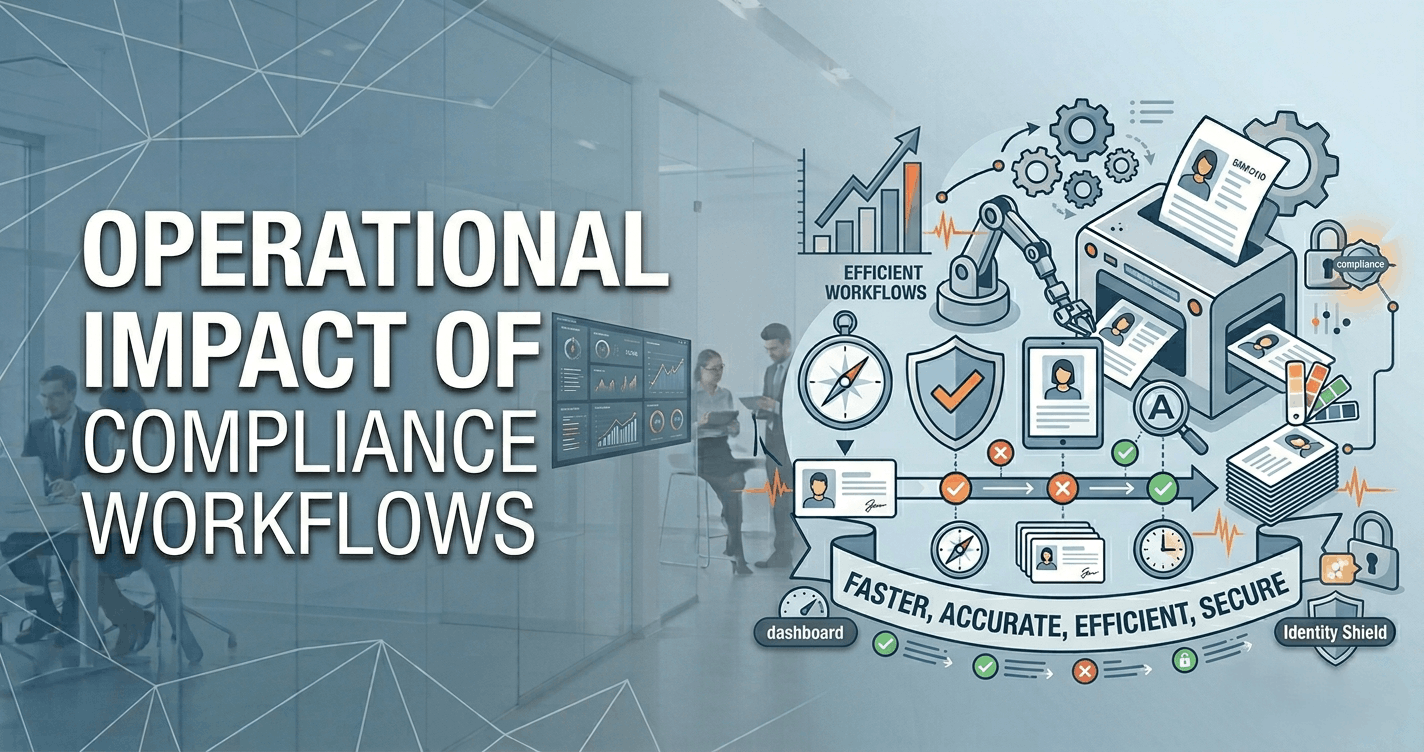
When organizations implement compliance workflows, they move from reactive enforcement to proactive control.
Before Compliance Workflows
- Templates distributed manually
- Inconsistent branding across teams
- Unauthorized vendor usage
- No centralized visibility
- We enforce compliance after production.
After Compliance Workflows
- Templates controlled centrally
- The system enforces brand consistency automatically
- Vendor usage governed
- Full visibility across all assets
- Compliance embedded into execution
This is not a design improvement.
It is an operational transformation.
Brand Compliance as Identity Infrastructure
In enterprise environments, brand is not just a marketing function.
It is part of the identity infrastructure.
Every identity asset connects to:
- HR systems (employee data)
- Procurement systems (vendor control)
- Workflow systems (approvals and routing)
- Compliance systems (audit and reporting)
Brand compliance workflows unify these systems into a controlled environment.
This ensures that identity execution is:
- Consistent
- Compliant
- Scalable
- Auditable
The Role of Governance Platforms
Manual processes cannot enforce compliance at enterprise scale.
Governance platforms enable:
- Template standardization across global teams
- Automated approval workflows
- Integration with HR and procurement systems
- Enforcement of brand policies at the system level
- Real-time audit tracking and reporting
Within this model, compliance is not a guideline.
It is a system function.
Strategic Takeaway
Enterprise organizations do not achieve brand compliance through guidelines alone.
They achieve it through workflow-driven governance systems.
Brand compliance workflows ensure that:
- The creators control identity assets at creation
- Execution follows structured processes
- Vendors operate within defined boundaries
- Every action is visible and auditable
As organizations scale, compliance must move from documentation to infrastructure.