

Business Card Management Software for Enterprises: Beyond Printing and Into Workflow Control
Introduction
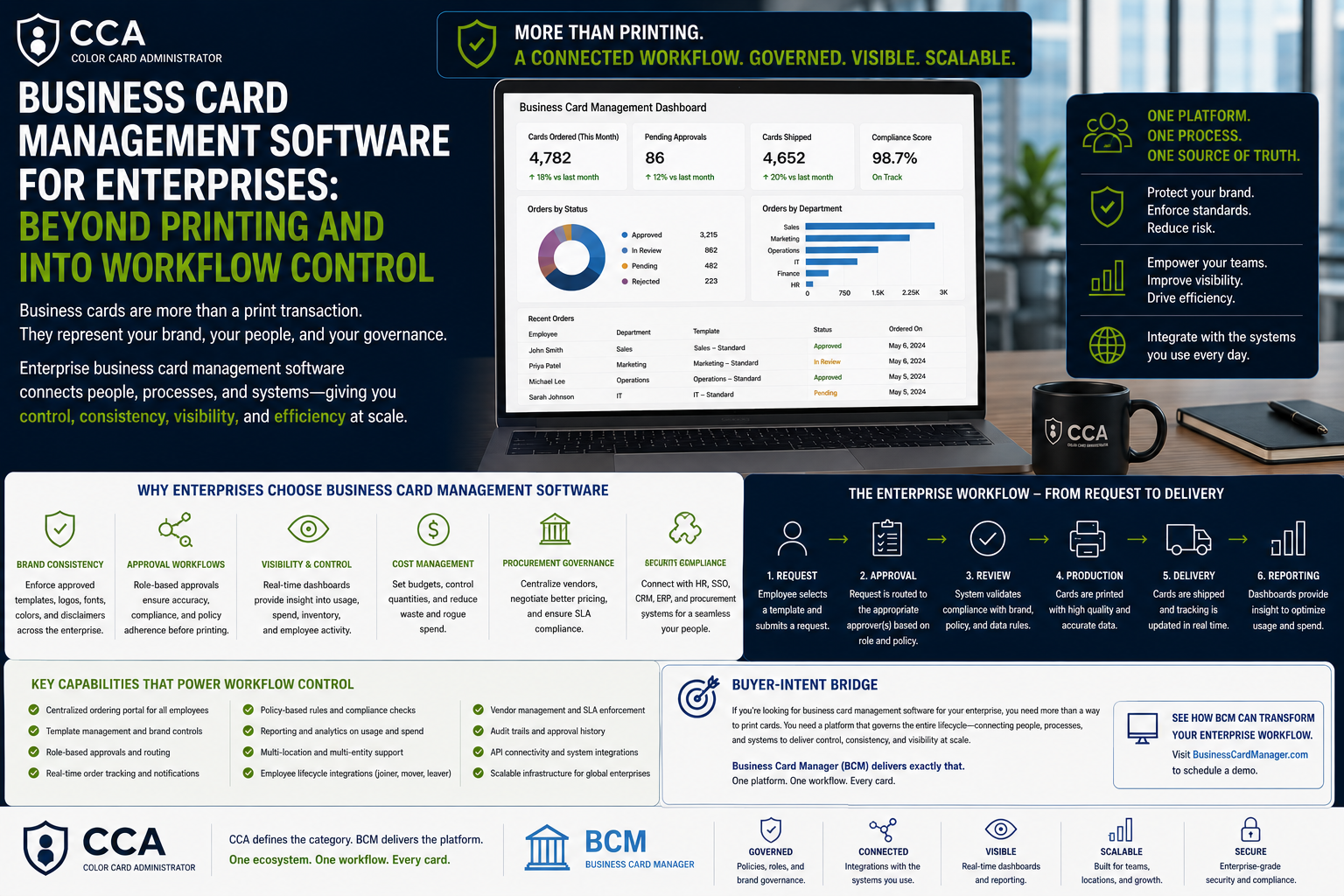
Many organizations still approach business cards as a purchasing activity. Employees request cards, orders are sent to a vendor, and finished cards are delivered. While this process may seem straightforward, it often becomes increasingly difficult to manage as organizations grow.
Modern enterprises operate across multiple locations, business units, brands, approval structures, procurement processes, and technology environments. Business card requests frequently intersect with employee onboarding, brand governance, reporting requirements, vendor management, procurement controls, and operational workflows.
As a result, organizations are moving beyond traditional print vendors and adopting business card management software.
This shift reflects a larger transformation occurring across enterprise operations. Business cards are no longer viewed solely as printed materials. They are becoming part of a broader workflow infrastructure that requires visibility, governance, automation, and integration.
Business card printing is the transaction.
Business card management is the workflow.
Governance is the control layer.
API integration is the differentiator.
Why Enterprises Outgrow Traditional Print Ordering

Traditional print ordering works reasonably well when organizations are small and operating from a single location. Employees can submit requests manually, and administrative teams can coordinate approvals without significant effort.
As organizations expand, however, complexity increases rapidly.
Growing Organizational Complexity
Organizations must manage:
- Employee onboarding and offboarding
- Departmental changes
- Job title updates
- Multiple office locations
- Vendor relationships
- Approval requirements
- Reporting expectations
Without a centralized management platform, business card ordering often becomes fragmented across email chains, spreadsheets, local print providers, and disconnected systems.
The Cost of Fragmentation
This fragmentation creates:
- Administrative overhead
- Visibility gaps
- Governance challenges
- Inconsistent processes
- Reduced operational efficiency
What Is Business Card Management Software?
Business card management software provides a centralized environment for managing the entire business card lifecycle.
Rather than focusing solely on printing, these platforms support:
- Employee ordering
- Approval workflows
- Brand governance
- Template management
- Vendor coordination
- Reporting and analytics
- Procurement visibility
- Operational controls
- API integrations
- Lifecycle management
The objective is not simply to print cards. The objective is to create a scalable and governed process for managing business card operations across the enterprise.
The Value of Centralized Ordering
Centralized ordering is one of the most important benefits of enterprise business card management software.
Employees gain a consistent experience regardless of location, department, or business unit. Organizations gain visibility into requests, spending, approvals, and fulfillment activity.
Benefits of Centralization
Centralized ordering helps organizations:
- Standardize user experiences
- Improve operational visibility
- Reduce duplicate orders
- Strengthen governance
- Support organizational growth
As organizations continue to scale, these advantages become increasingly important.
Approval Workflows and Governance
Approval workflows are a foundational component of business card management software.
Organizations often require manager approvals, marketing reviews, procurement oversight, or compliance validation before production begins.
Why Workflow Automation Matters
Manual approvals create delays and reduce visibility.
Workflow automation ensures requests follow predefined business rules while maintaining accountability and auditability.
This improves governance while reducing administrative effort.
Brand Consistency at Scale
Business cards remain customer-facing assets that directly represent the organization.
Inconsistent branding, incorrect titles, outdated logos, and unauthorized templates can weaken professional presentation and create operational issues.
Enforcing Brand Standards
Business card management software helps organizations:
- Control approved templates
- Maintain logo consistency
- Standardize employee information
- Prevent unauthorized modifications
- Support enterprise-wide branding initiatives
Brand standards become part of the workflow rather than an afterthought.
Reporting and Operational Visibility
Enterprise leaders increasingly expect operational visibility across all business processes.
They want to understand:
- How many cards are ordered
- Which departments generate requests
- How long approvals take
- How vendors perform
- Where spending occurs
Turning Data into Insights
Reporting capabilities transform business card operations into measurable business processes.
Organizations gain the information required to:
- Improve efficiency
- Strengthen governance
- Optimize workflows
- Support strategic decision-making
Procurement and Vendor Governance
Business card programs often involve procurement teams and external suppliers.
Organizations need visibility into vendor performance, fulfillment timelines, contract compliance, and spending activity.
Strengthening Procurement Oversight
Business card management software helps connect procurement governance with operational workflows.
Benefits include:
- Improved vendor accountability
- Better spending visibility
- Stronger compliance controls
- Enhanced supplier oversight
This creates a more controlled and transparent business card program.
Why API Integration Matters
One of the most important developments in the category is API integration.
Most organizations already operate a technology ecosystem that includes HRIS platforms, ERP systems, CRM environments, procurement applications, onboarding tools, and reporting systems.
Enterprise buyers increasingly expect business card management software to connect with these environments.
Benefits of API-Connected Infrastructure
API integration enables:
- Automatic employee data synchronization
- Onboarding-triggered workflows
- Reporting integration
- Reduced manual administration
- Improved operational consistency
This creates a connected framework for managing business card operations rather than an isolated ordering process.
Understanding the Difference Between a Print Vendor and Management Software
How This Differs from a Print Vendor
A print vendor focuses on production.
Business card management software focuses on workflow execution, governance, approvals, reporting, procurement visibility, and operational control.
Why Enterprises Need Management Software
As organizations grow, business card operations become increasingly complex.
Software provides the structure required to manage that complexity efficiently.
When Should Organizations Adopt a Platform?
Organizations should evaluate business card management software when manual processes create:
- Approval delays
- Reporting limitations
- Governance challenges
- Vendor management issues
- Excessive administrative effort
What Should Buyers Prioritize?
Enterprise buyers should prioritize:
- Centralized ordering
- Workflow automation
- Reporting visibility
- Brand governance
- Procurement controls
- API integrations
- Scalability
Strategic Takeaway
Business card management software for enterprises is no longer simply about ordering printed materials.
It is about creating a centralized operational framework that supports governance, approvals, reporting, procurement visibility, brand consistency, vendor coordination, and workflow execution.
Organizations that adopt enterprise business card management platforms gain:
- Stronger control
- Improved visibility
- Greater efficiency
- Better scalability
As the category continues to evolve, business card management software will increasingly become the foundation of API-Integrated Enterprise Business Card Printing and Management.