

API-Integrated Business Card Governance: Connecting HR, CRM, Finance, and Brand Workflows
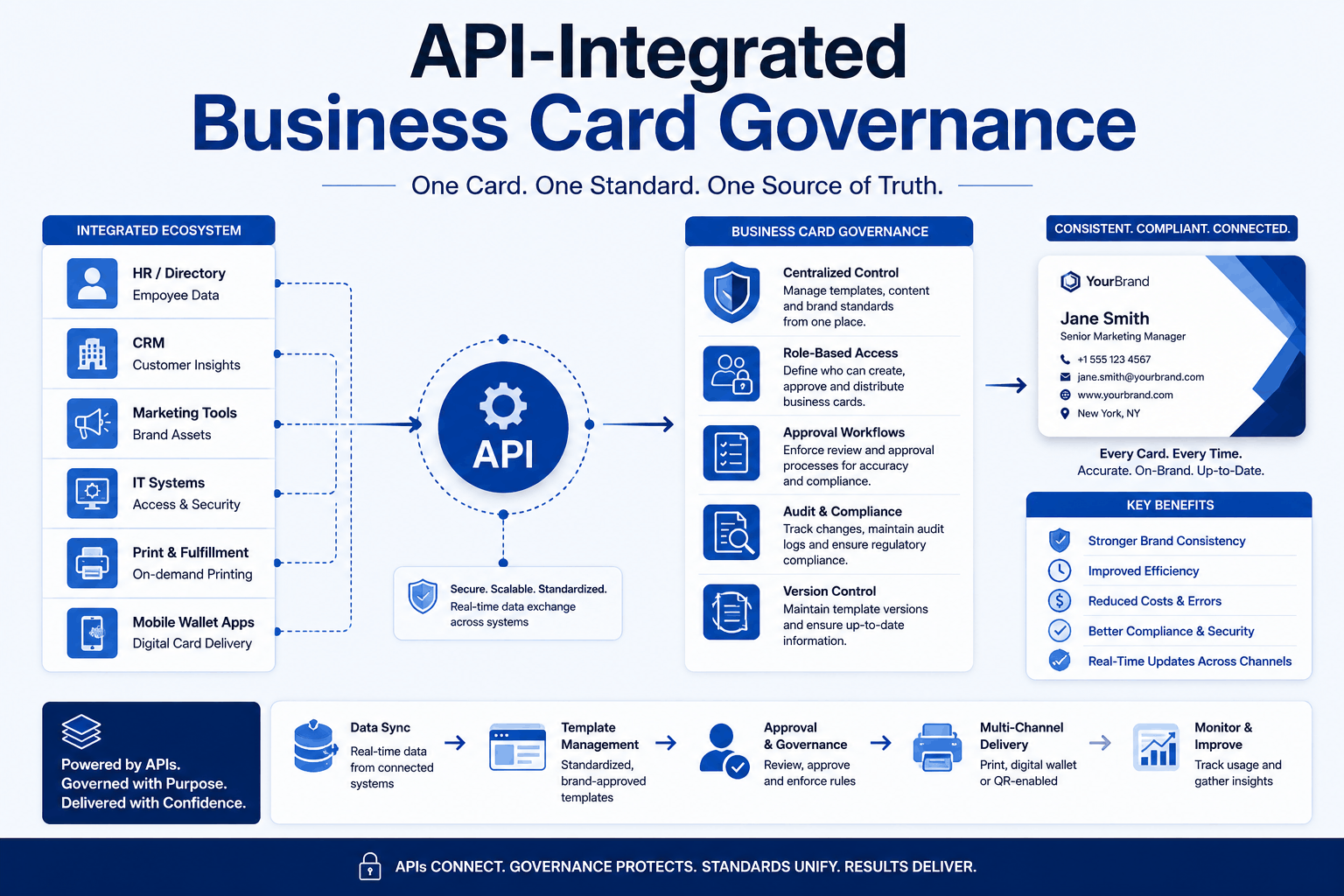
Business cards may look like a simple marketing asset, but inside medium and large organizations, they often sit at the intersection of employee identity, brand governance, sales operations, procurement, finance, and workflow control.
Every employee identity change can create downstream business card work. A new hire may need a card created. A promotion may require a title update. A territory change may require a new sales phone number. A location change may require a different address. A department change may require new approval routing, cost center assignment, or brand requirements.
When those changes are managed manually, organizations often end up with outdated templates, inconsistent branding, disconnected approvals, duplicate requests, weak financial visibility, and limited auditability.
This is why enterprise business card governance increasingly requires API-integrated infrastructure. The strongest programs do not treat business cards as isolated print orders. They connect identity data, approval workflows, brand rules, procurement activity, and financial reporting through governed systems that can communicate with each other through API integration and system connectivity.
Why Business Card Governance Is Becoming a Systems Problem?
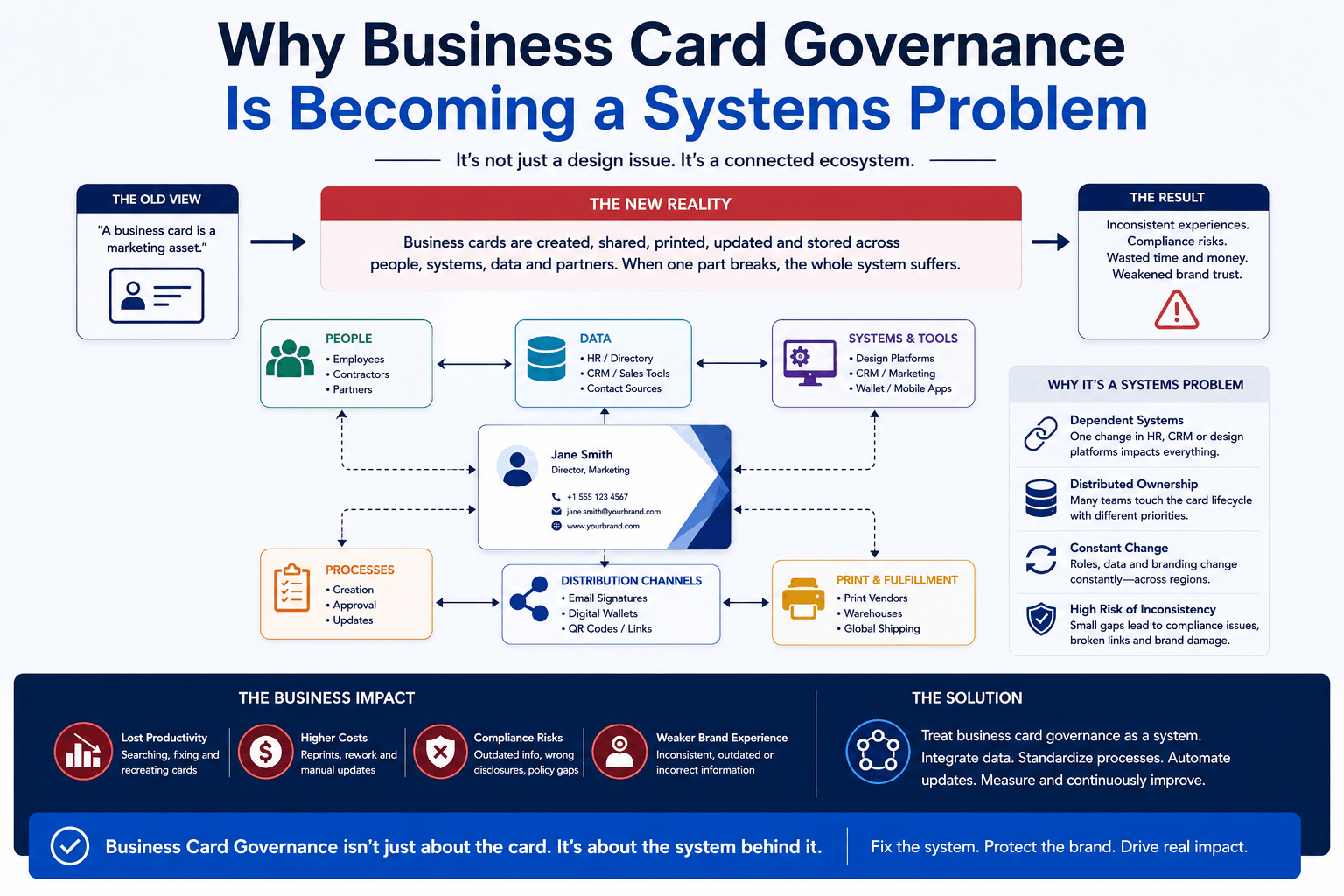
In small organizations, business card ordering can often be handled through a simple form or vendor portal. As organizations grow, that model starts to break down.
Larger companies may need to coordinate HR, Sales, Finance, IT, Procurement, Marketing, regional offices, franchise locations, branch managers, and approved vendors. Each group may own a different part of the employee identity or business card lifecycle.
The challenge is not just getting a card printed. The challenge is making sure the correct data, correct template, correct approval path, correct cost center, and correct vendor workflow are used every time.
That is an operational governance problem. It requires connected infrastructure, not just a basic ordering tool. In many organizations, enterprise business card governance now functions as part of the broader modern business systems stack that connects operational data, approvals, procurement, and reporting workflows.
The API-Integrated Business Card Governance Model
An API-integrated business card governance model connects the systems that already manage identity, sales data, approvals, procurement, finance, and operational reporting.
A common enterprise model may look like this:
- HRIS systems such as Workday publish employee lifecycle events, including hires, title changes, department changes, location transfers, and terminations.
- CRM systems such as Salesforce publish sales identity events, including territory changes, role updates, sales phone numbers, and sales hierarchy changes.
- An API layer applies field-level ownership rules to determine which system owns each piece of employee identity data.
- CCA receives a clean, governed identity record and applies template rules, brand standards, approval requirements, and production logic.
- Business Card Manager can support centralized ordering, approval routing, and operational execution across teams, departments, and locations through API-connected business card workflow infrastructure.
- Financial systems such as QuickBooks receive structured order data for cost centers, GL coding, department budgets, vendor reconciliation, and reporting.
- Operational reporting gives administrators operational visibility into requests, approvals, production status, delivery events, spend, and exceptions.
This creates a connected workflow environment where employee identity, brand governance, business card execution, and financial control operate through one coordinated infrastructure model.
Field-Level Ownership: Preventing Identity Data Conflicts
One of the most important parts of API-integrated governance is deciding which system owns each field. Without clear ownership rules, systems can overwrite one another, create conflicting records, or push inaccurate information into ordering workflows.
| Identity Field | System of Record | Governance Purpose |
| Legal name | HRIS / Workday | HR compliance and employee record accuracy |
| HR title | HRIS / Workday | Organizational accuracy |
| Department | HRIS / Workday | Reporting, budget, and workflow alignment |
| Cost center | HRIS / Workday | Financial allocation and GL mapping |
| HR manager | HRIS / Workday | Manager hierarchy and approvals |
| Sales title | CRM / Salesforce | Customer-facing role accuracy |
| Territory | CRM / Salesforce | Regional sales identity accuracy |
| Sales phone | CRM / Salesforce | Customer contact accuracy |
| Sales hierarchy | CRM / Salesforce | Sales routing and approval alignment |
A field-level ownership model gives each system a defined role. HR data stays governed by HR. Sales identity data stays governed by Sales. Brand and template execution stay governed by CCA. Financial posting stays governed by Finance. The API layer orchestrates the handoff between systems while supporting API integration and system connectivity across the organization.
How CCA Governs Templates, Approvals, and Identity Execution
The Color Card Administrator sits at the governance layer of the business card lifecycle. Its role is to help ensure that approved identity data is translated into governed business card execution.
That includes template selection, brand standards, approval workflows, multi-location rules, production routing, vendor coordination, and audit visibility.
Instead of relying on manual forms or disconnected vendor portals, CCA provides a governance framework that supports consistent identity execution across departments, locations, and enterprise systems.
For more on CCA governance infrastructure, see: CCA Governance
How API-Connected Workflow Infrastructure Supports Execution
Business Card Manager provides the workflow execution layer for organizations that need centralized ordering, approval routing, operational visibility, HR and procurement coordination, and multi-location delivery.
API-connected business card workflow infrastructure is especially valuable when business card activity must stay aligned with existing enterprise systems. This may include HRIS platforms, CRM systems, ERP environments, procurement tools, finance systems, identity platforms, and proprietary backends.
For enterprise teams, the goal is not simply to make ordering easier. The goal is to connect business card ordering workflow processes to the systems already running in the organization.
As organizations continue expanding their modern business systems stack, connected workflow infrastructure becomes increasingly important for maintaining operational visibility and governance consistency across departments and locations.
For more on BCM integration capabilities, see: Business Card Manager Integrations
Why Financial Governance Matters
Business card governance is also financial governance.
Every order creates financial activity. Without integration, teams may need spreadsheets, manual reconciliation, invoice matching, cost center corrections, and separate budget tracking.
When business card workflows connect to financial systems, each order can carry structured data such as employee name, department, cost center, GL code, quantity, unit cost, total cost, vendor, approval status, and order ID.
That gives Finance and Procurement better visibility into spend, chargebacks, department allocation, vendor reconciliation, and operational visibility across the business card ordering workflow lifecycle.
Enterprise Outcomes
| Outcome | Operational Impact |
| Less manual administration | Employee identity changes can trigger governed workflow updates instead of manual re-entry. |
| Stronger brand consistency | Templates, logos, regional requirements, and approved fields can be governed centrally. |
| Better approval control | Approval routing can reflect department, location, title, manager, or procurement rules. |
| Improved financial visibility | Orders can be tied to cost centers, GL codes, budgets, and reconciliation processes. |
| Stronger auditability | Identity changes, approvals, order activity, vendor actions, and financial postings can be tracked. |
| More scalable execution | The organization can support business card operations across departments, locations, and systems without adding unnecessary manual overhead. |
Why API-Integrated Governance Is the Next Enterprise Requirement?
Enterprise organizations are increasingly built around connected systems. HR manages employee lifecycle data. CRM manages customer-facing identity. ERP and procurement systems manage purchasing controls. Finance systems manage budgets and reconciliation. Identity platforms support access, directory, and employee records.
Business card workflows cannot remain disconnected from that environment.
As organizations scale, API-integrated enterprise business card infrastructure helps connect ordering, approvals, identity data, procurement activity, operational visibility, and financial reporting across the full lifecycle.
That is the difference between simple ordering and governed enterprise execution.
Explore API-Integrated Business Card Governance
Enterprise business card workflows should not sit outside the systems that manage employee identity, sales operations, procurement, finance, and reporting. CCA helps organizations connect business card governance to existing enterprise systems through API-integrated workflow infrastructure.