

API Dependency Mapping and Change Impact Governance For Enterprise Business Card Integrations

Change Impact Must Protect the Purpose of CCA
A field rename in HCM, a new identity claim, a procurement code change, or an event-schema update can appear local to one team. In a connected business card governance program, that change may affect eligibility, a locked identity field, approval routing, template selection, quantities, delivery, order reconciliation, or audit evidence. The visible API call is only one part of the dependency chain.
Color Card Administrator (CCA) is the authority for business card eligibility, trusted fields, templates, approvals and ordering rights. Business Card Manager (BCM) is the business card ordering management system or software that executes valid CCA-authorized orders. Business Ops Center (BOC) provides operational evidence and exception visibility. Dependency mapping must show how a proposed change reaches each of these responsibilities before it reaches production.
Build a Business Dependency Graph Not Just a System Diagram
A traditional architecture diagram shows applications and connections, but it often omits the business meaning that travels across them. A useful dependency graph connects systems to contracts, fields, transformations, policy rules, approvals, authorization artifacts, BCM order behavior, events, operational controls and accountable owners.
Every edge should explain why the dependency exists. HCM may supply worker status because CCA uses it for eligibility. IAM may provide tenant and role context because access is scoped. A template service may supply an approved design identifier because BCM must execute only the design authorized by CCA. Purpose makes the graph useful for decisions.
Map the Layers of Dependency
| Dependency layer | Representative objects | Change question | Potential CCA impact |
|---|---|---|---|
| Business purpose | Card program, tenant, legal entity, user journey | Does the approved purpose change? | Scope and accountability |
| Source data | Worker status, role, title, location, cost center | Did meaning, owner or availability change? | Eligibility and governed fields |
| Contract | API version, schema, event type, error model | Can current consumers still interpret it? | Validation and workflow continuity |
| Policy | Eligibility, approval, template and quantity rules | Could the same input produce another decision? | Authorization outcome |
| Execution | BCM order, proof, production, shipment | Can approved intent still execute exactly once? | Ordering continuity |
| Operations | BOC case, alert, metric and reconciliation | Will failures remain visible and recoverable? | Evidence and exception control |
Start with an Authoritative Consumer Inventory
Dependency analysis fails when consumer identities are shared or undocumented. Register each API client, webhook subscriber, batch job, portal and adapter with a business owner, technical owner, purpose, tenants, scopes, contract versions, policy package, data fields, event subscriptions, BCM dependency and last activity.
Use runtime telemetry to validate the inventory. A registered consumer with no traffic may be obsolete; traffic with no registered owner is a control gap. BOC should reconcile declared dependencies with observed calls, versions, event deliveries and authorization outcomes without storing unnecessary card identity data.
Trace Field-Level Lineage into CCA Decisions
System-level dependency is too broad for identity governance. Trace each governed field from its authoritative source through mapping and transformation into the canonical CCA model. Connect it to the rules that read it, the decision evidence that records it, and the authorization field that locks it for BCM execution.
Field lineage makes hidden blast radius visible. A change to employment status may affect eligibility and revocation. The change to location code may affect language, legal entity, template and delivery. A change to cost center may leave identity valid but prevent procurement reconciliation. Each effect needs a different owner and test.
Model Policy Dependencies Explicitly
| Policy dependency | Upstream trigger | CCA decision affected | Downstream consequence |
|---|---|---|---|
| Eligibility | Worker status, worker type, entity or role | Eligible, denied or incomplete | Order path available or blocked |
| Field authority | HCM, CRM, directory or approved override | Locked value and exception status | Printed identity remains governed |
| Template access | Program, brand, location or language | Approved template set | BCM receives permitted design only |
| Approval route | Quantity, role, program or exception type | Approver and approval state | Authorization waits or proceeds |
| Quantity limit | Role, event type or reorder policy | Approved maximum | BCM rejects excess quantity |
| Destination rule | Location, region or security policy | Permitted delivery context | Order routes only to approved destination |
Calculate Impact from the CCA Decision Outward
A change-impact review should start with the proposed object and traverse both upstream and downstream. Upstream traversal identifies source owners, mappings and assumptions. Downstream traversal identifies CCA rules, approvals, authorizations, BCM order functions, events, subscribers, BOC controls and business owners that depend on the outcome.
Do not treat the number of connected systems as the only measure of impact. One field used by an eligibility rule may carry greater risk than ten descriptive fields. Weight dependencies by authority, tenant reach, transaction volume, reversibility, physical fulfillment, personal-data exposure, financial impact and ability to detect failure.
Use a Consistent Impact Rating
| Impact factor | Low | Medium | High |
|---|---|---|---|
| Tenant reach | One test tenant | Limited production tenants | Enterprise or multi-entity reach |
| Decision effect | No policy outcome change | Approval or routing may change | Eligibility or identity authority changes |
| BCM execution | No order behavior change | Recoverable status or routing change | Duplicate, incorrect or unauthorized order risk |
| Data sensitivity | Non-sensitive metadata | Governed business identity field | Broader personal or restricted data exposure |
| Reversibility | Immediate configuration rollback | Coordinated consumer rollback | Physical production or irreversible external action |
| Detectability | Automated pre-execution control | Operational alert after processing | Failure may remain silent |
Protect the CCA to BCM Boundary During Change
BCM should not receive a different meaning because an upstream payload changed. CCA should continue issuing a versioned, immutable authorization artifact that locks tenant, program, template, governed fields, quantity, destination constraints, expiry, environment and correlation. BCM validates the artifact and rejects altered or unsupported intent.
Impact analysis must identify which BCM capabilities, validators, idempotency rules, status mappings, and reconciliation jobs depend on the change. If the authorization contract remains stable, upstream migration can be contained inside CCA adapters. If the contract changes, BCM testing and production readiness become mandatory parts of the approval.
Include Events and Operational Dependencies
Request-response maps often stop after an API returns successfully. Business card identity workflow governance continues through approval events, authorization issuance, BCM order acceptance, proof, production, shipment, delivery, cancellation, and exception handling. Each event may have multiple subscribers with distinct recovery behavior.
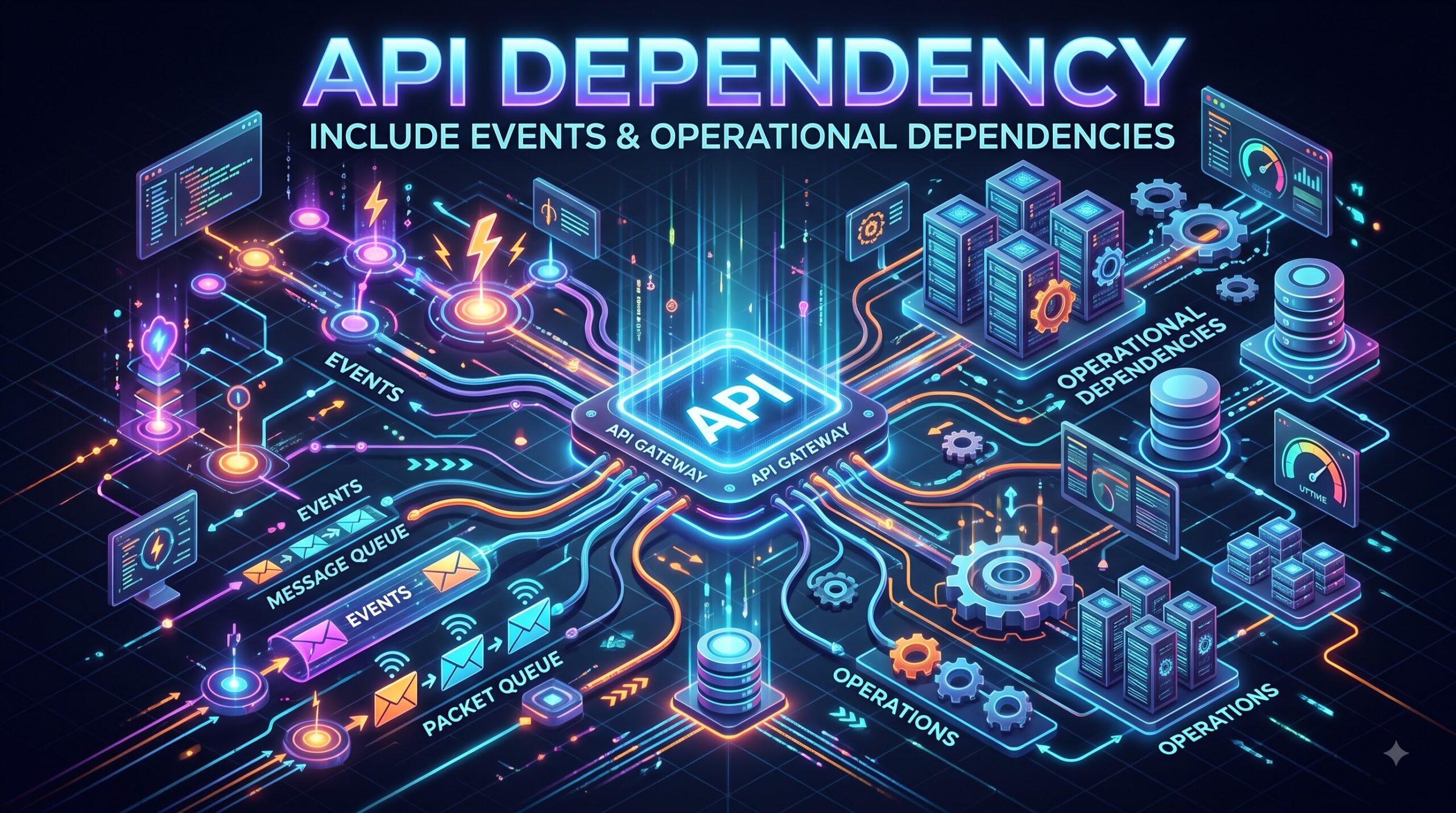
Map event type, schema version, publisher, subscribers, signature key, retry policy, dead-letter handling, correlation, and business action. A status rename can break BOC monitoring even if BCM continues ordering. A changed event identity can cause a subscriber to repeat an action. Operational dependencies belong in the same impact record as API dependencies.
Create an Evidence-Based Change Gate
| Gate question | Required evidence | Decision owner |
|---|---|---|
| Is the change understood? | Proposed contract, field, behavior and reason | Change owner |
| Is the blast radius complete? | Dependency traversal and observed consumer inventory | Enterprise architecture |
| Are CCA outcomes protected? | Synthetic policy comparison and approved differences | Business identity governance |
| Is BCM execution safe? | Authorization, idempotency and recovery results | BCM software operations |
| Are events and BOC controls ready? | Schema, subscriber, alert and reconciliation tests | Integration operations |
| Can the change be contained? | Rollout, rollback, kill switch and accountable support | Production authority |
Use Progressive Delivery to Limit Blast Radius
High-impact changes should move through sandbox, certification and limited production cohorts before enterprise execution excellence rollout. Select pilot tenants or consumers with representative policy scenarios and strong support coverage. Compare CCA decisions, BCM authorization results, event delivery and BOC exceptions against the expected baseline.
Progressive delivery does not replace approval. It enforces the approved scope while evidence accumulates. Define entry criteria, maximum exposure, observation period, success measures, automatic stop conditions and rollback. Prevent a pilot flag from becoming an undocumented permanent policy path.
Keep the Dependency Graph Current
A graph becomes unreliable when updates depend on periodic manual workshops. Capture relationships during consumer onboarding, schema registration, policy authoring, deployment and webhook subscription. Reconcile declared edges with runtime telemetry and flag dependencies that have no owner, no recent evidence or an expired exception.
Treat major gaps as production risks: unidentified consumers, shared credentials, rules with no field lineage, BCM functions with no authorization test and alerts with no response owner. The graph should support a concrete decision about change, not become a decorative inventory.
Implementation Roadmap
- Register every API client, adapter, portal, batch job and webhook subscriber with purpose and ownership.
- Map authoritative source fields into canonical CCA concepts, transformations and policy rules.
- Connect CCA decisions to approval paths, authorization fields and BCM ordering functions.
- Add event, subscriber, BOC alert, reconciliation and recovery dependencies.
- Define impact ratings for authority, tenant reach, fulfillment, data, reversibility and detectability.
- Automate traversal from a changed contract or field to affected consumers, decisions and controls.
- Build synthetic regression scenarios for every high-impact dependency path.
- Require CCA, BCM, event and operational evidence at a governed production change gate.
- Use progressive delivery with explicit scope, stop conditions, observation and rollback.
- Reconcile the graph with runtime telemetry and retire unknown, obsolete or ownerless dependencies.
Frequently Asked Questions
What is API dependency mapping for CCA?
It is the governed record connecting systems, fields, contracts, CCA policies, approvals, authorizations, BCM execution, events and operational controls.
Why is a system architecture diagram not enough?
It shows connections but often omits field meaning, authority, policy use, consumer ownership and the business consequences of change.
What is blast radius?
It is the set of tenants, consumers, decisions, orders, events, controls and owners that could be affected by a proposed change.
What is BCM in this model?
Business Card Manager (BCM) is the business card ordering management system or software that executes valid CCA-authorized orders.
How does CCA reduce upstream change impact?
CCA maps source contracts into a canonical model and preserves one authorization boundary, containing many source changes inside governed adapters.
Should event subscribers be included?
Yes. Events can trigger approvals, status updates, reconciliation and automation, so subscriber behavior is part of the dependency graph.
How is impact severity determined?
Consider identity authority, policy effect, tenant reach, BCM execution risk, data sensitivity, reversibility and detectability.
Can a low-volume dependency still be high risk?
Yes. A rarely used path may still change eligibility, expose data or create an unauthorized physical order.
How does BOC support change impact governance?
BOC reconciles declared dependencies with runtime evidence and shows errors, exceptions, migration progress and operational outcomes.
When is a change ready for production?
When the blast radius is understood, CCA and BCM controls are proven, events and operations are ready, residual risk is owned and rollback is available.
The Strategic Outcome
Dependency mapping changes integration governance from reactive troubleshooting to evidence-based change control. Teams can see which business decisions and order behaviors depend on a field or contract before approving a release. High-risk paths receive deeper testing, while contained changes move without unnecessary enterprise-wide delay.
The approach reinforces the core purpose of the CCA website. CCA remains the authority for business card identity and ordering rights. Business Card Manager remains the business card ordering management software that executes approved intent. BOC provides operational evidence. The dependency graph explains how change can move through these layers without allowing responsibility to become ambiguous.
Choose one planned integration change and trace it from source field or contract through CCA policy, approval, authorization, BCM execution, events and BOC monitoring. Name every affected consumer, tenant and owner. If the team cannot explain where the change stops, it is not ready for production approval.