

Idempotency and Duplicate Order Prevention In Enterprise Business Card APIs
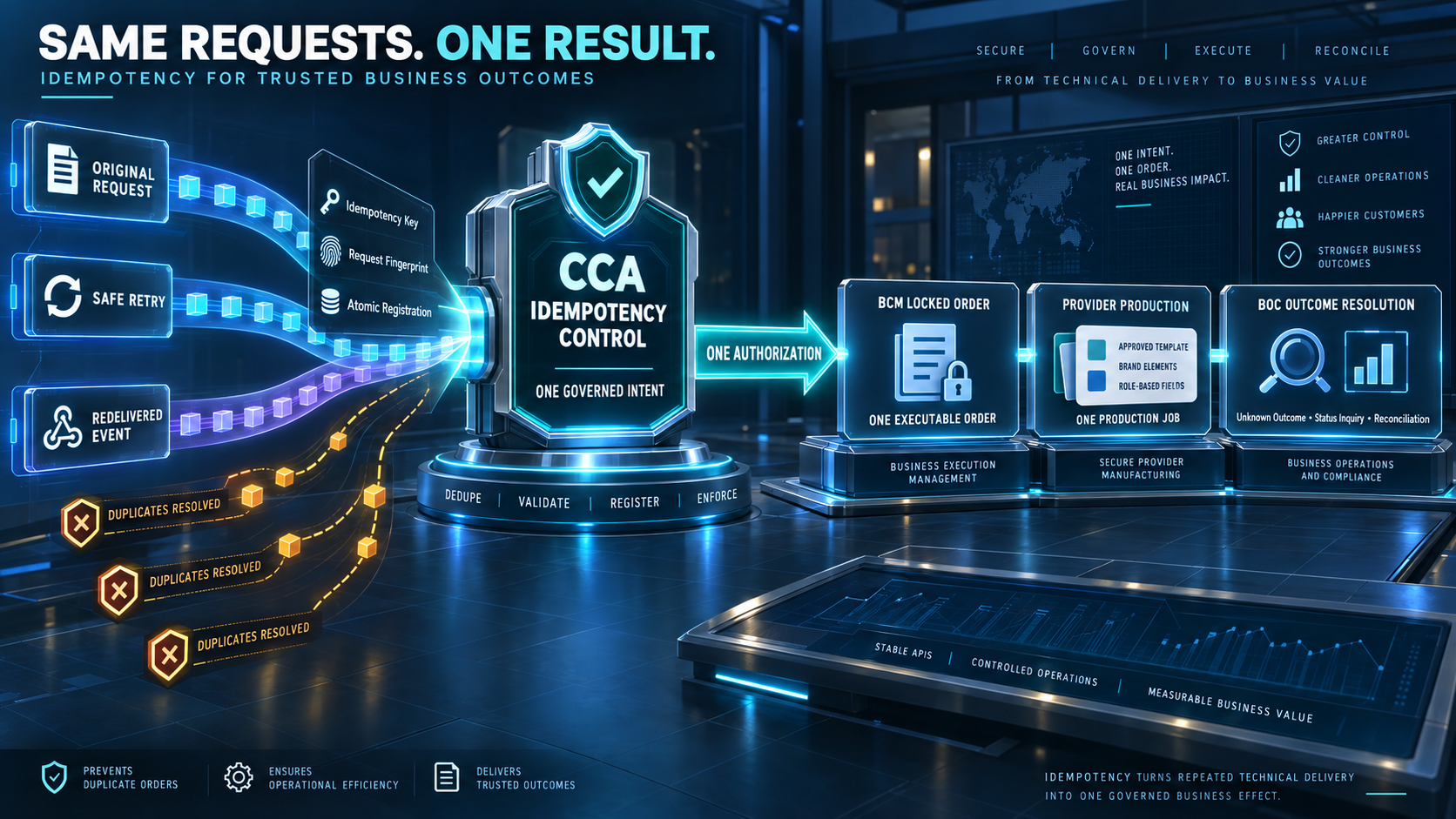
Making retries safe without weakening CCA ordering authority: one governed intent, one current decision, one executable order.
Retries Are Normal; Duplicate Cards Are Not
A business card request can be transmitted more than once even when an employee clicks once. Mobile connections fail after submission, portals retry after timeouts, gateways repeat messages, workers restart, queues redeliver events, and providers return an uncertain response. These behaviors are normal in distributed systems. If every delivery becomes a new order, however, the enterprise identity procurement pays for unnecessary production, creates conflicting shipment records, and loses confidence in its approval evidence.
Idempotency lets repeated delivery of the same governed intent return the same business result. It is not a shortcut that makes every similar request equivalent. Color Card Administrator (CCA) remains responsible for determining eligibility, approved identity, template, approval route, quantity, destination, and provider route. Business Card Manager (BCM) executes one valid locked authorization. Business Ops Center (BOC) resolves ambiguous outcomes and reconciles the complete record. The objective is safe repetition of transport without repetition of authority or physical production.
Separate Intent Decision and Execution
| Record | Purpose | Stable identity | Duplicate rule |
|---|---|---|---|
| Request intent | Represents what the calling experience is attempting to do | Consumer plus tenant plus idempotency key | A repeated key must refer to the same normalized request |
| CCA decision | Records the governed outcome for the request context | CCA decision ID and authorization hash | A retry returns the existing current outcome rather than deciding again silently |
| BCM order | Represents the accepted execution of one authorization | Order ID linked to one decision ID | Only one active order may consume the authorization unless policy permits a reorder |
| Provider job | Represents production at a selected supplier | Provider job reference and submission attempt | Recovery queries status before any resubmission |
| BOC case | Represents unresolved ambiguity or exception | Case ID linked to intent decision order and events | One operational case can collect repeated signals without creating orders |
Why Simple Duplicate Checks Fail
Searching for the same employee name or card details is unreliable. Two legitimate reorders can look identical, while the same request can appear different because the system normalized an address, fields arrived in another sequence or a source timestamp changed. Time-window rules such as block anything within five minutes can suppress valid urgent orders and still miss delayed duplicates.
The correct comparison begins with a caller-supplied idempotency key scoped to a known API consumer and enterprise context. CCA also stores a canonical fingerprint of the governance-relevant request. If the same key arrives with the same fingerprint, the prior result can be returned. If the key is reused with different meaning, the request should fail clearly rather than guess.
Design the Idempotency Key as a Contract
The consumer should generate the key before the first submission and reuse it for every retry of that intent. It should be unique within the agreed scope, opaque, sufficiently unpredictable and independent of personal data. Employee names, email addresses and phone numbers do not belong in the key. The contract should specify format, maximum length, scope, retention and conflict behavior.
| Design choice | Recommended treatment | Risk controlled |
|---|---|---|
| Scope | Bind key to API consumer enterprise tenant operation and environment | Prevents unrelated consumers or test traffic from colliding |
| Creation | Generate once at the start of the user or workflow intent | Ensures retries carry the same identity |
| Payload binding | Store a canonical governance-relevant request fingerprint | Detects accidental reuse with changed meaning |
| Retention | Keep through the longest retry recovery and fulfillment ambiguity window | Prevents late redelivery from becoming a new order |
| Response | Return the stored status decision reference and safe result | Gives consumers a deterministic recovery path |
| Conflict | Reject same key with a different fingerprint | Prevents a key from authorizing multiple business actions |
Canonicalize Only What Must Be Compared
A request fingerprint should be calculated from a documented canonical representation. Stable field order, normalized identifiers, defined null handling, consistent number and date formats, and explicit omission rules make equivalent deliveries compare correctly. The fingerprint should include fields that define the governed intent, such as tenant, program, employee reference, requested action, template context, quantity, and destination reference.
Volatile transport metadata, trace identifiers, and receipt timestamps usually do not belong in the fingerprint. Neither should secrets or unnecessary personal data. The canonicalization version must be recorded because a later rule change can otherwise make old requests appear different. Post 109 established contract versioning; idempotency depends on that same discipline.
Make the First Write Atomic
Two identical requests can arrive at nearly the same time. A read-then-create sequence allows both workers to see no record and both proceed. CCA needs an atomic create-or-return operation enforced by a uniqueness constraint over the defined idempotency scope. One request establishes the intent record; the other observes it and follows its current state.
The intent record should be written before expensive decision or standardizing identity execution work begins. Its state can move from received to evaluating, decided, submitted, completed, or exception. A repeated call during processing should return a stable in-progress response or safe polling reference. It should never start a second evaluation simply because the first worker has not finished.
Keep Idempotency State Separate from Authorization
Possessing a prior key does not grant permission to order. The calling application must still authenticate and hold the required technical scope. CCA must confirm that the enterprise context remains valid and that the requester may retrieve the stored outcome. Idempotency answers whether the intent has already been handled; authorization answers whether the consumer may perform or view the action.
An expired or revoked CCA authorization cannot be executed again merely because the idempotency record still exists. A retry of the original submission may return the historical outcome, but a new physical order requires a current permitted action. This distinction prevents a transport mechanism from becoming a permanent order token.
Handle Timeouts as Unknown Outcomes
A timeout does not prove failure. CCA may have decided the request, BCM may have accepted the order, or the provider may have started production before the response was lost. Retrying blindly at the next layer creates the classic duplicate-order failure. Recovery should first query the authoritative record using the idempotency key, decision ID, order ID, or provider correlation reference.
When status cannot be established automatically, BOC should open an ambiguity case and hold resubmission. The case should show the last confirmed state, submission attempts, response evidence, provider queries, owner, and next safe action. The enterprise business card management platforms should prefer a delayed answer over a second physical order whose relationship to the first is unknown.
Apply Idempotency at Every Side Effect Boundary
| Boundary | Duplicate trigger | Required control | Authoritative result |
|---|---|---|---|
| Portal to CCA | Double-click browser retry mobile reconnect | Intent key payload fingerprint and atomic registration | Existing CCA request status |
| CCA decisioning | Worker restart or repeated event | Decision operation key and versioned input evidence | One decision ID per governed evaluation |
| CCA to BCM | Timeout after submission or queue redelivery | Authorization consumption constraint and order correlation | One BCM order for the authorization |
| BCM to provider | Network loss or uncertain supplier acknowledgement | Stable submission reference and provider status lookup | Existing provider job or controlled exception |
| Provider events | At-least-once webhook delivery and replay | Event identity signature state-transition validation and inbox deduplication | One applied state transition |
| BOC remediation | Repeated alerts or manual recovery attempts | Case correlation action locks and approval evidence | One owned recovery path |

Do Not Confuse a Retry with a Reorder
A retry seeks the result of the same intent. A reorder is a new business request, even when the card artwork and recipient are unchanged. Reorders may be permitted for depletion, loss, damage, role change or a scheduled refresh, but they need a new intent key and a new CCA decision. The policy may consider prior orders, frequency, quantity, cost and approval requirements.
User interfaces should make this distinction explicit. A progress screen should encourage checking status rather than resubmitting. A Reorder action should disclose that it creates a new governed request. CCA can then apply limits and approvals intentionally instead of attempting to infer intent from similar payloads.
Deduplicate Events Without Losing Evidence
Webhook and queue delivery is commonly at least once. BCM and BOC should expect repeated provider events. Each event needs a stable source identifier or a deterministic identity derived from trusted fields. The receiver verifies signature, records receipt, checks whether the event has already been applied, and validates the proposed state transition.
A duplicate event should remain observable even when it produces no second state change. Receipt count, timestamps, and source can help diagnose provider or network behavior. An event with the same identifier but different content is not an ordinary duplicate; it is an integrity exception. Event deduplication must not conceal contradictory evidence.
Define Safe Expiration and Retention
Idempotency records cannot be discarded as soon as an API response is returned. Late queue delivery, provider uncertainty, and long fulfillment cycles may persist for days. Retention should cover the maximum consumer retry period, internal replay capability, supplier ambiguity window, and operational reconciliation cycle. Higher-risk physical production may justify longer protection than a read-only operation.
After active idempotency storage expires, required audit evidence may remain under a different minimized retention rule. The enterprise should document what it retains, why, who can access it, and how it performs deletion. Keys and fingerprints should not become an uncontrolled archive of employee information.
Failure Modes and Governed Responses
| Failure mode | Unsafe reaction | Governed response |
|---|---|---|
| Same key different payload | Accept the latest payload | Reject conflict and require a new key for a new intent |
| Timeout after CCA decision | Recalculate automatically | Return or retrieve the existing decision and current state |
| Timeout after BCM submission | Create another order | Query by authorization or order correlation and open ambiguity case |
| Provider gives no reference | Resubmit immediately | Use controlled status inquiry escalation and BOC ownership |
| Duplicate webhook | Apply the transition again | Record receipt and return the already-applied outcome |
| Expired authorization | Reuse because the key exists | Require CCA re-evaluation for any new execution |
| Manual operator uncertainty | Issue a replacement to be safe | Reconcile evidence and use approved reorder only when justified |
Security, Privacy, and Audit Requirements
Idempotency endpoints require the same authentication, authorization, tenant isolation, and rate controls as the original operation. A consumer should not be able to probe arbitrary keys and learn whether another employee or tenant submitted an order. Responses should disclose only the status and references the caller is permitted to see.
Audit evidence should connect consumer enterprise identity infrastructure, environment, key hash, canonicalization version, request fingerprint, CCA decision ID, authorization hash, BCM order ID, provider reference, event identities, BOC case, and final reconciliation. Avoid logging raw credentials or full personal card payloads. Access and retention should be proportionate to investigation and compliance needs.
Measures That Reveal Duplicate Risk
Track idempotent replays by consumer, key conflicts, simultaneous submissions, in-progress retries, reused authorizations, BCM duplicate rejects, provider ambiguity cases, duplicate events, contradictory event identifiers, manual reorders after timeouts, idempotency records expiring before reconciliation, and orders without a complete correlation chain. Segment results by integration, environment, program, provider, and release version.
Outcome measures include duplicate physical orders prevented, avoidable production and shipping cost, time to resolve unknown outcomes, percentage of retries returning the original result, exceptions closed with complete evidence, and legitimate reorders incorrectly blocked. The goal is not zero repeated messages; it is one correct governed business effect.
Implementation Roadmap
- Map every command event and manual action that can create or change a business card order.
- Define intent boundaries and distinguish retry, resubmission, amendment, cancellation, and reorder.
- Specify idempotency key ownership, scope format retention response and conflict behavior for each command.
- Create a versioned canonical request representation and minimized fingerprint for governance-relevant fields.
- Enforce atomic intent registration and unique authorization consumption across CCA and BCM.
- Add stable order provider event and BOC correlations with status inquiry before resubmission.
- Test concurrent requests timeouts worker restarts queue replay delayed events and conflicting payloads.
- Design user and operator experiences that show in-progress unknown completed and reorder states clearly.
- Instrument replay conflict ambiguity duplicate rejection and reconciliation measures without exposing personal data.
- Pilot with one high-volume integration and one provider before applying the control pattern enterprise-wide.
Frequently Asked Questions
What is idempotency in a business card API?
It means repeated delivery of the same request intent produces one governed business result rather than multiple card orders.
Who creates the idempotency key?
The API consumer normally creates it before the first submission and reuses it for every retry of that intent.
Can the employee email address be the key?
No. Personal data is neither sufficiently unique nor privacy-safe. Use an opaque key bound to the consumer and enterprise context.
How is a retry different from a reorder?
A retry asks for the result of the original intent. A reorder is a new governed request and requires a new key and CCA decision.
What happens when the same key carries different data?
CCA should reject the conflict. Accepting changed meaning under the same key could authorize more than one action.
Does idempotency remove the need for approvals?
No. CCA still applies current eligibility, identity, template, quantity, destination and approval policy.
How should a provider timeout be handled?
Query the existing submission by stable correlation, then open a BOC ambiguity case if the reviewer cannot confirm the outcome.
Should duplicate webhook events be deleted?
They should not trigger repeated state changes, but [the system/organization] can retain their receipt as minimized operational evidence.
The Strategic Outcome
Idempotency turns unreliable delivery into controlled enterprise behavior. Consumers can retry safely, CCA can preserve one governed intent and decision, BCM can execute one authorized order and BOC can resolve uncertainty without creating speculative replacements. Technical resilience no longer increases physical production risk.
This supports the central purpose of the CCA website: one administrative authority for enterprise business card eligibility, identity, brand, approvals, ordering and evidence. Connected systems gain reliable APIs, but they do not gain permission to multiply or reinterpret CCA-authorized actions.
Select one production ordering journey and simulate a timeout after every side effect: after CCA decision, after BCM acceptance, after provider submission and after event receipt. If the recovery procedure can create another order before the existing outcome is resolved, make that boundary the first duplicate-prevention priority.